
Our Honest Take on NVIDIA Cosmos: The Gold Standard for Synthetic Data, with a Reasoning Asterisk
The "Sim-to-Real" gap has been the graveyard of many promising robotics startups. You train a robot in a clean, digital simulation, and the moment it encounters a dusty warehouse or a flickering fluorescent light in the real world, it fails. NVIDIA’s latest update to its Cosmos World Foundation Models (WFMs)—specifically Cosmos Transfer 2.5, Predict 2.5, and Reason 2—is a massive, high-compute attempt to bridge that gap once and for all.
After reviewing the technical disclosures, it’s clear NVIDIA is no longer just selling chips; they are building the operating system for physical reality. But while the technical leaps in video fidelity are undeniable, the "reasoning" claims deserve a much closer look.
Verdict at a Glance
- What’s genuinely impressive: The use of ControlNet architecture in Cosmos Transfer 2.5 to turn "blocky" simulator data into photorealistic, physics-aligned video. This is the most viable path to scaling robot training without crashing expensive hardware.
- What’s disappointing: Cosmos Predict 2.5 is still limited to 30-second sequences. While a 10x accuracy boost is claimed, 30 seconds is a blink of an eye for long-term autonomous navigation.
- Who it’s for: Enterprise robotics labs (humanoids), autonomous vehicle (AV) developers, and industrial engineers already locked into the NVIDIA Omniverse ecosystem.
- Price/Performance verdict: Likely exorbitant in terms of compute requirements (H100/B200 territory), but potentially orders of magnitude cheaper than maintaining a physical testing fleet.
What’s actually new
NVIDIA is moving away from generic video generation (like Sora) and toward controllable physics-based generation.
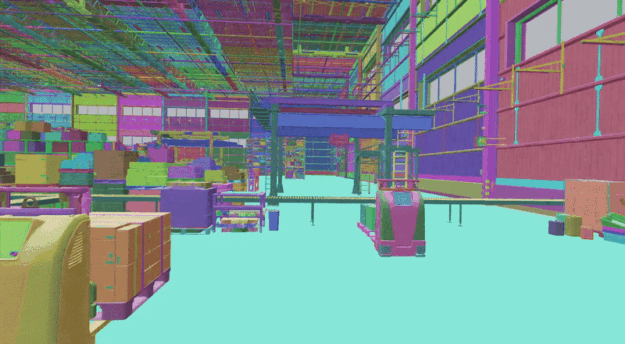
- Transfer 2.5 (The "Skinning" Engine): This model takes "ground truth" data—like 3D bounding boxes, LiDAR scans, or depth maps from NVIDIA Omniverse—and overlays photorealistic video. By using spatiotemporal control maps, it ensures that the "pretty" pixels don't drift away from the actual physics of the scene.
- Predict 2.5 (The "What If" Engine): This generates future states. It now supports sequences up to 30 seconds (a significant jump) and allows for "action simulation," where you can input a specific robot policy and see the predicted physical outcome.
- Reason 2 (The "Brain"): This is a multimodal LLM specifically tuned for the physical world. It features a massive 256K input token context window and provides 2D/3D point localization. It doesn't just say "there is a box"; it gives coordinates and explains its logic via chain-of-thought reasoning.
The hype check: Physics vs. Pixels
NVIDIA claims these models generate data "grounded in physics." We need to be careful here.
The Claim: "Generate scalable, photorealistic synthetic data that aligns with real-world physics." The Reality: Cosmos Transfer 2.5 uses structural inputs (depth maps, trajectories) as a skeleton. The skeleton is physics-aligned because it comes from a simulator like Omniverse/Isaac. The video is a generative overlay. The "physics" isn't being calculated by the pixels; it's being enforced by the input constraints. This is a smart architectural choice, but it’s not the same as a neural network "understanding" gravity from scratch.
The Claim: "10x higher accuracy" for Cosmos Predict 2.5. The Reality: This is a classic "up to" marketing metric. NVIDIA notes this 10x jump occurs when the model is "post-trained on proprietary or domain-specific data." If you’re using the base model out of the box, don’t expect a 10-fold improvement in your AV’s edge-case detection. This model is designed to be a foundation that you have to finish building.
Real-world implications: Solving the "Long Tail"
The real winner here is the Autonomous Vehicle (AV) sector.
Collecting real-world data for a car crash or a child running into the street is dangerous and rare. With Cosmos Transfer 2.5, a developer can take a "low-poly" simulation of a crash, apply a "rainy night in Seattle" filter, and generate 1,000 variations of that edge case for the AI to learn from.
For Humanoid Robotics (like the GR00T project mentioned), the 256K context window in Reason 2 is a sleeper hit. It allows the robot to "remember" the spatial layout of a large factory floor or a complex multi-step task without losing the thread—something that 4K or 8K context windows simply couldn't handle.
Limitations they’re not talking about
- The Compute Tax: Generating photorealistic, physics-aligned video at scale is computationally expensive. NVIDIA is essentially creating a virtuous cycle: to save money on physical robots, you must spend a fortune on NVIDIA GPUs to run Cosmos.
- The 30-Second Wall: 30 seconds of prediction is great for a lane change. It is insufficient for a robot navigating a warehouse from point A to point B, which might take five minutes. We still see a "horizon problem" where generative models struggle with long-term temporal consistency.
- The "Hallucinated Physics" Risk: Even with spatiotemporal control maps, generative models can introduce artifacts. If a synthetic video shows a ghosting effect on a curb, a robot might learn to ignore curbs in the real world. NVIDIA mentions "precise spatial alignment," but the margin for error in robotics is millimeters, not pixels.
How it stacks up
While OpenAI’s Sora or Runway Gen-3 can create beautiful videos, they lack the structural input hooks (LiDAR, HD Maps, depth maps) that Cosmos provides. Cosmos isn't trying to make a movie; it's trying to make a training manual.
Compared to "traditional" simulation (which often looks like a 2010 video game), Cosmos provides the visual complexity (reflections, lens flares, weather) that perception stacks need to reach "five nines" of safety. It bridges the gap between the sterile simulator and the messy real world.
Constructive suggestions
- Open the Reasoning Benchmarks: NVIDIA should release a specific "Physical AI" benchmark for Reason 2. We need to see how its 3D localization compares to human-labeled ground truth in non-simulated environments.
- Standardize the Workflow: The integration between OpenUSD, Omniverse, and Cosmos is powerful but notoriously steep in its learning curve. Simplifying the "Technical Recipes" in the Cosmos Cookbook for smaller labs would democratize this tech.
- Focus on Temporal Continuity: The next iteration needs to push past the 30-second mark. For physical AI to be truly "autonomous," it needs a world model that can maintain coherence over minutes, not seconds.
Our verdict
Who should adopt now: Large-scale robotics companies and AV developers who are data-starved and have the H100 clusters to spare. If you are struggling with "Sim-to-Real" transfer, this is currently the most sophisticated toolkit on the market.
Who should wait: Small startups and academic labs. The setup cost and compute requirements for Cosmos 2.5 will likely outweigh the benefits until NVIDIA provides a more optimized, "distilled" version of these models.
Who should skip: Developers focused purely on NLP or 2D image generation. Cosmos is a specialized beast for the physical world; it is overkill for non-spatial AI.
FAQ
Should we switch from a pure simulation (like Isaac Sim) to Cosmos?
No—you should use them together. The source makes it clear that Cosmos uses simulation (OpenUSD/Omniverse) as the ground truth. Cosmos is the "render layer" and "reasoning layer" that sits on top of your existing simulations to make them useful for high-stakes training.
Is the "Reasoning" model actually better than GPT-4o for robotics?
For spatial tasks, likely yes. While GPT-4o is a generalist, Cosmos Reason 2 is built for object localization (2D/3D points) and spatiotemporal understanding. If your task requires knowing exactly where an object is in 3D space rather than just what it is, Reason 2 is the better tool.
Is it worth the price premium?
If it reduces your "real-world" testing hours by even 20%, the answer is a resounding yes. Real-world testing involves safety drivers, insurance, and the risk of destroying $100k+ robot prototypes. Synthetic data at this level of fidelity is a high upfront cost that pays for itself in safety and scale.
Sources
All technical specifications, pricing, and benchmark data in this article are sourced directly from official announcements. Competitor comparisons use publicly available data at time of publication. We update our coverage as new information becomes available.