
NVIDIA Cosmos: Teaching AI How the Real World Works
The Short Version
NVIDIA Cosmos is a suite of AI "world foundation models" designed to teach robots and self-driving cars how to navigate the physical world safely and intelligently. By generating realistic, physics-based simulations, these models allow AI to practice in a virtual world before heading out into the real one. This technology helps make autonomous systems, like delivery robots and self-driving vehicles, faster to build and much safer for the public.
What Happened?
Think of training a robot like teaching a teenager to drive. You wouldn't want them to learn only on a busy highway during rush hour—it's dangerous and inefficient.
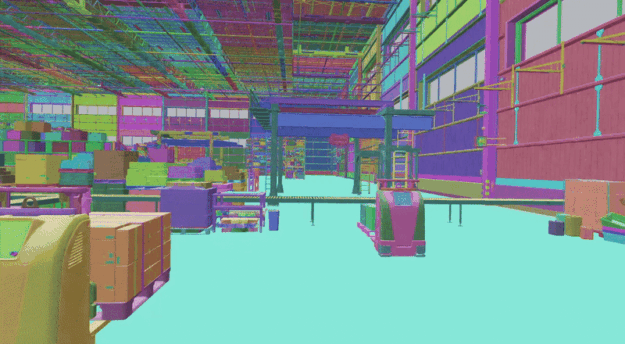
NVIDIA has updated its "Cosmos" system, which acts as a massive, high-tech training simulator for robots and autonomous vehicles. The latest versions—called Cosmos Transfer, Predict, and Reason—allow developers to create incredibly realistic virtual environments. These environments obey the laws of physics, meaning if a robot drops a box in this virtual world, it falls exactly how a real box would. This allows developers to simulate millions of "what if" scenarios—like a dog running into the street or a sudden rainstorm—without the cost and danger of testing in the real world.
Why Should You Care?
For most people, the immediate impact isn't a new app on your phone, but rather the safety and reliability of the machines that will eventually share your sidewalks and roads.
Currently, it is incredibly expensive and slow to collect enough "real-world" experience to make a robot smart. Because of this, robots can sometimes act unpredictably. By using these Cosmos models to train, robots gain "experience" from millions of simulated events. For you, this means the autonomous delivery robot on your sidewalk or the self-driving car in your neighborhood is more likely to handle unexpected situations correctly, making accidents less likely.
What Changes for You?
- Faster Innovation: You may start seeing more advanced robotics and automated services in your daily life sooner, as companies can now test and refine their tech much faster.
- Improved Safety: Because these robots are "trained" in environments that perfectly mimic real-world physics, they are better prepared for those rare, tricky situations (like a child chasing a ball) that often cause AI to fail.
- No Direct Tech Changes: You don’t need to download or install anything. These tools are designed for the engineers and companies building the robots and vehicles you interact with.
Frequently Asked Questions
Is NVIDIA Cosmos something I can use?
No, this is a specialized platform built for developers, roboticists, and engineers. It is a set of tools used behind the scenes to create the "brains" of robots and autonomous vehicles.
Is this the same as the AI in my phone?
Not quite. While both use AI, Cosmos is focused on "Physical AI"—the ability for machines to understand space, gravity, and objects in the real world. Your phone's AI is mostly focused on processing text, photos, or voice commands.
When will I see this in action?
You might not see "NVIDIA Cosmos" branding, but you will experience its effects through smarter robots and more reliable autonomous vehicles that perform better in the real world over the coming years.
The Bottom Line
NVIDIA’s updated Cosmos models provide a safe "playground" for robots to learn the rules of the physical world. By speeding up how we train machines, this technology aims to move autonomous robots and self-driving cars from the lab to our streets more safely and efficiently than ever before.
Sources
All technical specifications, pricing, and benchmark data in this article are sourced directly from official announcements. Competitor comparisons use publicly available data at time of publication. We update our coverage as new information becomes available.