
The next frontier of Artificial Intelligence is moving from the digital screen to the physical world. At GTC 2025, NVIDIA announced a significant breakthrough in this transition with the major release of NVIDIA Cosmos, a suite of World Foundation Models (WFMs) and data tools specifically engineered to solve the "data wall" in robotics and autonomous systems.
Executive Summary
- NVIDIA Cosmos is a suite of World Foundation Models (WFMs)—including Cosmos Transfer, Cosmos Predict, and Cosmos Reason—designed to generate high-fidelity, physics-aware synthetic data and provide multimodal reasoning for physical AI systems like humanoids and autonomous vehicles.
- The architecture leverages spatiotemporal control maps to align synthetic representations with real-world physics, bridging the "Sim2Real" gap.
- Cosmos introduces an open, fully customizable reasoning model (Cosmos Reason) to curate synthetic datasets and enable complex physical planning.
- Early adopters include industry leaders such as 1X, Agility Robotics, Figure AI, and Skild AI.
Technical Architecture: Under the Hood of Cosmos
NVIDIA Cosmos is not a single model but a multi-pillar framework designed to handle the end-to-end pipeline of physical AI: from data generation to real-time reasoning.
1. Cosmos Transfer: Structural-to-Visual Mapping
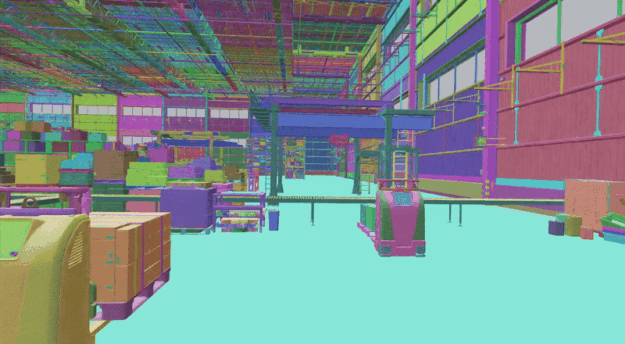
Cosmos Transfer is a specialized WFM that generates photorealistic videos from structural inputs (such as depth maps, surface normals, or segmentation masks).
- Spatiotemporal Control Maps: Unlike standard video generators that focus on visual aesthetics, Cosmos Transfer utilizes spatiotemporal control maps to ensure that the generated video dynamically aligns with the underlying physical structure.
- Preservation of Knowledge: It is designed to preserve pretrained knowledge from massive visual datasets while allowing fine-grained control over how objects move in 3D space. This allows developers to take a low-fidelity simulation (like a wireframe robot movement) and render it into a photorealistic environment for sensor training.
2. Cosmos Predict: State-Action Prediction
Cosmos Predict functions as a "mental simulator" for robots. It takes the current state of the world and a proposed action as input to predict the future state.
- Mechanism: $State (S_t) + Action (A_t) \rightarrow Predicted State (S_{t+1})$.
- Physics Awareness: By training on massive amounts of physical interaction data, the model learns the "intuitive physics" of the world—such as gravity, friction, and object permanence—enabling robots to simulate the consequences of their actions before executing them physically.
3. Cosmos Reason: The Decision Engine
Cosmos Reason is described as an open and fully customizable reasoning model. It serves two primary functions:
- In-Robot Reasoning: Perceiving multimodal inputs (vision, depth, tactile) and responding intelligently to complex commands or environmental changes.
- Synthetic Data Curation: It acts as a "filter" for the data engine. It can analyze millions of generated synthetic frames, reason about their physical plausibility, and filter out edge cases that are not useful for training, significantly increasing the quality of the training pipeline.
Performance Analysis: Benchmarks and Capabilities
While specific hardware latency and parameter counts for the entire suite are not yet disclosed, NVIDIA has positioned Cosmos against traditional synthetic data generation methods and existing video foundation models.
| Capability | Traditional Simulation (e.g., standard CG) | General Video Models (e.g., Sora/Gen-3) | NVIDIA Cosmos WFMs |
|---|---|---|---|
| Physics Fidelity | High (but manual/slow) | Low (visually plausible only) | High (physics-aware learning) |
| Control Granularity | High (per-vertex) | Low (prompt-based) | High (spatiotemporal maps) |
| Reasoning Layer | None | Limited/None | Integrated (Cosmos Reason) |
| Data Scaling | Linear (manual effort) | High (digital only) | Exponential (synthetic generation) |
| Customizability | High | Low (closed API) | High (Open reasoning model) |
Early Adopter Impact
- Agility Robotics & Figure AI: Utilizing Cosmos to scale training data for humanoid robots in unstructured environments where real-world data is dangerous or impossible to collect (e.g., a robot falling or handling fragile materials).
- 1X & Skild AI: Leveraging the reasoning capabilities to improve task generalization, allowing robots to understand "why" a task failed rather than just "that" it failed.
Technical Implications: Solving the "Edge Case" Problem
The primary bottleneck for autonomous vehicles (AVs) and humanoids is the "long tail" of edge cases. Collecting real-world data for a car nearly hitting a pedestrian in a blizzard is dangerous and expensive.
NVIDIA Cosmos changes the math of data collection:
- Safety: Developers can generate millions of permutations of a dangerous scenario without risking hardware or human life.
- Diversity: By using Cosmos Transfer, a single structural movement (a robot arm reaching) can be rendered in thousands of different lighting conditions, textures, and backgrounds to prevent over-fitting.
- The Reasoning Feedback Loop: By using Cosmos Reason to filter synthetic data, the "trash in, trash out" problem of synthetic training is mitigated. The model only trains on data that the reasoning engine deems physically consistent.
Limitations and Trade-offs
- Compute Requirements: As with all foundation models, Cosmos likely requires significant H100/B200 compute resources for inference and fine-tuning. Small-scale robotics startups may find the barrier to entry high without NVIDIA's cloud infrastructure.
- Sim2Real Gap: While Cosmos Transfer improves photorealism, the "tactile gap" (how things feel and micro-frictions) remains a challenge that visual-only foundation models may struggle to fully solve.
- Latency for Real-time Control: Predict and Reason models must operate at extremely low latency to be used in closed-loop control of a fast-moving robot. The exact "tokens-per-second" for Cosmos Reason in a deployment environment is not yet disclosed.
Expert Perspective
NVIDIA Cosmos represents a shift from Robotics as a Code Problem to Robotics as a Data Problem. For years, we tried to program the rules of physics into robots. With Cosmos, NVIDIA is betting that we can instead teach robots the rules of physics by letting them observe and generate their own world states.
The decision to keep Cosmos Reason open and customizable is a strategic masterstroke. It ensures that the ecosystem of robotics researchers can adapt the reasoning engine to specific hardware (like a 5-fingered hand vs. a wheeled base) without waiting for NVIDIA to release a specialized model.
Technical FAQ
How does Cosmos Transfer compare to a standard VAE or GAN?
Cosmos Transfer is significantly more sophisticated than a traditional Variational Autoencoder (VAE). It is a World Foundation Model that incorporates spatiotemporal control maps, meaning it doesn't just map pixels; it maps the progression of physical structures over time to ensure visual and physical consistency across frames.
Is Cosmos Reason a separate LLM or integrated?
Cosmos Reason is a multimodal reasoning model designed for Physical AI. While it shares architectural DNA with Large Language Models, it is specifically fine-tuned for perception-action loops and physical data curation, allowing it to handle "reasoning" within a physical context rather than just linguistic context.
Is it compatible with NVIDIA Omniverse?
Yes. Cosmos is designed to sit within the NVIDIA Isaac and Omniverse ecosystems. It effectively acts as the "AI engine" that can take data out of Omniverse (structural inputs) and transform it into high-fidelity training data (via Cosmos Transfer) or use it to predict future states (via Cosmos Predict).
References
- NVIDIA Cosmos Official Page
- NVIDIA Technical Blog: Scaling Synthetic Data
- NVIDIA GTC 2025 Keynote Announcements