
NVIDIA Launches Cosmos 2.5: World Models with 10x Accuracy for Physical AI
- What: NVIDIA released Cosmos Transfer 2.5, Cosmos Predict 2.5, and Cosmos Reason 2.
- Key Metric: Cosmos Predict 2.5 delivers up to 10x higher accuracy for long-tail scenarios.
- Technical Spec: Cosmos Reason 2 expands long-context support to 256K input tokens.
- Use Case: High-fidelity synthetic data generation for humanoids and autonomous vehicles.
NVIDIA has unveiled a significant update to its Cosmos World Foundation Models (WFMs), introducing Cosmos Transfer 2.5, Cosmos Predict 2.5, and Cosmos Reason 2 to bridge the "sim-to-real" gap for physical AI. One year after the platform's initial debut, these new models allow developers to generate massive, physics-aware synthetic datasets and perform advanced spatiotemporal reasoning, addressing the primary bottleneck in training humanoids and autonomous vehicles.
Scaling Synthetic Data with Physics-Aware Precision
The development of next-generation AI-driven robots depends on diverse, high-fidelity training data. However, collecting real-world data is often prohibitively expensive, time-consuming, and dangerous when testing edge cases. NVIDIA’s latest Cosmos update addresses these hurdles by providing a foundation for post-training task-specific physical AI models.
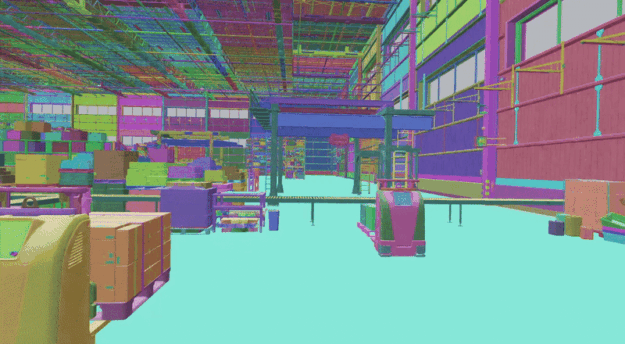
At the center of this release is Cosmos Transfer 2.5. This model focuses on photorealistic data augmentation, transforming simulation and 3D spatial inputs into high-fidelity video sequences. By employing a ControlNet architecture, Cosmos Transfer preserves pretrained knowledge while ensuring that synthetic outputs remain grounded in real-world physics.
According to NVIDIA's technical announcement, Cosmos Transfer utilizes spatiotemporal control maps to align synthetic representations with real-world dynamics. This allows for fine-grained control over object placement, motion, and scene composition. Developers can input structured geometric data—including LiDAR scans, HD maps, depth maps, and human motion keypoints—to produce photorealistic videos that are precisely aligned with ground-truth annotations.
10x Accuracy for Long-Tail Scenarios
Predicting the future state of the world is a critical requirement for autonomous systems, particularly when navigating "long-tail" scenarios—rare but high-stakes events that occur in the real world.
Cosmos Predict 2.5 is designed to generate these future world states from multimodal inputs. NVIDIA reports that when post-trained on proprietary or domain-specific data, the model can achieve up to 10x higher accuracy in predicting sequences of up to 30 seconds. This version also introduces support for multiview outputs and custom camera layouts, allowing developers to simulate action-policy outcomes across various sensor configurations.
By generating these realistic future states, Cosmos Predict enables autonomous vehicles and robots to "rehearse" potential maneuvers in a safe, virtual environment before encountering them on the road or the factory floor.
Advanced Reasoning and Spatiotemporal Understanding
Physical AI requires more than just visual processing; it requires an understanding of how objects move through time and space. Cosmos Reason 2 introduces a massive leap in this capability, featuring expanded long-context support of up to 256K input tokens.
This update brings advanced "chain-of-thought" reasoning to the physical world. Key features include:
- Improved Spatiotemporal Precision: Enhanced understanding of timing and object persistence.
- Advanced Localization: The ability to perform object detection with precise 2D and 3D point localization and bounding box coordinates.
- Reasoning Labels: The model now provides explanations for its decision-making process, supporting complex tasks such as motion prediction and context-aware navigation.
Impact on the Robotics Industry
The release of these models signifies a shift in how the industry approaches the "data scarcity" problem in robotics. By leveraging NVIDIA Omniverse and OpenUSD (Universal Scene Description), developers can create 3D scenes that serve as the ground truth for Cosmos models.
For developers, this means the ability to scale training data exponentially without the physical risks of real-world testing. For the industry, it represents a move toward more "reasoning-capable" robots that don't just follow programmed paths but understand the physical implications of their actions.
"Cosmos introduces an open and fully customizable reasoning model for physical AI and unlocks opportunities for step-function advances in robotics," according to NVIDIA's newsroom announcement.
What’s Next
NVIDIA is positioning the Cosmos WFMs as the backbone for the future of physical AI deployment. To assist developers in integrating these tools, the company has released the "NVIDIA Cosmos Cookbook," which provides step-by-step workflows, technical recipes, and concrete examples for building and adapting these models.
As humanoids and autonomous systems move toward mass deployment, the ability to generate "infinite" synthetic data that remains grounded in physics will likely become the standard for the industry. Developers can currently access these models and SDKs via NVIDIA’s developer platform to begin post-training for domain-specific applications.
Sources
- NVIDIA Technical Blog: Scale Synthetic Data and Physical AI Reasoning with NVIDIA Cosmos World Foundation Models
- NVIDIA Newsroom: NVIDIA Announces Major Release of Cosmos World Foundation Models
- NVIDIA Cosmos Product Page
- NVIDIA Technical Blog: Curating Synthetic Datasets with Cosmos Reason
All technical specifications, pricing, and benchmark data in this article are sourced directly from official announcements. Competitor comparisons use publicly available data at time of publication. We update our coverage as new information becomes available.