
The short version
NVIDIA Cosmos is a new suite of AI tools designed to help robots and self-driving cars "understand" the physical world by generating highly realistic training data. Instead of just learning from text or 2D images, these models allow AI to practice in a virtual environment that obeys the laws of physics. By mastering this "virtual reality," robots can become safer, smarter, and more reliable when they encounter the unpredictable real world.
What happened
Imagine trying to teach a teenager how to drive a car, but you aren't allowed to take them on the road. You could give them a textbook or show them pictures of signs, but they wouldn't actually know how a car feels when it turns or how it reacts to slippery pavement.
Current AI often faces this same problem. Robots and autonomous vehicles need to learn how the world works—gravity, movement, and reaction—but gathering enough "real-world" experience to train them is slow, expensive, and sometimes dangerous.
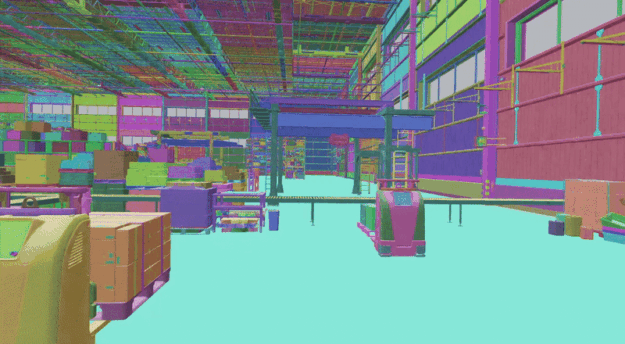
NVIDIA’s new Cosmos tools solve this by acting as a high-fidelity flight simulator for AI. These models can create photorealistic videos of physical scenarios, predict how a scene will change in the next few seconds, and help the AI "reason" about what it sees. Think of it like a sandbox where the AI can fail thousands of times without causing a single actual accident, allowing it to perfect its skills before it ever touches a real steering wheel or robotic arm.
Why should you care?
If you are worried about the safety of self-driving cars or curious about when we might see more capable helper robots in warehouses or factories, this is a big deal.
The biggest hurdle for "Physical AI"—AI that controls real-world objects—is that the world is messy. A human can handle a sudden gust of wind or a misplaced item, but traditional AI often gets confused by these "edge cases." By using Cosmos to simulate millions of these tricky scenarios, companies can train their robots to be far more observant and less likely to behave unpredictably. For you, this means a future where autonomous technology is not just more common, but significantly safer and more dependable.
What changes for you
In the short term, you won’t see "Cosmos" on your phone or computer. Instead, you will see its impact through the companies that use it.
- Reliability: Expect self-driving car software and industrial robots to handle unexpected situations better as they get "smarter" training.
- Faster Innovation: Because developers can simulate training data rather than manually collecting it, new features for robotics may arrive more quickly.
- Safety: By stress-testing these systems in a virtual environment that mirrors real-world physics, companies can catch dangerous flaws long before the AI is deployed in your neighborhood.
Frequently Asked Questions
Is Cosmos a robot I can buy?
No. Cosmos is a set of "World Foundation Models"—essentially a powerful software brain—that companies build upon to train their own robots and autonomous vehicles. It is a toolkit for developers, not a consumer product.
How is this different from regular AI like ChatGPT?
While ChatGPT is great at processing language, Cosmos is designed for "Physical AI." It understands space, movement, and physics, helping robots understand what they are seeing in the physical world rather than just analyzing text or patterns in data.
Will this make self-driving cars safer?
That is the primary goal. By allowing developers to safely simulate millions of miles of "difficult" driving conditions—like sudden obstacles or bad weather—the AI can learn how to react correctly without ever putting a human in danger during the learning phase.
The bottom line
NVIDIA Cosmos is a major step forward in bridging the gap between digital intelligence and the physical world. By giving AI a realistic, physics-aware "classroom," NVIDIA is helping the next generation of robots and self-driving vehicles overcome the trial-and-error limitations of the past. While you won't be using this software directly, the safety and intelligence it imparts to the machines of the future will eventually become part of your everyday life.