
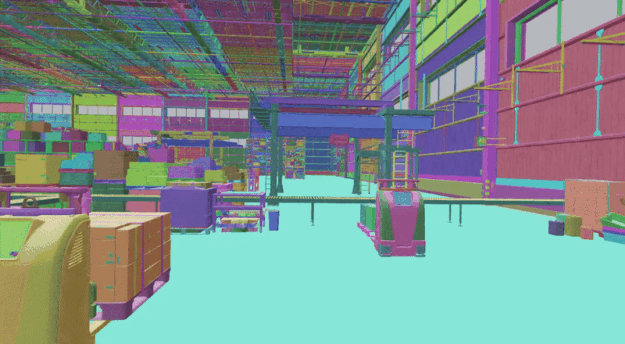
- What: NVIDIA launched "Cosmos," a suite of World Foundation Models (WFMs) including Cosmos Transfer, Cosmos Predict, and Cosmos Reason.
- When: Announced March 18, 2025, during the NVIDIA GTC conference.
- Key Adopters: Industry leaders including 1X, Agility Robotics, Figure AI, and Skild AI are among the first to integrate the technology.
- Core Benefit: Accelerates the development of physical AI by generating high-fidelity, physics-aware synthetic data for training humanoid robots and autonomous vehicles.
NVIDIA has unveiled NVIDIA Cosmos, a suite of world foundation models (WFMs) designed to solve the critical shortage of high-fidelity training data for humanoid robots and autonomous vehicles. Announced at the NVIDIA GTC 2025 conference, these models integrate physics-aware reasoning and synthetic data generation to enable AI systems to perceive, predict, and interact with the physical world with unprecedented accuracy. By bridging the gap between digital simulation and physical reality, NVIDIA aims to accelerate the deployment of autonomous systems across global industries.
Breaking the Physical AI Data Bottleneck
The development of next-generation robots, such as humanoids and autonomous vehicles (AVs), has long been hindered by a "data drought." While large language models (LLMs) can be trained on the vast expanse of the internet, physical AI requires high-fidelity, physics-aware data that accurately represents the complexities of the real world.
According to NVIDIA’s technical blog, relying solely on real-world data collection is "difficult, time-consuming, and costly to scale." Without diverse and representative datasets, robots face significant testing risks due to poor generalization and unpredictable behavior in "edge cases"—rare scenarios that are nearly impossible to capture manually but are critical for safety.
NVIDIA Cosmos addresses this by providing an open and fully customizable framework. This allows developers to generate massive amounts of synthetic data that adheres to the laws of physics, ensuring that robots trained in these virtual environments can transition seamlessly to the real world.
The Cosmos Ecosystem: Transfer, Predict, and Reason
The NVIDIA Cosmos release is centered around three distinct but interconnected world foundation models, each serving a specific role in the physical AI development pipeline:
Cosmos Transfer: Photorealistic Synthetic Data
Cosmos Transfer focuses on the generation of high-fidelity synthetic data. It is capable of generating photorealistic videos from structural inputs, such as 3D layouts or wireframes. A key technical feature of Cosmos Transfer is its use of spatiotemporal control maps, which allow developers to dynamically align synthetic data with real-world representations. This ensures that while the video is synthetic, it preserves the pretrained knowledge and physical consistency required for effective training.
Cosmos Predict: Anticipating the Future
Cosmos Predict is designed to model the temporal aspects of the physical world. It generates "future world states," allowing a robot or autonomous vehicle to visualize what will happen next based on a current set of inputs. This predictive capability is vital for navigation and obstacle avoidance, as it allows AI systems to "hallucinate" potential outcomes and choose the safest path before taking a physical action.
Cosmos Reason: Multimodal Logic and Filtering
As the most advanced component of the suite, Cosmos Reason serves as the "brain" of the operation. It is a multimodal reasoning model that can perceive, reason, and respond intelligently to diverse inputs. Beyond acting as a controller for robots, Cosmos Reason is used to curate and filter synthetic datasets. It can analyze generated data to ensure it is physically plausible and high-quality, significantly reducing the manual labor involved in data engineering.
Early Adopters and Industry Momentum
The announcement has already seen immediate traction among the world’s leading robotics companies. NVIDIA confirmed that 1X, Agility Robotics, Figure AI, and Skild AI are among the early adopters utilizing Cosmos to refine their humanoid models.
By leveraging Cosmos, these companies can simulate complex human-robot interactions and industrial tasks that would be too dangerous or expensive to test in a physical lab. For example, Figure AI can use the models to train humanoids on intricate warehouse tasks, while Agility Robotics can refine the balance and locomotion of its robots using the physics-aware outputs of Cosmos Predict.
In the autonomous vehicle sector, the need for diverse sensor data is paramount. NVIDIA reports that Cosmos enables the generation of diverse, high-fidelity sensor data required for safely training, testing, and validating AVs. This includes simulating extreme weather conditions, rare traffic accidents, and complex urban environments that are difficult to encounter during standard road testing.
Impact on Developers and the Industry
For the AI industry, the launch of Cosmos represents a shift from purely digital AI to "Physical AI." This transition changes how developers approach model training, moving away from "collecting" data to "generating" and "reasoning" with it.
"Cosmos introduces an open and fully customizable reasoning model for physical AI and unlocks opportunities for step-function advances in robotics and the physical industries," according to the official NVIDIA newsroom announcement.
For developers, the implications are profound:
- Reduced Costs: Massive reduction in the need for expensive physical test fleets.
- Safety: The ability to train for dangerous edge cases in a risk-free environment.
- Speed to Market: Faster iteration cycles by generating the specific data needed to fix model weaknesses.
The impact section can be summarized by a single realization: This changes how developers will build the machines of the future by making physics as programmable as code.
Technical Specifications and Availability
While specific pricing tiers for the Cosmos API and enterprise models were not detailed in the initial announcement, NVIDIA emphasized the "open and fully customizable" nature of the framework. Cosmos Reason is currently available for developers looking to transform how they curate and generate synthetic data.
The models are built to leverage NVIDIA’s existing GPU infrastructure, ensuring that companies already using the NVIDIA Isaac or DRIVE platforms can integrate Cosmos into their existing workflows with minimal friction. Specific benchmarks regarding the frames-per-second (FPS) generation speed or the parameter counts of the models are expected to be released as the tools move into wider availability later in 2025.
What’s Next for Physical AI
The release of NVIDIA Cosmos at GTC 2025 marks the beginning of a new era where the barrier between the digital and physical worlds becomes increasingly thin. As these world foundation models mature, the industry can expect a "step-function" increase in the capabilities of humanoid robots—moving them from controlled lab environments into the unpredictable world of homes and factories.
The timeline for broader availability suggests that 2025 will be a year of rapid scaling for physical AI. With Cosmos, NVIDIA is not just providing a tool; they are providing the foundational infrastructure for the next industrial revolution.
Sources
- NVIDIA Technical Blog: Scale Synthetic Data and Physical AI Reasoning with NVIDIA Cosmos World Foundation Models
- NVIDIA Newsroom: NVIDIA Announces Major Release of Cosmos World Foundation Models and Physical AI Data Tools
- Edge AI and Vision Alliance: NVIDIA Announces Major Release of Cosmos World Foundation Models
- NVIDIA Technical Blog: Curating Synthetic Datasets to Train Physical AI Models with NVIDIA Cosmos Reason
- NVIDIA Official Product Page: Physical AI with World Foundation Models | NVIDIA Cosmos