
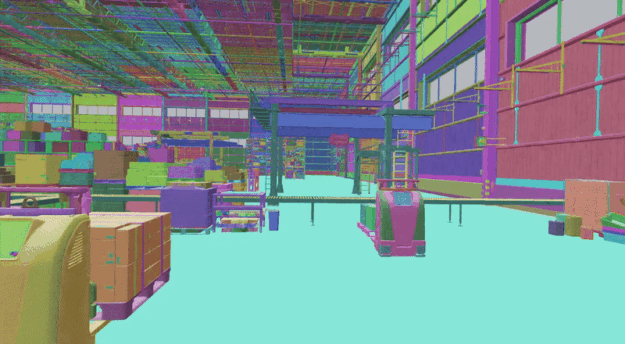
NVIDIA Cosmos World Foundation Models: A Technical Deep Dive
Executive Summary
NVIDIA Cosmos is a suite of World Foundation Models (WFMs)—including Cosmos Transfer 2.5, Predict 2.5, and Reason 2—designed to accelerate synthetic data generation and physical AI reasoning for robotics and autonomous systems via a physics-grounded, multimodal architecture. By integrating spatiotemporal control maps and supporting context windows up to 256K tokens, the platform bridges the gap between digital simulation and real-world physical dynamics.
- Core Utility: Provides a foundation for post-training downstream domain-specific models (e.g., humanoids, AVs) using high-fidelity, physics-aware synthetic data.
- Key Capability: Cosmos Reason 2 introduces advanced chain-of-thought reasoning and precise 2D/3D point localization for complex object interaction.
- Scale & Performance: Cosmos Predict 2.5 delivers up to 10x higher accuracy in long-tail scenario generation when post-trained on proprietary data, supporting sequences up to 30 seconds.
- Ecosystem Integration: Fully compatible with NVIDIA Omniverse, OpenUSD, and the Isaac GR00T Blueprint, facilitating a seamless Sim-to-Real pipeline.
Technical Architecture
The NVIDIA Cosmos suite is not a single model but a multi-modal ecosystem comprising three specialized World Foundation Models (WFMs). These models are architected to handle the unique "spatiotemporal" requirements of physical AI, where time and space are not just dimensions but constraints of physics.
1. Cosmos Transfer 2.5: The Rendering Backbone
Cosmos Transfer 2.5 serves as the bridge between structured geometric data and photorealistic video. It utilizes a ControlNet architecture, which allows the model to preserve extensive pre-trained knowledge of the visual world while conditioning its output on specific structural inputs.
- Spatiotemporal Control Maps: The model uses these maps to dynamically align synthetic representations (from simulation) with real-world visual distributions. This ensures that while the "look" of the video is photorealistic, the "layout" remains strictly grounded in the provided 3D geometry.
- Input Modalities: It accepts a wide array of structured data, including:
- Geometric: Depth maps, edge maps, and 3D bounding boxes.
- Semantic: Segmentation maps and HD maps.
- Sensor-specific: LiDAR scans and human motion keypoints.
- Dynamic: Trajectories and motion vectors.
2. Cosmos Predict 2.5: Temporal Dynamics and Forecasting
While Transfer 2.5 focuses on the "now" (rendering), Predict 2.5 focuses on the "next." It is designed to generate future world states based on multimodal inputs and current actions.
- Action Simulation: The model supports "alternate policy outputs," allowing developers to simulate how a world state might change if a robot takes Action A versus Action B.
- Multiview Consistency: Unlike standard video generators, Predict 2.5 supports custom camera layouts and multiview outputs, which is critical for autonomous vehicles (AVs) that rely on a 360-degree sensor suite.
- Long-Sequence Generation: It is optimized for temporal consistency over sequences of up to 30 seconds—a significant duration for physical AI where small errors in physics can compound into "hallucinated" or impossible physical states.
3. Cosmos Reason 2: The Physical Logic Engine
Cosmos Reason 2 acts as the cognitive layer of the suite. It is designed to understand the "why" and "where" of a physical scene.
- Long-Context Support: With an expanded 256K input token window, the model can ingest vast amounts of historical sensor data or complex environmental descriptions to make informed decisions.
- Chain-of-Thought (CoT) Reasoning: The model provides reasoning explanations and labels, allowing it to perform complex tasks like motion prediction and context-aware decision-making.
- Spatial Precision: Unlike previous versions, Reason 2 adds 2D/3D point localization and bounding box coordinates, enabling it to pinpoint objects within a 3D coordinate frame directly from visual or multimodal data.
Performance Analysis
The release of the 2.5 and 2.0 series represents a significant leap in accuracy and utility for physical AI developers. The primary performance metric emphasized is "long-tail accuracy"—the ability to correctly simulate and reason about rare or high-stakes edge cases that are difficult to capture in the real world.
Benchmark and Capability Comparison
| Feature | Cosmos Transfer 2.5 | Cosmos Predict 2.5 | Cosmos Reason 2 |
|---|---|---|---|
| Primary Architecture | ControlNet-based WFM | Temporal Predictive WFM | Reasoning WFM |
| Max Sequence Length | Not disclosed | 30 Seconds | N/A (Decision-based) |
| Context Window | Not disclosed | Not disclosed | 256K Tokens |
| Accuracy Improvement | Scalable diversity | 10x (Long-tail) | Improved spatiotemporal |
| Key Output | Photorealistic Video | Future States/Policies | 2D/3D Coordinates & Logic |
| Core Input | 3D/OpenUSD Maps | Multimodal/Action | Text/Multimodal |
Accuracy Gains
NVIDIA reports that Cosmos Predict 2.5 achieves up to 10x higher accuracy when post-trained on domain-specific or proprietary data compared to previous iterations or generalized models. This leap is attributed to the model's ability to better internalize the physical constraints of a specific environment (e.g., a specific warehouse floor or a specific city's traffic patterns).
Technical Implications
Solving the "Sim-to-Real" Bottleneck
Historically, robots trained in simulation often failed in the real world because "sim" looked and felt different from "reality" (the "reality gap"). Cosmos Transfer 2.5 mitigates this by allowing developers to create "Ground Truth" simulations in NVIDIA Omniverse and then "skin" them with photorealistic textures and lighting that adhere to real-world physics.
Post-Training as a Standard Workflow
The Cosmos architecture suggests a shift in how physical AI is developed. Rather than building models from scratch, NVIDIA proposes using Cosmos WFMs as a "foundation for post-training." Developers take the pre-trained Cosmos models and fine-tune them on their specific robot's sensors and environment, significantly reducing the R&D cycle.
OpenUSD and Omniverse Integration
By basing the workflow on OpenUSD (Universal Scene Description), NVIDIA ensures that Cosmos is compatible with a wide array of 3D tools. This allows for the ingestion of complex 3D scenes that can be procedurally varied (changing weather, lighting, or object placement) to generate the massive datasets required for humanoid training.
Limitations and Trade-offs
- Computational Intensity: While Cosmos "speeds up" synthetic data generation, the underlying models (especially with 256K context windows) require massive GPU resources (likely H100/B200 clusters) for efficient inference and post-training.
- Dependency on High-Quality Ground Truth: Cosmos Transfer 2.5 is only as good as the input simulation. If the initial OpenUSD scene has physical inaccuracies (e.g., clipping or incorrect mass properties), the photorealistic output will simply be a "beautifully rendered" version of an incorrect simulation.
- Post-Training Requirement: To achieve the headline "10x accuracy" for long-tail scenarios, developers must perform post-training on proprietary data. The base models, while powerful, are intended as starting points rather than "turnkey" solutions for specific edge cases.
Expert Perspective
The introduction of Cosmos 2.5 and Reason 2 signals NVIDIA's intent to move beyond "generative AI" for entertainment and toward "Physical AI" for industrial utility. The most significant technical advancement here is the integration of 2D/3D point localization within a reasoning model. Most LLMs/VLMs "hallucinate" coordinates; by providing precise bounding box coordinates and 3D points, NVIDIA is treating the WFM as a spatial operating system rather than just a chat or video interface.
For senior developers, the takeaway is clear: the bottleneck for robotics is no longer just "the brain" (logic) but "the data" (experience). Cosmos provides the machinery to manufacture high-fidelity experience at scale.
Technical FAQ
How does Cosmos Transfer 2.5 maintain physical consistency compared to standard video diffusion models?
Standard diffusion models generate pixels based on statistical likelihood, often leading to "shimmering" or objects disappearing. Cosmos Transfer 2.5 uses a ControlNet architecture tied to spatiotemporal control maps derived from 3D ground truth (Omniverse). This ensures that every pixel is anchored to a geometric coordinate that remains consistent across frames.
Is Cosmos Reason 2 capable of direct robot control?
While Reason 2 can output motion predictions and 3D coordinates, it is primarily designed as a reasoning foundation. In a standard stack, Reason 2 would process multimodal inputs and provide high-level logic or "chain-of-thought" planning, which is then translated into low-level motor commands by a downstream model like GR00T N1.
What are the specific requirements for long-context (256K) reasoning?
The 256K token context window allows the model to "remember" long sequences of sensor data. This is critical for tasks like navigating a large warehouse where a robot must remember an obstacle it saw 5 minutes ago (and several thousand frames ago) to plan its current path. The specific memory and compute overhead for this context length have not yet been fully disclosed, but it typically requires specialized attention mechanisms or KV-cache optimization.
Can Cosmos Predict 2.5 simulate non-visual sensor data?
The current documentation focuses on visual and multiview outputs, as well as action simulation. While it ingests LiDAR and HD maps as inputs for Transfer, the primary output of Predict 2.5 discussed is visual/spatial world states. Support for direct raw LiDAR or radar output generation is not yet explicitly detailed in the current release notes.
References
- NVIDIA Cosmos: World Foundation Models for Physical AI
- NVIDIA Isaac GR00T Blueprint for Humanoid Robotics
- OpenUSD Documentation and Standards
Sources
All technical specifications, pricing, and benchmark data in this article are sourced directly from official announcements. Competitor comparisons use publicly available data at time of publication. We update our coverage as new information becomes available.