
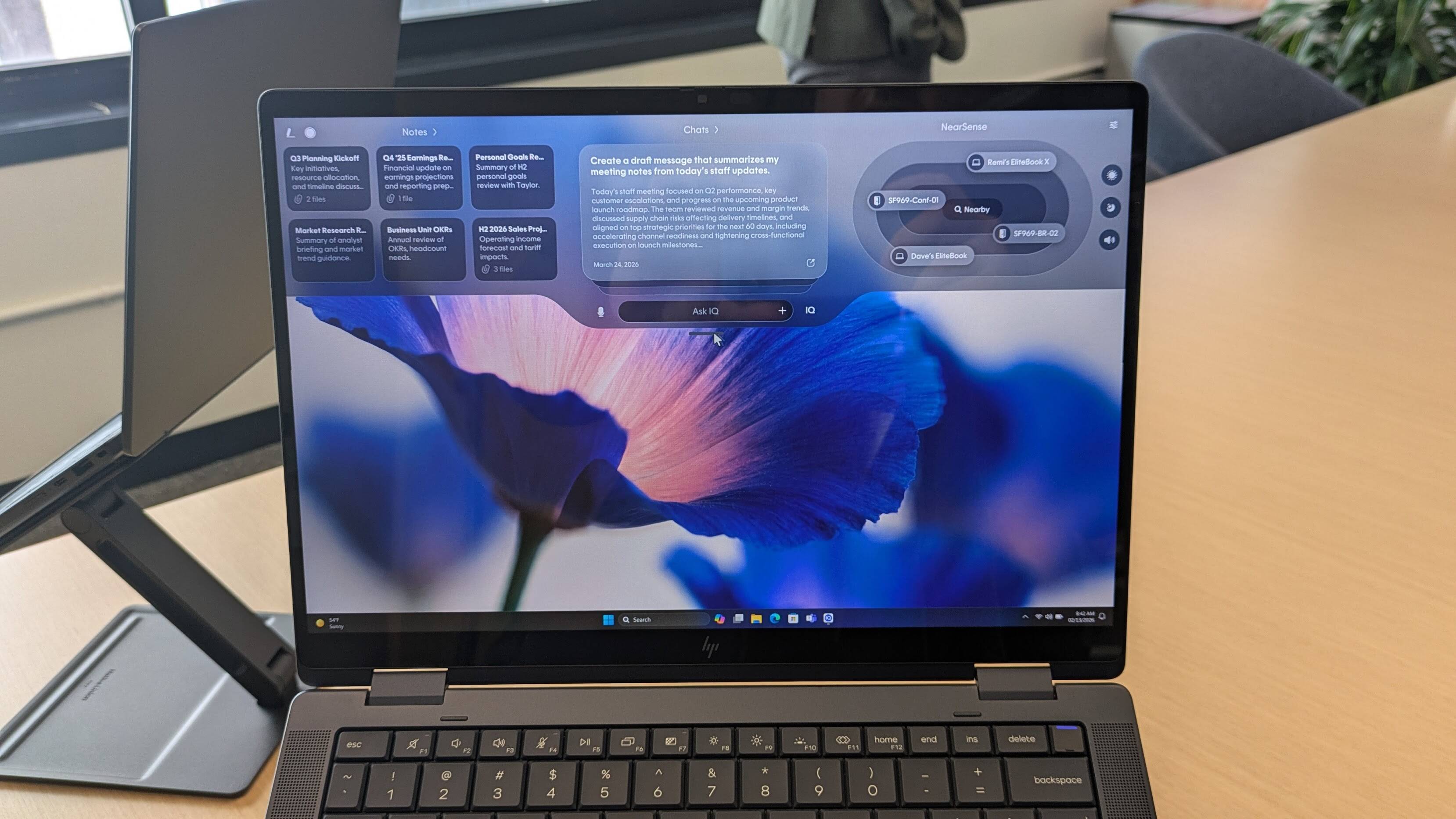
Our Honest Take on HP IQ: A Smart Ecosystem Play Marred by Privacy Blind Spots
HP is attempting to do what every legacy hardware manufacturer dreams of: moving from being a commodity box-seller to an essential intelligence provider. With the announcement of HP IQ, a collaboration suite powered by a local OpenAI model, the company is targeting small-to-medium businesses (SMBs) who are wary of the cloud but eager for AI productivity.
While the technical integration of local LLMs into the "AI PC" workflow is a commendable step toward data sovereignty, the execution raises significant questions about hardware gatekeeping and workplace ethics.
Verdict at a glance
- The Win: Local execution of
gpt-oss-20bensures sensitive business documents never leave the device, providing a genuine "Privacy First" alternative to cloud-based assistants. - The Fail: A restrictive 24GB RAM minimum requirement makes this a "pay-to-play" feature that effectively obsoletes HP’s existing fleet of 16GB business laptops.
- Who it’s for: Small legal, medical, or financial firms that handle high-stakes confidential data and are already invested in the HP/Poly ecosystem.
- Price/Performance: TBD on software licensing, but the hardware entry barrier is high. It’s an expensive way to get features that are increasingly becoming standard in free software.
What’s actually new
The standout technical achievement here isn't the chat interface—it’s the local implementation of gpt-oss-20b. This appears to be one of the first major fruit-bearings of OpenAI’s shift toward open-source/local weights. By running a 20-billion parameter model on-device, HP is offering a middle ground: significantly more "intelligence" than a basic 7B model, but with the security of an air-gapped environment.
Secondly, HP NearSense uses a clever triangulation of Wi-Fi, Bluetooth, and microphone sensors to map room proximity. While proximity sharing isn't new (Apple’s AirDrop has existed for over a decade), the integration with HP Poly conferencing hardware—allowing a laptop to "know" it’s in a specific meeting room and log in automatically—is a meaningful reduction in "meeting start friction" that plagues modern offices.
The hype check
HP’s marketing frames this as a "layer of intelligence that will stretch across devices." Let’s be clear:
- Claim: "Make [PCs] more valuable than ever before."
- Reality: Much of HP IQ's utility is contingent on buying more HP hardware. The "ecosystem" benefits only trigger if you also own HP Poly Video Bars and IQ-enabled printers.
- Claim: The local model provides "great detail" on sensitive documents.
- Reality: A 20B model is a lightweight in the world of LLMs. While efficient for summaries and drafting, it will likely struggle with the complex reasoning or long-context windows found in GPT-4o or Claude 3.5 Sonnet. HP is betting that "local and fast" beats "cloud and brilliant" for the average office worker.
Real-world implications
The biggest winners here are industries where data residency is a legal requirement. A law firm can use the meeting agent to summarize a client deposition without worrying about the transcript training a third-party model.
However, the NearSense file sharing could finally solve the "How do I send this to the person sitting next to me?" friction in Windows environments—a problem Microsoft has failed to solve elegantly for years. If HP successfully extends this to Android, they will have built a cross-platform bridge that rivals Apple’s walled garden.
Limitations they’re not talking about
- The RAM Tax: Requiring 24GB of RAM is a bold move. Most "standard" business laptops are still sold with 16GB. This suggests that the
gpt-oss-20bmodel, even with quantization, is a memory hog. If you bought a top-tier EliteBook in 2025 with 16GB, you are already locked out of HP's "future of AI." - The "Stealth Recording" Problem: The meeting agent uses the laptop's microphones to summarize in-person conversations but provides no physical indicator or automated notification to other participants that they are being recorded. HP’s defense—that users should "follow best practice" and ask permission—is a massive hand-wave of a serious HR and legal liability.
- Knowledge Stagnation: The model was trained in September 2025. While it can poll the internet for weather and stocks, its core "reasoning" is frozen. Users will need to be wary of "hallucinations" regarding any industry shifts or news that occurred after the training cutoff.
How it stacks up
Compared to Microsoft Copilot, HP IQ wins on privacy (local vs. cloud) but loses on integration with the wider web and the M365 graph. Compared to Apple Intelligence, HP is catching up on proximity features (NearSense vs. AirDrop/Handoff) but offers a more powerful, albeit more power-hungry, local LLM for document analysis.
Constructive suggestions
- Add a Hardware "AI Active" LED: To solve the "creepy" factor, future EliteBooks should have a physical LED (similar to a webcam light) that glows when the HP IQ meeting agent is capturing audio. This protects the user and the company from "secret recording" accusations.
- Optimize for 16GB: If HP wants "AI PCs" to be the standard, they need to optimize their stack. A 24GB floor limits the secondary market and makes the entry-level ProBooks significantly more expensive.
- Open the NearSense API: If HP wants this to be a true "layer of intelligence," they should allow third-party developers (like Zoom or Slack) to trigger actions based on NearSense proximity data.
Our verdict
Wait.
While HP IQ is a sophisticated attempt to integrate local AI with office hardware, the early access phase (launching "later this spring") and the high hardware requirements suggest this is a first-generation product. If you are an IT DM at an SMB, wait to see the benchmarks for gpt-oss-20b and wait for HP to address the privacy implications of the meeting agent.
FAQ
Should we switch from Microsoft Copilot to HP IQ?
No. Think of them as complementary. Copilot is for global data and ecosystem integration; HP IQ is for local, sensitive document processing and hardware-level automation. You don't "switch," you layer them—assuming you have the hardware to support both.
Is it worth the price premium for 24GB RAM?
Only if your business handles sensitive data that cannot touch the cloud. For general office tasks, the 24GB RAM requirement is a high "AI tax" that may not provide enough ROI until more local-first applications are released.
Will the local AI work without an internet connection?
Yes, for document analysis and meeting summaries. However, any "live" data (stock prices, weather, recent news) will fail, and the model's intelligence will be limited to its September 2025 training cutoff.
Sources
All technical specifications, pricing, and benchmark data in this article are sourced directly from official announcements. Competitor comparisons use publicly available data at time of publication. We update our coverage as new information becomes available.