
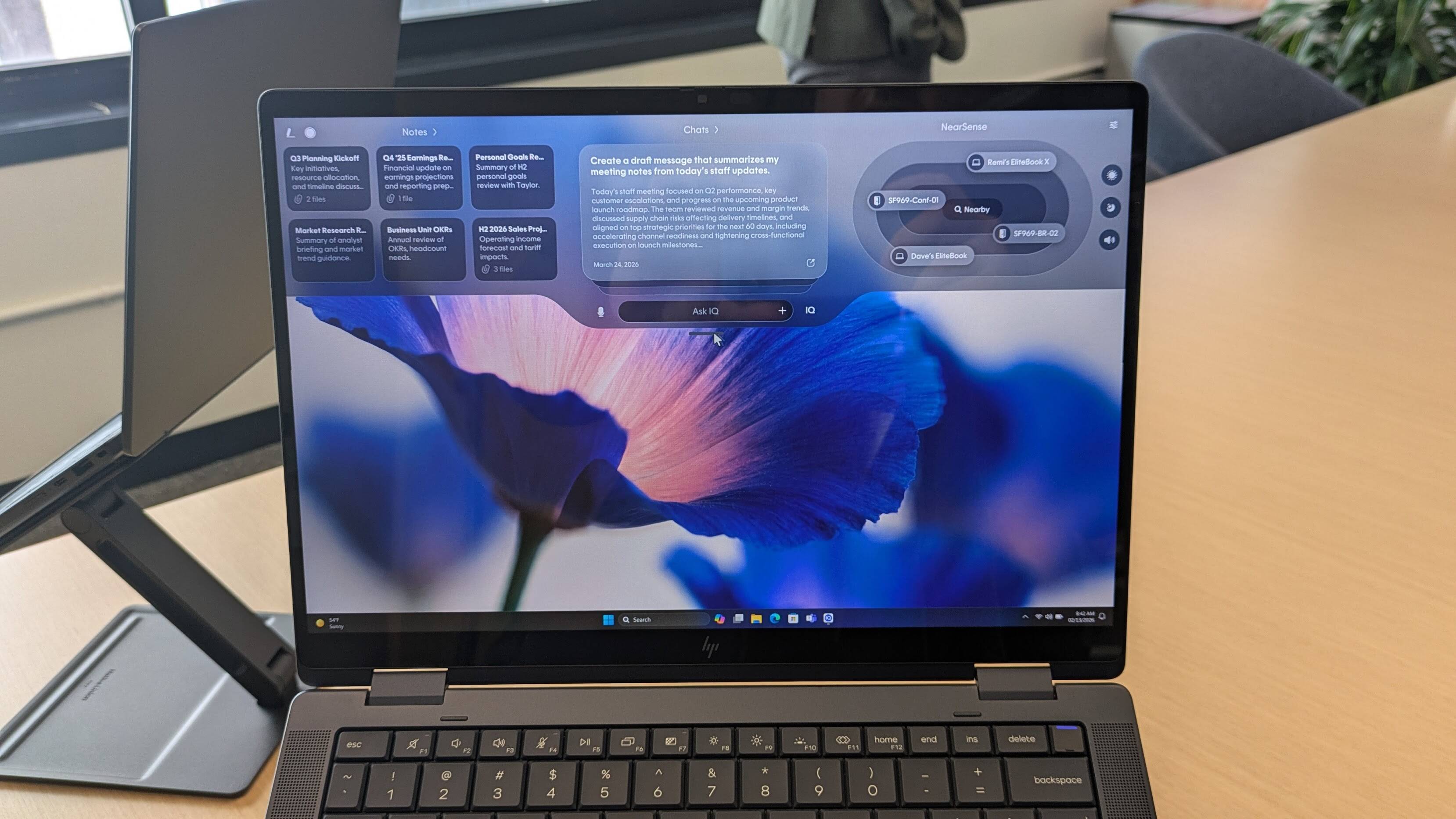
HP IQ: A Technical Deep Dive
Executive summary
HP IQ is an integrated local AI and collaboration ecosystem deployed on 2026-generation EliteBook and ProBook "AI PCs," utilizing a localized version of OpenAI’s gpt-oss-20b model to provide document analysis, meeting summarization, and proximity-aware file sharing.
- Model Core: Utilizes
gpt-oss-20b, a 20-billion parameter Large Language Model (LLM) optimized for local inference. - Hardware Threshold: Requires a minimum of 24GB RAM and 2026-era NPU-equipped silicon.
- Sensor Fusion: Employs "NearSense" technology, a proprietary stack combining Wi-Fi, Bluetooth, and acoustic room mapping to facilitate sub-meter proximity detection.
- Privacy Model: Features a "local-first" architecture where audio recordings for meeting summaries are processed in volatile memory without persistent audio storage or full transcripts.
Technical architecture
The HP IQ architecture represents a shift from cloud-dependent assistants toward a hybrid-edge computing model. It functions as a persistent intelligence layer sitting between the OS and user applications.
Local Inference Engine
The heart of the system is the gpt-oss-20b model. Developed by OpenAI and finalized in September 2025, this model is designed for high-throughput local execution.
- Parameter Count: 20 billion.
- Quantization: While not explicitly detailed in the announcement, the requirement for 24GB of RAM suggests a 4-bit or 5-bit quantization (likely GGUF or EXL2 format) to fit the model weights and a functional KV cache within a shared memory architecture (UMAs common in modern laptops).
- Hybrid RAG (Retrieval-Augmented Generation): The system allows users to "grant access to documents." This implies a local vector database (likely utilizing the laptop's NPU for embedding generation) to perform semantic searches over sensitive local files without data egress.
The NearSense Stack
NearSense is HP’s implementation of spatial awareness. It bypasses the traditional limitations of simple Bluetooth "handshaking" by utilizing a multi-modal sensor fusion:
- Acoustic Mapping: Uses the laptop's microphone array to detect room resonances and determine if a user is behind a physical barrier (like a glass door).
- Signal Triangulation: Combines Wi-Fi and Bluetooth Low Energy (BLE) RSSI (Received Signal Strength Indicator) values to create a proximity list of other IQ-enabled devices.
- Poly Integration: This stack is natively integrated with HP Poly Studio Video Bars, allowing for automatic session handoff (log-ins) via proximity rather than manual pairing codes.
Intelligence Layer & Connectivity
The system uses a "Polling Logic" for real-time data. While the base model is static (knowledge cutoff Sept 2025), the application layer can fetch external data (weather, stocks). This is controlled via IT-level JSON policies:
{
  "hpiq_policy": {
    "local_inference_only": true,
    "internet_polling": false,
    "allowed_realtime_sources": ["internal_stock_api"],
    "audio_persistence": "volatile_only"
  }
}
Performance analysis
The introduction of a 20B parameter model on a laptop marks a significant escalation in local compute requirements. Previous "AI PCs" often relied on 7B or 3B models.
Comparison: Local LLM Performance
Note: Benchmarks for gpt-oss-20b are based on preliminary data provided by HP for the 2026 hardware cycle.
| Metric | HP IQ (gpt-oss-20b) | Standard Copilot (Cloud) | Typical 7B Local Model |
|---|---|---|---|
| Parameters | 20 Billion | Undisclosed (Large) | 7 Billion |
| Inference Latency | Low (Local) | Variable (Network) | Ultra-Low |
| Privacy Tier | Local / Zero-Egress | Cloud Processing | Local / Zero-Egress |
| Context Window | Not yet disclosed | 128k+ | 4k - 32k |
| Min. System RAM | 24 GB | 8 GB | 16 GB |
| Knowledge Cutoff | Sept 2025 | Real-time | Varies (Static) |
Hardware Efficiency
HP’s decision to mandate 24GB of RAM reflects the "Memory Wall" in local AI. With memory contributing to 35% of PC build costs, HP IQ is effectively positioning itself as a premium enterprise feature. The 2026 EliteBook series is expected to utilize high-bandwidth memory (LPDDR5x or newer) to ensure the gpt-oss-20b model remains responsive during multi-tasking.
Technical implications
1. The Death of the "Transcription"
A notable technical choice is the omission of full transcripts in the Meeting Agent. From a data engineering perspective, this suggests HP is prioritizing "summarization-on-the-fly." The audio is likely fed into a sliding window buffer, converted to text tokens, and summarized by the LLM in real-time, with the raw audio and intermediate text discarded to mitigate legal and privacy liabilities.
2. Ecosystem Lock-in via NearSense
By tying file sharing and meeting room logins to proprietary sensor fusion (NearSense), HP is creating a hardware-level "moat." While it mimics Apple’s AirDrop, the integration with Poly conferencing hardware suggests a push for vertical integration in the "Pro-AV" space.
3. Android Cross-Compatibility
The planned expansion to Android indicates that HP is developing a cross-platform "IQ Service" that likely uses a standardized protocol for proximity detection, potentially leveraging the upcoming "AI PC" standards for cross-device LLM handoffs.
Limitations and trade-offs
- RAM Tax: The 24GB requirement excludes the vast majority of existing business fleets, making HP IQ a "refresh-only" feature for 2026.
- Static Knowledge: With a September 2025 training cutoff, the model is inherently "blind" to recent events unless internet polling is enabled, which introduces potential security holes.
- Acoustic Privacy: The use of microphones for "room mapping" to detect users through glass doors is technically impressive but introduces significant "creep factor" concerns regarding persistent environmental monitoring.
- No Persistent Transcripts: While a privacy win, the inability to access a full transcript may frustrate users who need to verify the AI's summary against the actual conversation.
Expert perspective
The launch of HP IQ signals that the "AI PC" era is moving past the marketing gimmick phase into the Heavyweight Edge Inference phase. By opting for a 20B parameter model, HP is betting that users value local reasoning capability over the lightweight speed of 7B models.
The partnership with OpenAI to provide an "OSS-style" model (gpt-oss-20b) is a strategic move. It gives HP a "GPT-grade" brand name while maintaining the security of local execution. This is a direct shot at Microsoft Copilot, which, despite its integration, still relies heavily on cloud processing for complex reasoning tasks. For the Small Business (SMB) sector, this provides a "private-cloud" experience without the need for an expensive server rack.
Technical FAQ
How does this compare to Microsoft Copilot on benchmarks?
Official head-to-head benchmarks are not yet disclosed. However, gpt-oss-20b is designed for lower latency in document summarization because it avoids the round-trip network time of Copilot. In local inference tasks, expect higher tokens-per-second on dedicated 2026 NPU silicon compared to current-gen cloud-hybrid solutions.
Is it backwards-compatible with 2024/2025 AI PCs?
No. HP has explicitly stated that the early access program and initial rollout require 2026 EliteBook or ProBook models with a minimum of 24GB of RAM. Older hardware lacks the specific NPU performance and memory capacity required to run the gpt-oss-20b weights efficiently.
Can the LLM be swapped for other models (e.g., Llama 3 or Mistral)?
The HP IQ application is currently hard-coded to the OpenAI gpt-oss-20b model. While tools like Ollama allow for model swapping on these machines, the specific "Meeting Agent" and "NearSense" features are proprietary to the HP IQ layer and do not currently support third-party model hooks.
Sources
All technical specifications, pricing, and benchmark data in this article are sourced directly from official announcements. Competitor comparisons use publicly available data at time of publication. We update our coverage as new information becomes available.