
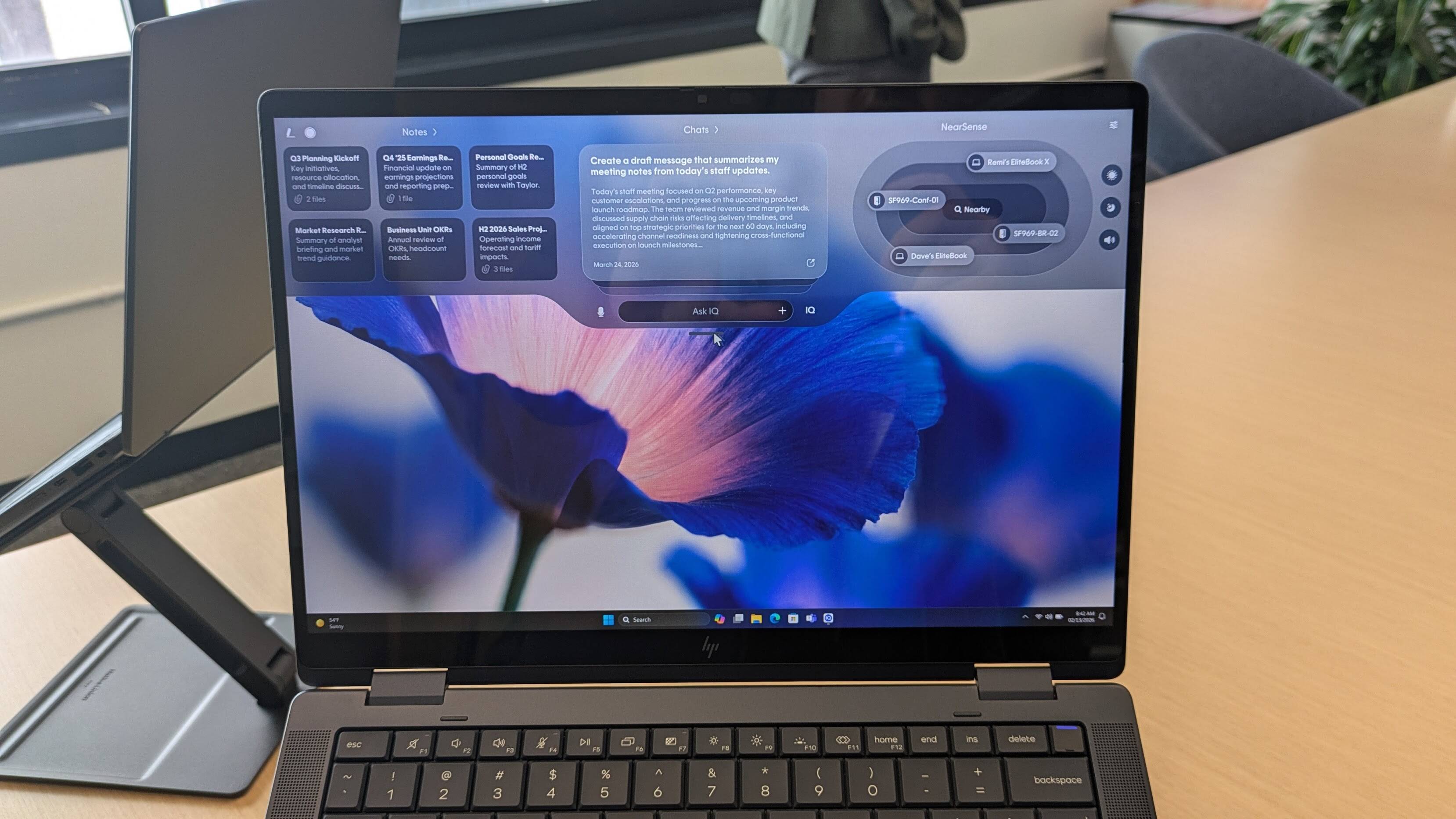
- What: HP IQ, a local AI intelligence layer and collaboration application.
- Hardware: Exclusive to 2026 HP EliteBook and ProBook "AI PC" models.
- Key Features: On-device OpenAI LLM integration, in-person meeting transcription, and context-aware automation.
- Availability: Early access program begins in Spring 2026.
HP Inc. is bringing OpenAI’s large language models directly onto its hardware with the launch of "HP IQ," a new on-device AI application designed to capture the small business and enterprise market. Announced as a "device-level intelligence layer," HP IQ will ship with the company's 2026 EliteBook and ProBook "AI PC" models, allowing users to summarize in-person meetings and automate workflows locally rather than relying exclusively on cloud-based processing.
The move marks a significant escalation in the "AI PC" arms race, as HP seeks to differentiate its hardware from competitors like Apple and Microsoft by offering a more deeply integrated, local-first AI experience. According to reports from The Register, the application is designed to act as a central hub for collaboration, capable of chatting with users, sharing files, and providing a comprehensive breakdown of everything discussed in a physical conference room.
Local Intelligence for the Small Business Sector
HP IQ represents a shift away from generic cloud chatbots toward context-aware, local assistance. By utilizing OpenAI’s LLMs on-device, HP aims to address the privacy and security concerns that have previously hindered small businesses from adopting generative AI.
As reported by Ground News, HP IQ functions as a device-level layer that provides automation and assistance based on the user's specific local context. One of the most touted features is the ability to record and analyze in-person meetings. The software can reportedly distinguish between different speakers in a room and provide a summarized transcript of action items, a feature HP hopes will make its laptops indispensable for office-based collaboration.
To support these intensive AI workloads, HP is leveraging high-performance hardware. Technical specifications for the upcoming "AI PC" SKUs include Intel’s next-generation processors, such as the Core Ultra 7 268V, paired with at least 32GB of RAM. In collaboration with Intel, HP has benchmarked these machines for local LLM performance, specifically measuring "tokens per second" for tasks like real-time text translation and document analysis.
Challenging the Ecosystem Giants
The introduction of HP IQ places the PC manufacturer in direct competition with Microsoft’s Copilot and Apple Intelligence. While Microsoft has integrated AI across the Windows 11 operating system, HP’s approach focuses on a proprietary software layer that is optimized specifically for its workstation and business-grade hardware.
According to HP’s official newsroom, the company claims to be "the only manufacturer to develop an AI platform for workstations with built-in generative AI trust for LLM development." This "trust" refers to the ability for businesses to leverage proprietary data for AI training and inference without compromising security—a common pitfall for cloud-only AI solutions.
The partnership with NVIDIA and Intel further reinforces this hardware-centric AI strategy. During previous industry events, NVIDIA CEO Jensen Huang noted that the future of software involves "large language models, connected into other LLMs," a vision HP is now implementing by stuffing OpenAI’s models directly into the chassis of its laptops.
Impact: A New Standard for Enterprise Productivity
For developers and small business owners, the arrival of HP IQ signals a change in how daily work is managed. The focus on "local-first" AI means that critical business data—such as meeting transcripts and internal files—does not necessarily have to leave the device to be processed by a powerful LLM.
For users, this means lower latency for AI tasks and the ability to use sophisticated automation features even without a stable internet connection. However, the requirement for 2026-model hardware creates a clear upgrade cycle, forcing businesses to invest in new "AI PC" designated SKUs to access these features.
"This changes how small businesses view the laptop; it is no longer just a tool for input, but an active participant in the meeting room," according to industry analysts cited by The Register.
The social impact of "always-on" meeting recording is also expected to be a point of discussion. With HP IQ designed to "break down everything people said in the conference room," the dynamic of the physical office could shift as every verbal commitment or brainstorm becomes a searchable, digital record.
What’s Next
HP is scheduled to launch an early access program for HP IQ later this northern spring. This initial rollout will be limited to the 2026 EliteBook and ProBook models. While pricing for the specific HP IQ software layer has not been disclosed separately from the hardware, it is expected to be a core value proposition of the 2026 "AI PC" lineup.
As the program expands, HP is expected to release further benchmarks comparing the on-device OpenAI performance against cloud-based alternatives. The industry will be watching closely to see if local LLMs can truly match the versatility of their cloud-bound counterparts while maintaining the privacy standards small businesses demand.