
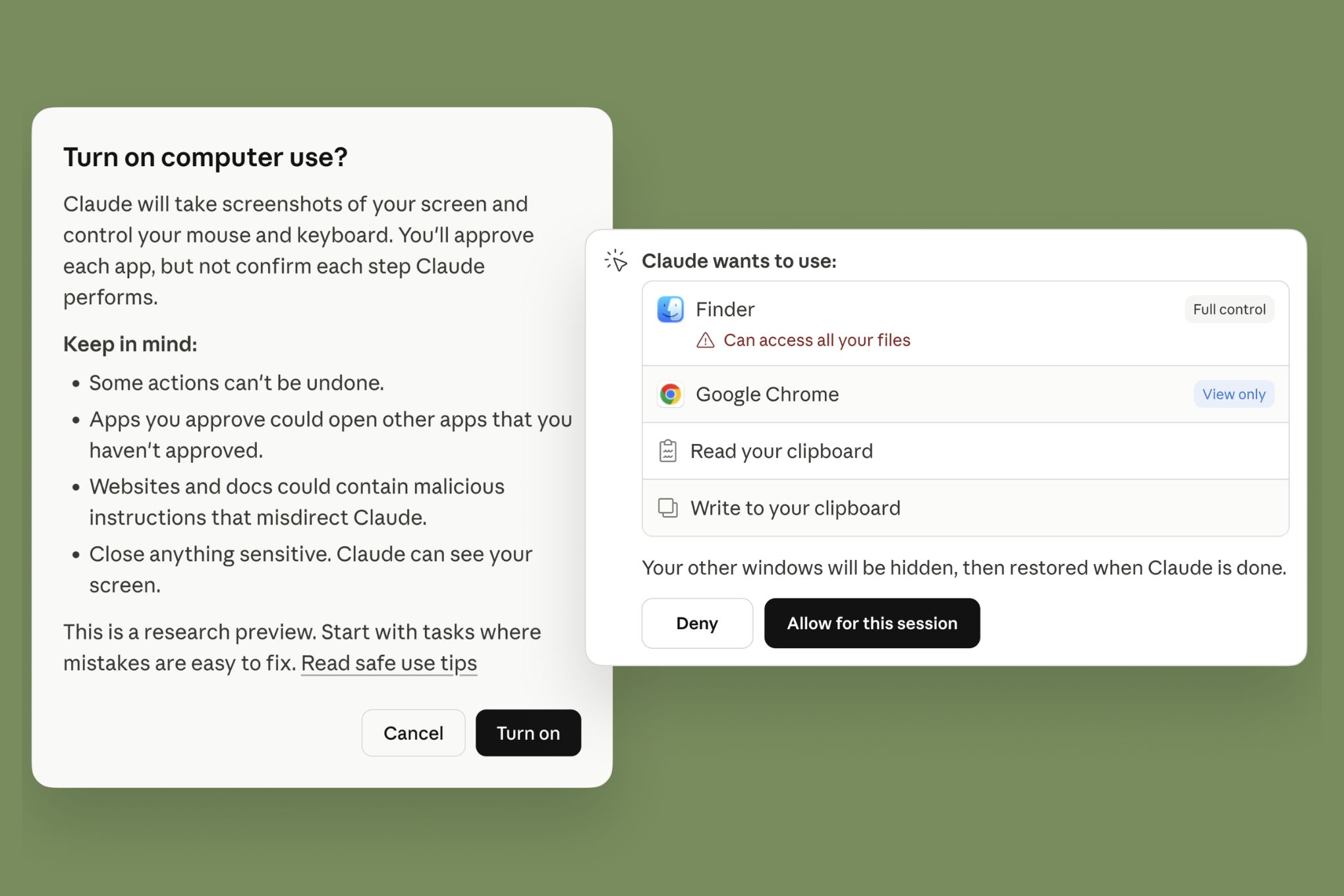
- What: Anthropic has updated Claude with autonomous computer usage capabilities for its "Code" and "Cowork" AI tools.
- Platforms: The research preview is currently exclusive to macOS devices.
- Access: Available immediately to users with Claude Pro and Claude Max subscriptions.
- Key Feature: The "Dispatch" function allows users to assign tasks to their computer via a mobile app while away from their desks.
- Requirement: Users must run the Claude desktop app on macOS paired with the Claude mobile app.
In a massive leap toward fully autonomous AI agents, Anthropic has announced that its Claude AI can now take direct control of a user’s computer to execute complex workflows. Released as a research preview on March 24, 2026, the new capabilities integrated into "Claude Code" and "Claude Cowork" allow the AI to move the cursor, click buttons, type text, and navigate through apps and browsers to complete tasks with "no setup required."
This update represents a critical shift in the AI industry, moving from chatbots that simply generate text to "action-oriented agents" that operate software as a human would. According to Anthropic’s official announcement, the feature is designed to bridge the gap between human intent and technical execution, allowing the AI to handle everything from complex coding tasks to administrative spreadsheets without constant human oversight.
The Dawn of the Autonomous Desktop Agent
The new functionality allows Claude to perform a wide array of actions that were previously restricted to manual human input. According to reporting from The Verge, the AI can now automatically open files, utilize web browsers, interact with third-party applications, and run developer tools. This builds upon the "computer use" capabilities Anthropic first introduced to its Claude 3.5 Sonnet model in 2024, but this latest iteration integrates the technology directly into specialized tools for programmers and enterprise workers.
Technically, the system operates through a hierarchy of execution. When tasked with a mission, Claude prioritizes "connectors" to supported services, such as Slack and Google Workspace. These direct API-style integrations allow for faster, more reliable data transfer. However, if a direct connector is unavailable, Claude can fall back on its most revolutionary capability: direct UI control. In this mode, the AI perceives the display, calculates mouse coordinates, and executes clicks and keystrokes to navigate any piece of software, regardless of whether that software has an official AI integration.
'Dispatch': Remote Productivity from Your Phone
Perhaps the most significant addition to this rollout is "Dispatch," a cross-device feature that enables remote task management. According to Anthropic, Dispatch allows a user to send a task to Claude via their smartphone, which then triggers the Claude desktop app on their Mac to begin working.
This means a developer could be away from their desk and use their phone to tell Claude to "start the build process and fix any linting errors in the new repository." The AI agent will then wake the computer (provided the app is running), open the IDE, navigate the file system, and execute the commands. Anthropic notes that this feature works "especially well" for maintaining productivity during gaps in the workday, effectively turning the user’s computer into a 24/7 autonomous workstation.
Security, Permissions, and Technical Guardrails
Given the inherent risks of an AI controlling a personal or professional computer, Anthropic has implemented several safety layers. The company emphasizes that Claude will "always ask for your explicit permission" before it begins exploring a file system, scrolling through browsers, or clicking on screen elements.
"We’re sharing it early because we want to learn where it works and where it falls short," the company stated in its announcement blog. Anthropic acknowledges that while the system is powerful, it is not yet infallible. Complex tasks may occasionally require multiple attempts, and the company warned that "working through your screen is slower than using a direct integration."
For now, the feature is strictly a research preview. Access is limited to the highest tiers of Claude’s service—Claude Pro and Claude Max—suggesting that the high computational cost and experimental nature of the feature are being reserved for power users who can provide technical feedback.
Impact: What This Means for the AI Industry
This launch places Anthropic at the forefront of the "Agentic AI" race, a competitive landscape that includes heavyweights like OpenAI and Microsoft. By enabling Claude to use a computer just like a human, Anthropic is bypassing the need for every software developer in the world to build custom AI plugins. Instead, the AI simply learns to use the existing user interface.
For developers using "Claude Code," the impact is immediate. The AI can now perform "end-to-end" tasks—writing the code, saving the file, opening the terminal, running the test suite, and even checking documentation in a browser if an error occurs. For "Claude Cowork" users, the AI becomes a virtual administrative assistant capable of filling in spreadsheets and managing communications across different platforms like Slack.
As noted by CNBC, this move signals a broader push by Anthropic to turn AI into a proactive partner rather than a reactive tool. "You can now message Claude a task from a phone, and the AI agent will then complete that task," effectively decoupling the worker from their physical desk.
What’s Next: The Road Beyond macOS
While the current research preview is locked to macOS, Anthropic has hinted that this is only the beginning. The phrase "for now" regarding macOS exclusivity suggests that Windows and perhaps Linux support could be on the horizon.
As the AI community tests the limits of Claude’s computer control, the focus will likely shift toward reliability and speed. As Anthropic mentioned, direct UI manipulation is currently slower than API-based tasks. Future updates will likely aim to optimize the AI’s "visual reasoning" to make mouse movements and screen interactions near-instantaneous.
For the first time, the "AI agent" is no longer a theoretical concept trapped in a chat box—it is an active participant in the operating system.