
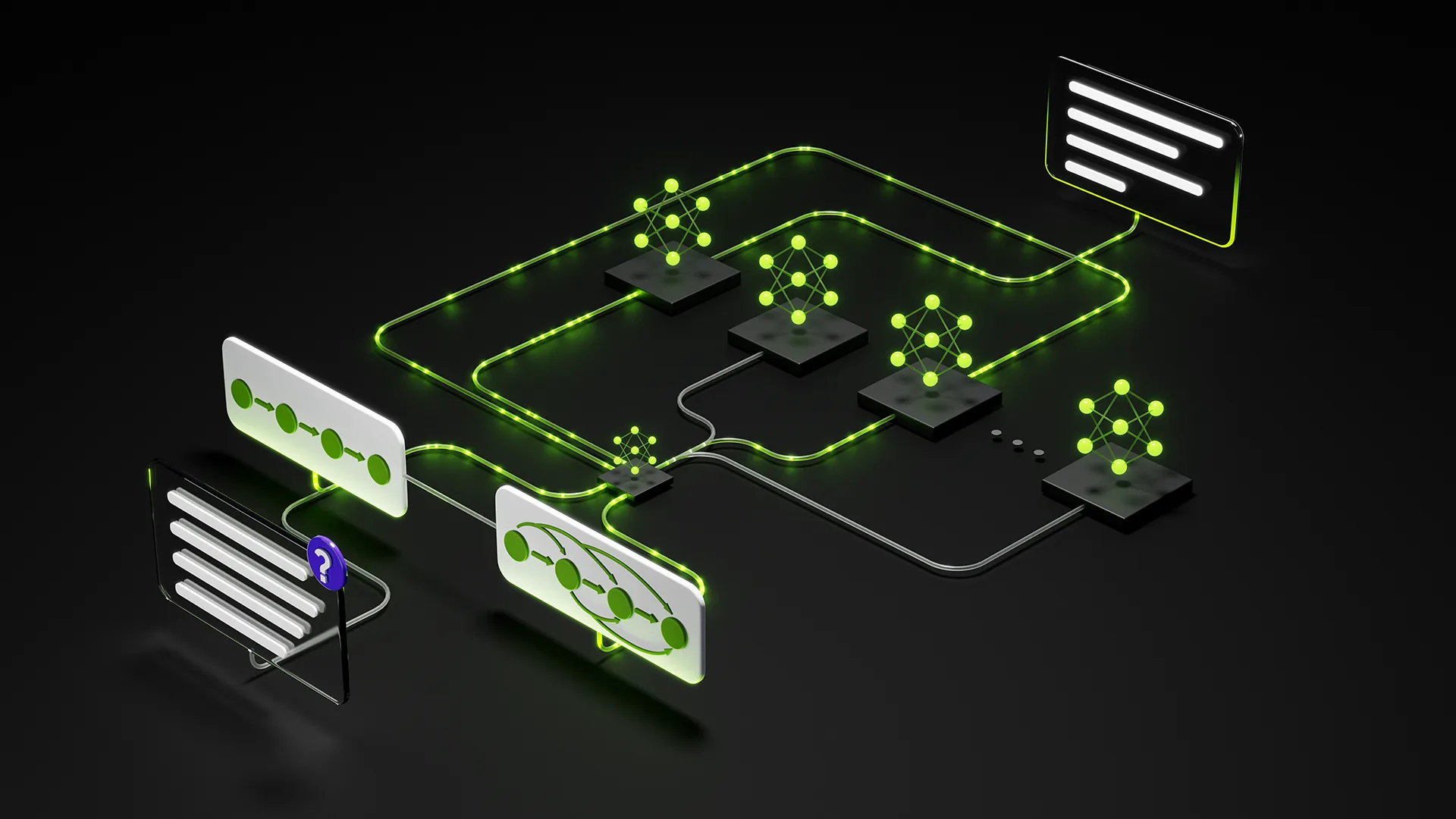
NVIDIA Reveals Nemotron 3: 5x Faster AI Agent Stack for Blackwell GPUs
- What: NVIDIA introduced the Nemotron 3 family, a unified stack of specialized models for agentic AI systems.
- Key Specs: Nemotron 3 Super features a 1-million-token context window and a hybrid Mamba-Transformer MoE architecture.
- Hardware: Optimized for NVIDIA Blackwell GPUs using NVFP4 precision to deliver 5x higher throughput.
- Innovation: Includes a "thinking budget" to bound chain-of-thought reasoning costs and latency.
At GTC 2026, NVIDIA announced the launch of Nemotron 3, a comprehensive suite of AI models specifically engineered to build and scale "agentic" AI systems. By utilizing a hybrid architectural approach and optimization for the latest Blackwell hardware, the new model family aims to solve the performance bottlenecks and "context explosion" currently hindering complex multi-agent workflows.
The Engine of Agentic AI: Nemotron 3 Super
The flagship of the announcement is NVIDIA Nemotron 3 Super, an open hybrid mixture-of-experts (MoE) model designed for long-context reasoning. While the model maintains a massive knowledge base, it is designed for efficiency, activating only 12 billion parameters per inference pass.
According to NVIDIA's technical announcement, the model utilizes a hybrid architecture combining Mamba and Transformer layers. This design, coupled with multi-token prediction and NVFP4 precision, allows Nemotron 3 Super to achieve up to 5x higher throughput than previous-generation models when running on Blackwell GPUs.
NVIDIA is positioning Nemotron 3 Super as a solution to the "thinking tax"—the high computational cost associated with chain-of-thought (CoT) reasoning. To address this, the company introduced a "configurable thinking budget." This feature allows developers to set boundaries on how much reasoning a model performs, ensuring that latency and operational spend remain predictable even during continuous, complex agent tasks.
Optimized Performance and Latent MoE
NVIDIA's data highlights that Nemotron 3 Super currently sits in the "most attractive efficiency quadrant" of the Artificial Analysis Intelligence Index for open-weight models under 250 billion parameters. It matches the intelligence scores of leading alternatives while providing significantly higher output throughput per GPU.
A key technical driver behind this efficiency is "latent MoE." This technology enables the system to call four expert specialists for the inference cost of only one by compressing tokens before they reach the experts. This optimization is particularly critical for multi-agent systems, which NVIDIA notes can suffer from "context explosion" where token histories grow up to 15 times faster than standard chat applications.
A Specialized Ecosystem for Voice and Safety
Beyond the core reasoning model, the Nemotron 3 family includes several specialized components designed to handle real-world multimodal data:
- Nemotron 3 Content Safety: A low-latency model for multimodal and multilingual moderation, providing safety guardrails across different languages and media types.
- Nemotron 3 VoiceChat: Currently in early access, this model is designed for natural, full-duplex voice interactions with minimal latency, allowing for more human-like digital assistants.
- Nemotron RAG: A suite of tools including the NVIDIA Llama Nemotron Embed VL and Rerank VL, which enable agents to generate embeddings and reorder candidates based on visual content as well as text.
- Nemotron 3 Nano Omni: An upcoming model focused on enterprise-grade multimodal understanding for smaller-scale or on-device applications.
To support these models, NVIDIA is providing the NeMo Evaluator and Agent Toolkit. These tools allow developers to benchmark and optimize agentic systems from end-to-end, facilitating the transition from experimental builds to production-grade deployments.
Impact on the AI Industry
This release marks a significant shift in how enterprise AI is structured, moving away from monolithic "jack-of-all-trades" models toward a "unified agentic stack" of specialists. For developers, the combination of high-throughput Blackwell optimization and the "thinking budget" reduces the primary barriers to deploying complex agents: cost and unpredictability.
"Agentic AI is an ecosystem where specialized models work together to handle planning, reasoning, retrieval, and safety guardrailing," the company stated in its technical blog. By providing the models, the training recipes, and the evaluation tools in a single ecosystem, NVIDIA is tightening its grip on the full AI development lifecycle, from silicon to software.
The ability to process 1 million tokens of context while maintaining high throughput could fundamentally change how industries like legal, medical research, and software engineering utilize AI to analyze massive datasets in real time.
What’s Next
While Nemotron 3 Super and the Content Safety models are the current focus, NVIDIA has a clear roadmap for the remainder of the family. The Nemotron 3 Ultra, which NVIDIA claims will offer the "highest reasoning accuracy and efficiency among open frontier models," is labeled as "coming soon." Similarly, the Nemotron 3 Nano Omni is expected to debut shortly to address the needs of enterprise-grade multimodal understanding.
Developers can currently access Nemotron 3 Super and explore the early access versions of VoiceChat through the NVIDIA NeMo platform.
Sources
All technical specifications, pricing, and benchmark data in this article are sourced directly from official announcements. Competitor comparisons use publicly available data at time of publication. We update our coverage as new information becomes available.