
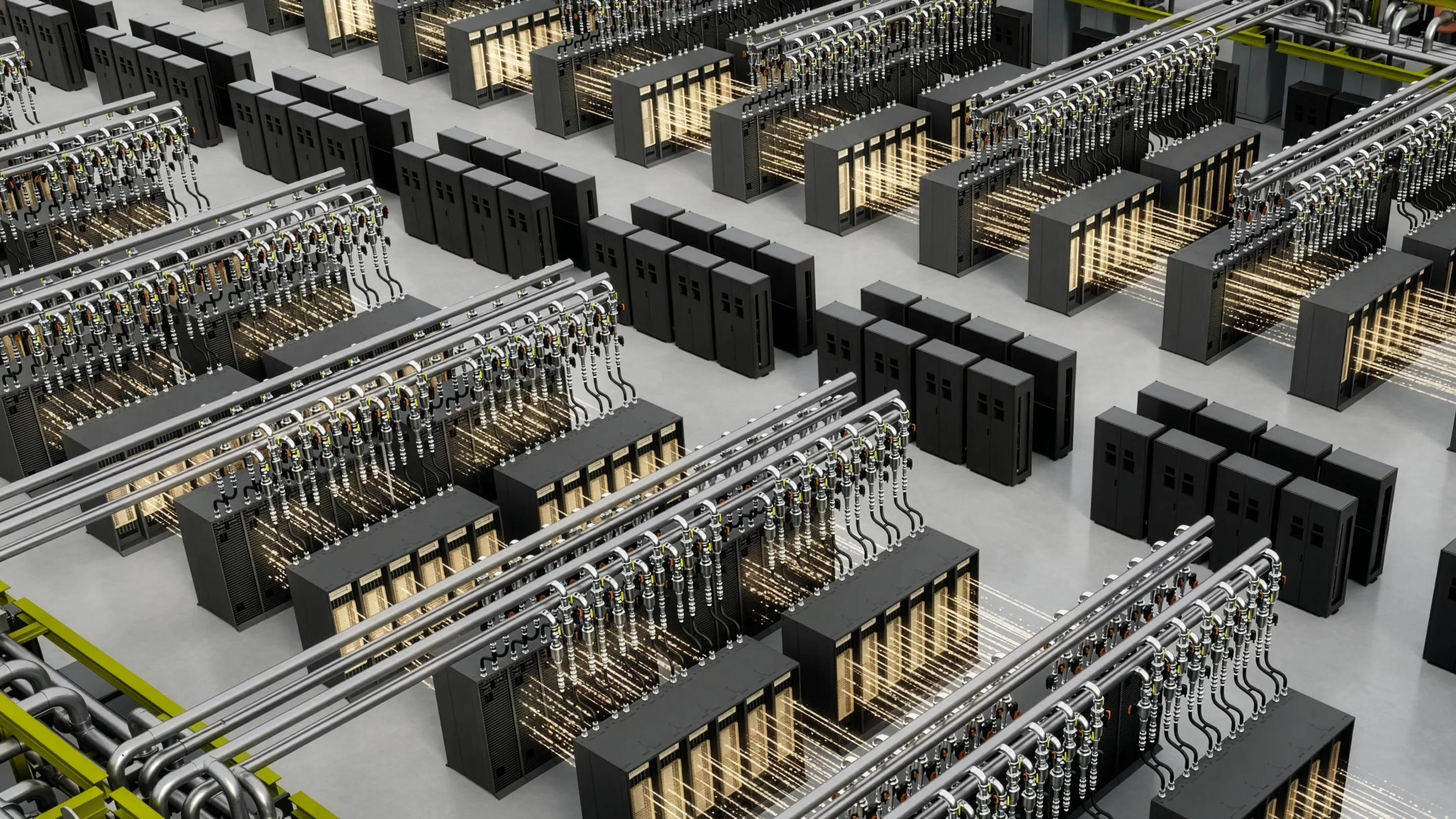
- What: NVIDIA redefines AI data centers as "Token Factories" focusing on performance per watt.
- Key Formula: Revenue = (Tokens per Watt) × (Available Gigawatts).
- Technology: NVIDIA Blackwell GB200 and the upcoming Vera Rubin platform.
- Efficiency: The Vera Rubin platform aims for a 10x increase in inference performance per watt.
- Economic Impact: Next-generation systems are projected to reduce token generation costs by 90%.
NVIDIA is fundamentally shifting the economic model of artificial intelligence by repositioning data centers as "token factories" where energy efficiency serves as the primary driver of profitability. At GTC 2026, CEO Jensen Huang introduced a new mathematical framework for the AI era, asserting that revenue is now directly tied to a company’s ability to convert raw electricity into "revenue-generating intelligence."
This strategic pivot comes as the industry faces severe physical limitations, with Huang identifying power as the "ultimate constraint" for modern infrastructure. By maximizing performance per watt, NVIDIA aims to help enterprises bypass traditional scaling bottlenecks and treat energy as a direct revenue multiplier rather than a operational cost center.
The Rise of the Token Factory
According to NVIDIA’s official developer blog, the modern AI data center has evolved beyond simple storage or compute; it has become a factory that produces tokens—the basic units of large language model (LLM) outputs. This "Token Factory" operates within the hard limits of the energy ecosystem, where access to land and power determines the ceiling of a company’s growth.
To address these constraints, NVIDIA is prioritizing "performance per watt" as the defining metric for AI infrastructure. In this new paradigm, the efficiency with which a system converts power into tokens determines the total throughput and, consequently, the revenue potential of the facility. As reported by FinancialContent, Huang’s formula for the modern CEO—Revenue = (Tokens per Watt) × (Available Gigawatts)—forces a realization that every milliwatt saved is a token earned.
Breaking Down the Vera Rubin Platform
A centerpiece of this strategy is the announcement of the next-generation Vera Rubin platform. While the Blackwell architecture currently leads the market, the Vera Rubin platform is set to radically alter the cost structure of AI inference.
According to reports from GTC 2026, the Vera Rubin platform promises:
- 10x higher inference performance per watt compared to previous generations.
- 90% reduction in token generation costs, making high-end AI intelligence significantly more accessible for mass-market applications.
- Optimized integration with NVIDIA InfiniBand networking to ensure that data flows as efficiently as the processors compute.
The Blackwell GB200 NVL72 systems already lay the groundwork for this transition. These systems are specifically tailored to maximize token throughput per watt, providing high efficiency for both massive total throughput and low-latency responses. By pairing Blackwell chips with InfiniBand networking, NVIDIA claims to have created a highly tuned environment that minimizes energy waste during the communication phase of distributed AI workloads.
The New AI Operating Model: Tiered Token Delivery
The shift toward token-based economics is also giving rise to "Tiered AI" delivery models. As noted by RCR Wireless, "AI factories" will soon monetize different levels of intelligence based on the energy cost required to produce them.
Under this model, enterprises can maximize their per-watt performance by choosing different tiers of token quality for different tasks. High-reasoning tasks may utilize more energy-intensive paths, while routine queries utilize high-efficiency "commodity" tokens. This allows operators to optimize their "available gigawatts" to produce the highest possible financial return across a diverse range of AI services.
Impact on Developers and the Industry
For developers and enterprise leaders, this news represents a shift in how AI projects are budgeted and scaled. Instead of focusing solely on the number of GPUs or the size of a model, the focus is shifting toward the energy footprint of the inference cycle.
"This changes how developers will build," according to industry analysts. "For the first time ever, the cost of an AI application is being linked directly to the physical efficiency of the hardware's power conversion."
For the broader industry, NVIDIA's focus on the 90% cost reduction for token generation could trigger a massive wave of AI monetization. By lowering the floor of entry for high-performance inference, the Vera Rubin platform may enable $1 trillion in AI monetization, turning previously unprofitable AI agents into high-margin products.
What’s Next
NVIDIA's roadmap suggests a relentless pursuit of the power-to-revenue ratio. As data center operators struggle to secure new power grid connections, the competition will move from "who has the most chips" to "who can produce the most tokens with the power they already have."
The Blackwell GB200 systems are currently the standard for this high-efficiency approach, but the industry is now looking toward the formal rollout of the Vera Rubin platform to hit the 10x performance-per-watt milestone. As these "Token Factories" become the backbone of the global economy, NVIDIA's mathematical formula may become the standard KPI for every technology executive in the AI era.