
Executive Summary
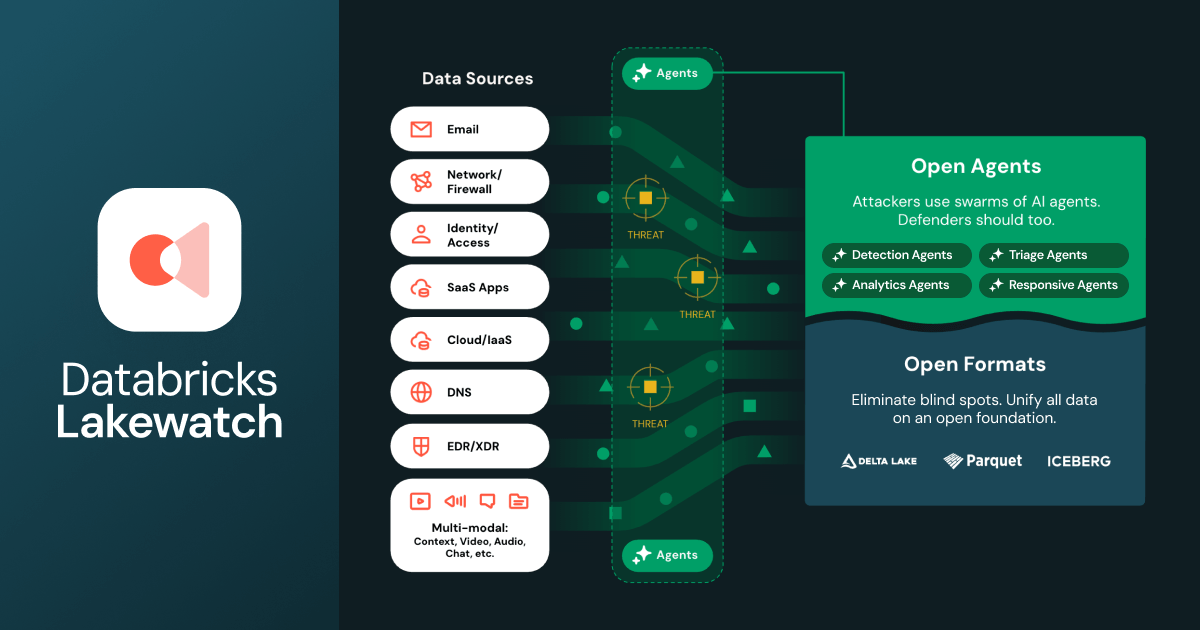
- Technical Summary: Lakewatch is an AI-native security information and event management (SIEM) platform built on the Databricks Lakehouse architecture that utilizes autonomous agents for multi-modal threat detection, automated triage, and incident response across unified security and business datasets.
- Data Convergence: The system breaks down traditional silos by unifying security, IT, and business data into a single, governed environment, leveraging open data formats to eliminate vendor lock-in.
- Agentic Defense: It is specifically engineered to counter "agent attackers"—sophisticated, AI-driven threats—by deploying defensive security agents that automate complex SOC (Security Operations Center) workflows at scale.
- Market Position: Currently in Private Preview, Lakewatch positions Databricks as a direct competitor to legacy SIEM providers by offering a decoupled storage and compute model optimized for massive-scale AI analysis.
Technical Architecture: The Agentic Lakehouse
Lakewatch represents a fundamental shift in SIEM architecture, moving away from the proprietary, indexed-search silos of the last decade toward a "data-first" security model. Under the hood, Lakewatch is built upon the Databricks Data Intelligence Platform, utilizing several core components to enable its "agentic" capabilities.
1. Unified Open Data Layer
Traditional SIEMs often require data to be moved or transformed into proprietary formats, leading to high "egress" and "ingestion" costs. Lakewatch utilizes open formats (specifically Delta Lake, based on the context of the Databricks ecosystem) to allow organizations to ingest and retain unprecedented volumes of multi-modal data.
- Multi-modal Ingestion: Unlike legacy systems that primarily handle structured logs, Lakewatch is designed to analyze multi-modal data, which can include unstructured text, system telemetry, and complex business data types.
- Single Governed Environment: By utilizing a unified governance layer (Unity Catalog), security teams can apply fine-grained access controls across security and non-security data (like HR or financial records) to provide context for threat detection without compromising data privacy.
2. The Agentic Reasoning Engine
The "agentic" nature of Lakewatch is its most significant architectural differentiator. While traditional SIEMs rely on static correlation rules (e.g., "If 5 failed logins, then alert"), Lakewatch deploys autonomous security agents.
- Autonomous Triage: These agents do not just flag anomalies; they reason about them. They can autonomously query different data tables, correlate a login failure with a simultaneous change in a cloud configuration, and determine the severity of an incident.
- Threat Hunting: Agents can be tasked with "hunting" missions, where they proactively scan the lakehouse for patterns associated with new zero-day vulnerabilities or sophisticated "agentic" attackers that utilize AI to mask their movements.
3. Programmable Defensive Agents
Developers and security engineers can deploy these agents to automate response workflows. This moves the SIEM from a "system of record" to a "system of action." The agents are designed to handle the "massive scale" of modern enterprise telemetry, which would overwhelm human analysts.
Performance Analysis
While specific benchmark figures (such as queries per second or precise latency in milliseconds) have not yet been disclosed in the initial announcement, the architectural shift implies several performance advantages over traditional SIEM competitors like Splunk or Microsoft Sentinel.
Benchmark Comparison (Architectural)
| Feature | Legacy SIEM | Databricks Lakewatch |
|---|---|---|
| Storage Format | Proprietary / Indexed | Open (Delta Lake / Parquet) |
| Detection Logic | Rule-based (Regex/SQL) | Agentic (AI-driven reasoning) |
| Data Types | Primarily Structured Logs | Multi-modal (Logs, Text, Telemetry) |
| Scalability | Cost-prohibitive at Petabyte scale | Cloud-native Lakehouse scaling |
| Vendor Lock-in | High (Data is hard to move) | Low (Open data formats) |
| Response Capability | Manual/Playbook-based | Autonomous Security Agents |
Cost and Scale Analysis
The announcement emphasizes "slashing costs." In a technical sense, this is achieved by decoupling compute from storage. In traditional SIEMs, you pay for the "ingest," which forces many companies to delete data after 30–90 days to save money. Because Lakewatch operates on the Lakehouse, storage costs are essentially commodity cloud storage prices, allowing for years of "hot" data retention—critical for identifying long-term persistent threats (APTs).
Technical Implications for the Ecosystem
The launch of Lakewatch signals a new era in the "Data-Security Convergence."
- The Rise of the "Agentic Attacker": Databricks explicitly mentions defending against sophisticated agent attackers. This acknowledges a new threat landscape where malicious actors use LLMs to automate reconnaissance and exploit generation. Lakewatch is the first major security platform to pivot its entire architecture toward "Agent vs. Agent" security.
- SIEM Modernization: For senior developers, this means the security stack is becoming a data engineering problem. Security data is no longer siloed; it is part of the enterprise data mesh.
- Governance as Security: By unifying security, IT, and business data, organizations can now use business context (e.g., "Is this user currently on a flight?") as a primary signal for security alerts, reducing the "false positive" fatigue that plagues modern SOCs.
Limitations and Trade-offs
Despite its innovative approach, Lakewatch faces several technical hurdles:
- Model Hallucination in Security: Relying on AI agents for "triage and response" introduces the risk of hallucinations. A false positive in a security context could lead to the autonomous (and incorrect) isolation of critical production servers.
- Private Preview Constraints: As the product is in Private Preview, the full API surface area and integration capabilities with existing EDR (Endpoint Detection and Response) or SOAR (Security Orchestration, Automation, and Response) tools are not yet disclosed.
- Compute Overheads: While storage is cheap, running autonomous agents (likely powered by high-parameter LLMs) over petabytes of data can incur significant compute costs if not optimized with efficient RAG (Retrieval-Augmented Generation) or filtering layers.
Expert Perspective
Lakewatch is Databricks' "shot across the bow" to the cybersecurity industry. By labeling traditional tools as "stagnating," Databricks is betting that the future of security is not a standalone tool, but a capability built directly into the data platform.
The move to an "agentic" model is technically sound. As the volume of telemetry data outpaces human cognitive capacity, the only way to achieve "massive scale" security is to move from human-in-the-loop to human-on-the-loop systems. Lakewatch provides the infrastructure for this transition, but its success will depend on how effectively its agents can minimize false positives and integrate with the existing "spaghetti" of enterprise security tooling.
Technical FAQ
How does Lakewatch handle data gravity and ingestion from non-Databricks sources?
While specific connectors have not yet been disclosed, the announcement emphasizes "open formats." This suggests that Lakewatch will likely utilize Databricks’ existing ingestion engines (like Delta Live Tables) to pull in data from cloud providers (AWS, Azure, GCP) and SaaS applications via standard protocols.
Is Lakewatch backwards-compatible with existing SIEM rules (e.g., Sigma or YARA)?
The source content does not explicitly state support for Sigma or YARA rules. However, given the focus on "agentic capabilities," it is likely that Lakewatch will either provide a translation layer for these rules or use agents to interpret and apply the logic of existing security standards.
What is the underlying model powering the "Defensive Agents"?
The specific model architecture (e.g., whether it uses Databricks’ DBRX or a third-party LLM) is not yet disclosed. However, the "agentic" description implies a sophisticated reasoning framework capable of tool-use (executing queries and API calls).
How does Lakewatch protect against "Agent-to-Agent" attacks?
Lakewatch is designed to defend against "agent attackers" by utilizing its own defensive agents to monitor for patterns of automated, AI-driven exploitation. The unification of business and security data allows the defensive agents to spot behavioral anomalies that simple pattern-matching rules would miss.