
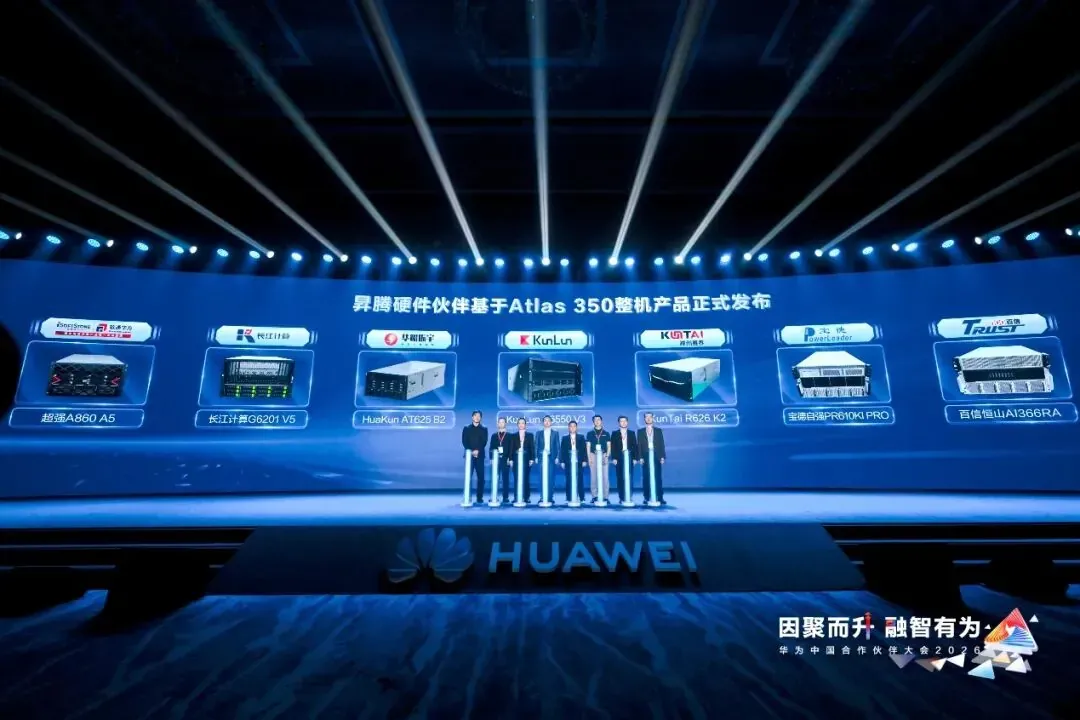
- What: Huawei unveiled the Atlas 350 AI accelerator, powered by the Ascend 950PR chip.
- Performance: Reportedly delivers 1.56 PFLOPS of FP4 compute, a 2.8x increase over Nvidia’s H20.
- Memory: Features up to 112GB of proprietary "HiBL 1.0" High Bandwidth Memory (HBM).
- Price: Reportedly priced at approximately 111,000 Yuan (~$16,000 USD).
- Availability: Part of Huawei’s Q1 2026 release roadmap for the Ascend 950 series.
Huawei has reportedly intensified its challenge to Nvidia’s dominance in the Chinese market with the unveiling of the Atlas 350, a new AI accelerator designed for high-efficiency inference. Announced at the Huawei China Partner Conference 2026 in Shenzhen, the device is built on the in-house Ascend 950PR chip and reportedly delivers 1.56 PFLOPS of FP4 throughput. Huawei claims this performance level is 2.87 times higher than Nvidia’s H20, the current "sanctions-compliant" GPU sold by the American firm in China.
Breaking the FP4 Barrier
The Atlas 350 represents a significant technical pivot for domestic Chinese silicon, specifically targeting the "prefill" stage of AI deployment. According to reports from the conference, the Atlas 350 is the first homegrown Chinese accelerator optimized for FP4 precision. This move mirrors a shift in the global industry; while Nvidia’s current Hopper-era cards like the H20 do not support FP4 natively, the company only recently introduced the format with its next-generation Blackwell architecture.
By utilizing FP4, the Atlas 350 can reportedly handle larger AI models on the same hardware footprint while reducing overall memory requirements. According to Huawei’s Ascend computing business head, Zhang Dixuan, the 1.56 PFLOPS of FP4 throughput is intended to crush the performance of restricted foreign hardware currently available in the region. However, analysts note that because the Nvidia H20 does not support FP4, direct comparisons are based on Huawei's specific optimization for the lower-precision format.
Proprietary HBM and Advanced Interconnects
To circumvent U.S. sanctions that limit access to global semiconductor supply chains, Huawei is reportedly leveraging proprietary memory and packaging technologies. The Atlas 350 features 112GB of "HiBL 1.0," Huawei’s own brand of High Bandwidth Memory. This memory reportedly provides 1.4 TB/s of bandwidth, which is a slight reduction from the 1.6 TB/s maximum capable on the full Ascend 950PR silicon, but remains highly competitive for the region.
The hardware also introduces the "LingQu" interconnect protocol, which supports 2 TB/s of bandwidth. This represents a 2.5x increase over the previous generation Ascend 910 series. Furthermore, the memory access granularity has been optimized, dropping from 512 bytes to 128 bytes to improve efficiency. These technical gains come at a cost of higher power consumption; the Atlas 350 is rated at 600W, which is 200W higher than the Nvidia H20's 400W thermal design power.
Navigating the Sanctions Landscape
The development of the Atlas 350 highlights Huawei’s progress in achieving "self-reliance" despite stringent U.S. export controls. Because Huawei is barred from using TSMC’s Chip-on-Wafer-on-Substrate (CoWoS) packaging—the standard used by Nvidia to stack HBM—the company is reportedly using alternative advanced packaging methods to integrate its proprietary HBM.
While the specific manufacturer of the HiBL 1.0 memory remains unconfirmed, the technology is designed to compete with industry leaders like SK Hynix and Micron. This internal supply chain is critical for Chinese tech firms as they seek to build a domestic ecosystem that is immune to Western trade restrictions.
Market Impact and Pricing
The Atlas 350 is positioned as a cost-effective alternative to Nvidia’s restricted hardware. According to data from BigGo Finance, the NPU is priced at approximately 111,000 Yuan (roughly $16,000). In contrast, Nvidia’s H20 typically sells for between $15,000 and $25,000 in China, depending on the supplier and volume.
For developers and enterprises, this hardware represents a serious attempt to bridge the "CUDA gap." While Nvidia’s CUDA software stack remains the industry standard, Huawei’s aggressive performance claims for the Atlas 350 are intended to incentivize a migration to the Ascend ecosystem. "This changes how domestic developers will view the trade-off between software maturity and raw hardware performance," according to industry reports.
What’s Next
The Atlas 350 is expected to be available as part of Huawei's broader Q1 2026 rollout for the Ascend 950-class silicon. While Huawei has not announced precise shipping dates, the company has historically adhered to its quarterly release targets for its flagship NPU lines.
The industry will be watching closely to see if the Atlas 350 can maintain its claimed 2.8x performance advantage in real-world benchmarks. As Huawei continues to expand its Ascend roadmap, the competition for AI dominance in the Chinese market is likely to shift from a reliance on "nerfed" foreign chips to a battle between local hardware and the established global software ecosystem.