
Replit–Databricks Vibe Coding vs. Traditional BI: Which Should You Choose?
The Replit–Databricks integration is best for teams needing to rapidly build and deploy custom, governed data applications using natural language, while traditional BI tools remain the standard for structured, static reporting and enterprise dashboards.
On March 13, 2026, Replit and Databricks announced a new native connector that brings "vibe coding"—Replit’s term for AI-assisted, natural-language software development—directly into the enterprise data layer. This integration allows product managers, analysts, and developers to build applications that interact with production data without the security risks of moving sensitive datasets out of governed environments.
Feature Comparison Table
| Feature | Replit + Databricks Integration | Traditional BI / Manual Development |
|---|---|---|
| Primary Interface | Natural language prompts (Replit Agent) | SQL, Python, or Drag-and-Drop UI |
| Data Governance | Governed tables/warehouses (No data copying) | Often requires data extraction or CSV exports |
| Development Speed | Minutes (AI-generated scaffolding/UI) | Weeks (Manual coding/Engineering queue) |
| Data Copilot | Databricks Genie (Natural language + citations) | Standard AI chat or manual SQL assistance |
| Deployment | Direct to Databricks Apps | Standard web hosting or BI server |
| Best For | Rapid prototyping of custom data tools | Standardized reporting and dashboards |
Detailed Analysis
Security and Governance
The primary differentiator for this integration is the elimination of "data gravity" issues. Historically, using AI agents to build tools required moving data into the development environment. The Replit–Databricks connector allows the Replit Agent to discover available catalogs, schemas, and tables while the data remains safely inside Databricks. This ensures that the resulting apps inherit existing enterprise access controls and governance.
Development Velocity (The "Vibe Coding" Factor)
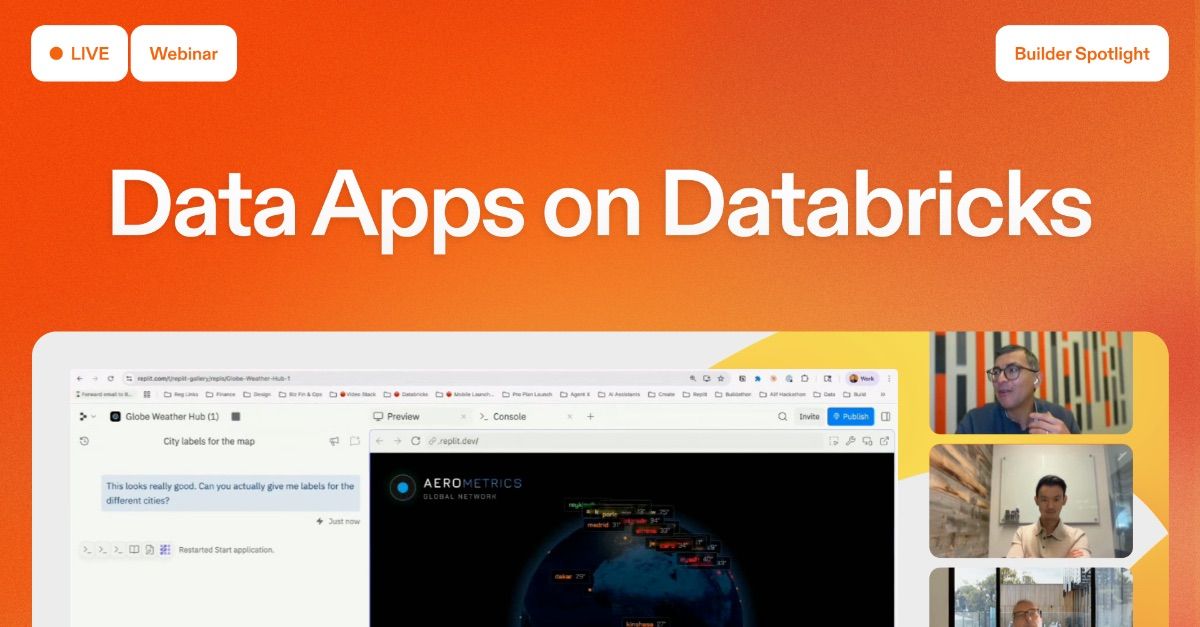
Replit Agent handles the "scaffolding and UI," allowing users to describe an application (e.g., a "3D weather globe powered by Databricks data") and receive a functional tool in minutes. This bypasses the traditional engineering queue, enabling non-technical roles like RevOps or Product Management to ship production-grade tools that previously required a dedicated engineering sprint.
Data Transparency with Databricks Genie
Integrated into the workflow is Databricks Genie, which acts as an in-app data copilot. Unlike black-box AI tools, Genie provides cited tables for its answers. This allows builders to verify exactly which data source an insight was derived from, a critical requirement for enterprise-grade applications.
Pricing and Performance Verdict
| Metric | Detail |
|---|---|
| Pricing Model | Check latest official pricing for Replit and Databricks. |
| Performance | High-scale execution via Databricks warehouses. |
| Cost-Effectiveness | High for custom "one-off" or specialized internal tools. |
Verdict: For organizations already utilizing Databricks for data storage, the integration is a high-value addition. The cost-effectiveness is driven by the reduction in engineering hours—moving from weeks of development to minutes of "vibe coding." However, users should monitor compute costs associated with Databricks warehouses when running these custom apps at scale.
Model Launch Specifics: Is it Worth the Move?
1. Worth upgrading?
If you are currently using Replit for side projects or disconnected prototypes, this is a must-adopt feature. It bridges the gap between "sandbox" coding and "enterprise-grade" application development. If you rely on manual exports (CSVs) to build data tools, this integration offers a significant security and efficiency upgrade.
2. vs. the Competition
- vs. Traditional Manual Coding: Replit + Databricks is significantly faster but offers less granular control over every line of code compared to a manual React/Node.js build.
- vs. Standard BI (Tableau/PowerBI): While BI tools are better for "static" dashboards, the Replit integration allows for the creation of functional apps (e.g., tools that can write back to systems or provide interactive 3D visualizations) that standard BI struggles to provide.
- vs. Siloed AI Coding: Unlike generic AI agents, the Replit Agent is "data-aware" regarding your specific Databricks schema, reducing hallucination in data queries.
3. Price/Performance Verdict
The pricing is justified for teams that frequently need custom internal tools. By allowing PMs and Analysts to "vibe code" their own solutions, enterprises can reallocate expensive engineering resources to core product development.
4. Migration Effort
The migration effort is low. The setup involves adding the connector in the Replit IDE, authenticating against a Databricks workspace, and letting the Agent discover the data. There is no need to manually manage credentials or spin up new infrastructure, as the apps can be deployed directly as Databricks Apps.
Use Case Recommendations
Best for RevOps and Sales
Quickly spin up automations or custom pipelines that track revenue and sales performance against live production tables without waiting for a developer to build a custom dashboard.
Best for Product Managers
Prototype and ship internal data tools or "pro" versions of features to test with real company context (marketing performance, support history) in a governed environment.
Best for Data Scientists
Move beyond static notebooks to deploy interactive, governed data products that colleagues can actually use, utilizing Databricks Genie to provide transparent, cited insights.
Verdict
The Replit–Databricks integration marks a shift in enterprise software development. It moves "vibe coding" from a hobbyist activity to a professional-grade workflow. While it may not replace the need for traditional, highly complex engineering for core products, it effectively eliminates the "engineering queue" for internal data tools. It is a "must-upgrade" for Databricks customers looking to empower their non-engineering teams to build with data.
Sources
All technical specifications, pricing, and benchmark data in this article are sourced directly from official announcements. Competitor comparisons use publicly available data at time of publication. We update our coverage as new information becomes available.