
Our Honest Take on Replit + Databricks: A Sophisticated Bridge for the "Vibe Coding" Era
Verdict at a glance
- What’s genuinely impressive: The integration solves the "data gravity" problem for AI agents. By allowing Replit Agent to "see" Databricks metadata (catalogs and schemas) without moving data, it effectively turns governed enterprise warehouses into a live playground for rapid prototyping.
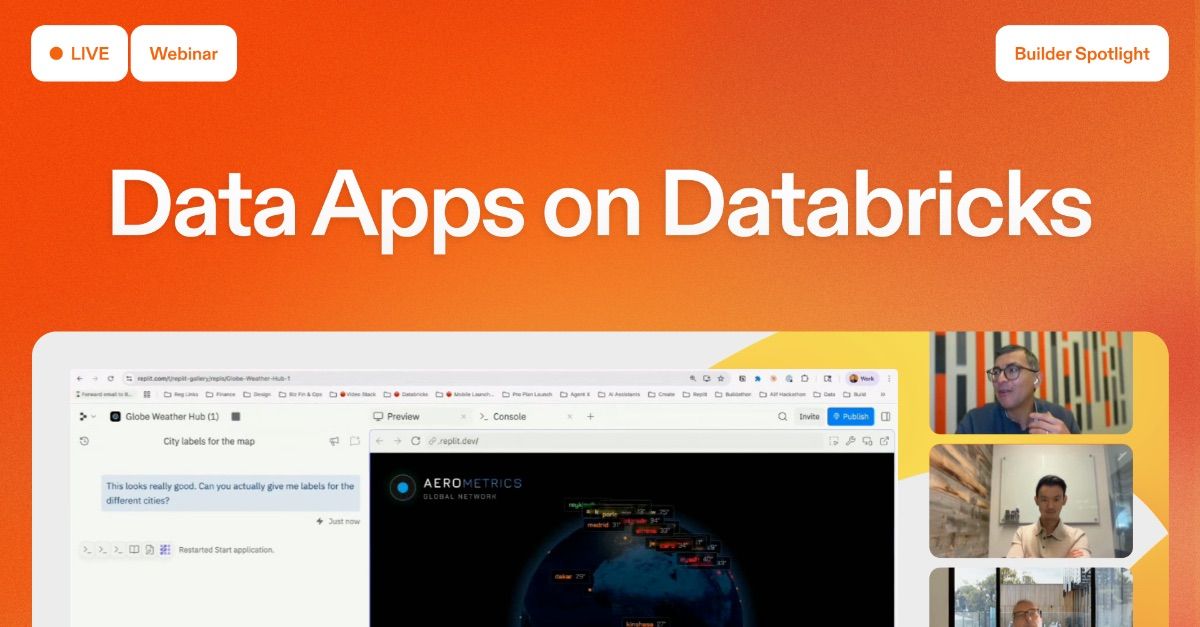
- What’s disappointing: The "vibe coding" moniker remains a double-edged sword. While the demo of a 3D weather globe is visually striking, the announcement is light on how these "vibe" apps handle the "un-vibe-able" realities of enterprise software: unit testing, regression monitoring, and complex state management.
- Who it’s for: Fast-moving Product Managers, Revenue Ops, and Data Analysts who are tired of waiting in a six-month BI (Business Intelligence) queue for simple internal tools.
- Price/Performance verdict: If you are already paying for Databricks and Replit, this is a massive value-add for developer velocity. However, the cost of Databricks compute for these "vibe" apps could scale quickly if not managed closely.
What’s actually new
Strip away the "vibe coding" branding, and you find a significant technical bridge between two previously isolated worlds. Historically, building an app on enterprise data required a high-friction "handshake": an engineer had to provision an environment, secure credentials, define an API layer, and ensure the frontend didn't violate data sovereignty.
The Replit–Databricks connector introduces three specific technical shifts:
- Metadata-Aware Scaffolding: Replit Agent doesn't just write generic SQL; it authenticates against a Databricks workspace and discovers specific catalogs and schemas. This allows the LLM to generate code that is contextually aware of the user's actual data environment.
- Governed Execution: The announcement highlights that apps "stay safely inside Databricks." This implies that the Replit-built app inherits the Unity Catalog permissions of the authenticated user. This moves us away from the dangerous "export to CSV" culture that defines most shadow IT.
- Genie Integration: Databricks Genie acts as a conversational intermediary. By answering natural-language questions with cited tables, it provides the "ground truth" that Replit Agent uses to build the UI and logic. This is a multi-agent workflow where Genie handles data discovery and Replit handles the application layer.
The hype check
Replit claims this is "vibe coding going pro." Let's look at that claim.
The Claim: "Ship a working data tool in minutes instead of weeks of traditional BI work." The Reality: Mostly True. For a specific class of "read-only" or "simple-write" internal tools, the speed is undeniable. Eliminating the infrastructure setup (the "scaffolding") is where 80% of the friction lives. However, "traditional BI work" includes data cleaning, validation, and stakeholder alignment—tasks an AI agent can't "vibe" its way through if the underlying data is a mess.
The Claim: "It should be as easy to build a custom app for your use case than it is now to create a slide." The Reality: Hyperbole. A slide doesn't have a backend. A slide doesn't have a runtime that can crash if the database returns a null value. This marketing language risks setting false expectations for non-technical users. Building the first version of an app is like a slide; maintaining it is still software engineering.
Real-world implications
The most immediate benefit is for Internal Tools (IT). Every large enterprise has a massive "long tail" of requested apps that never get built because the ROI doesn't justify the engineering hours.
- Scenario A (The RevOps Analyst): An analyst needs a tool to visualize territory performance against real-time pipeline data in Databricks. Instead of waiting for a dashboard, they use Replit Agent to "vibe code" a custom React interface that queries the live warehouse.
- Scenario B (The Prototyping Lead): A product team wants to test an AI-driven search tool on proprietary company documentation stored in Databricks vector indexes. They can now stand up a functional POC (Proof of Concept) in an afternoon.
The shift here is from centralized delivery to governed self-service.
Limitations they’re not talking about
While the "3D weather globe" makes for a great livestream, it masks several looming challenges for enterprise adoption:
- The "Vibe" Debt: Software built with natural language prompts often lacks a coherent architecture. If a PM "vibes" an app into existence and then leaves the company, who maintains the prompt history? How does an engineer debug a hallucinated join in a complex generated query?
- Compute Costs: Databricks SQL warehouses and compute clusters are not cheap. If an organization suddenly has 50 "vibe-coded" apps making frequent, unoptimized calls to the data warehouse, the month-end cloud bill could be a shock.
- Complex Logic: The demo focused on visualization. What happens when an app needs complex business logic—multi-step approvals, integration with external APIs (Stripe, Salesforce), or sophisticated state management? Replit Agent is good, but "vibe coding" often struggles when the requirements move from "show me this" to "do these 10 conditional things."
How it stacks up
- vs. Retool / Appsmith: Retool is the gold standard for low-code internal tools. It is more "deterministic" than vibe coding but has a steeper learning curve. Replit + Databricks is faster for "zero-to-one," but Retool is currently superior for "one-to-one hundred" in terms of enterprise-grade UI components.
- vs. Microsoft Power Apps: Power Apps has the distribution, but the developer experience is often criticized. Replit offers a "real" code environment that developers actually like, making it more likely to be adopted by the technical "shadow IT" crowd.
- vs. Streamlit (Snowflake): This is the direct competitor. Streamlit is code-first and very popular with data scientists. Replit + Databricks is aiming for a broader audience by putting an Agent at the center of the experience, whereas Streamlit still requires you to write the Python yourself.
Constructive suggestions
To move beyond the "vibe" and into true enterprise stability, we suggest the Replit and Databricks teams prioritize:
- Automated Testing Harness: Allow the Replit Agent to automatically generate a suite of unit tests for the code it writes, ensuring the "vibe" doesn't break when the underlying Databricks schema evolves.
- Cost Guardrails: Build a "cost-conscious" mode into the connector that estimates the Databricks credit consumption of a generated query before it’s deployed.
- Prompt Versioning as Code: Treat the conversation with the Agent as a first-class citizen in the Git history. If the app breaks, we need to see the "why" behind the code.
Our verdict
Who should adopt now: Data-literate teams who are already on Databricks and need to churn out internal prototypes or simple data-viz tools quickly. Who should wait: Teams looking for mission-critical, customer-facing applications. The "vibe coding" workflow is currently optimized for speed and "magic," not for five-nines reliability. Who should skip: Organizations with highly rigid Change Management processes where every line of code must be manually reviewed and audited. The generative nature of this workflow will likely trigger every red flag in your compliance handbook.
FAQ
Should we switch from Retool to Replit/Databricks?
Not yet. If your apps require complex form logic, granular RBAC (Role-Based Access Control) on the UI level, and a large library of pre-built components, Retool is still the leader. Switch to Replit + Databricks for projects where the speed of AI-driven generation and the deep integration with Databricks catalogs are more important than UI polish.
Is "vibe coding" secure for PII (Personally Identifiable Information)?
The integration claims that the app "stays safely inside Databricks," which is a strong start. However, the risk isn't just where the data lives, but how the code treats it. An AI agent might accidentally generate a visualization that exposes PII to a user who shouldn't see it. Human-in-the-loop review is still mandatory for sensitive data.
Is it worth the price premium?
The value lies in "time-to-market." If a "vibe coded" app helps a sales team close a deal a week faster, it pays for itself. If it’s just used to make existing dashboards look "cooler" with 3D globes, the Databricks compute costs may outweigh the utility.
Sources
- Vibe Coding Enterprise Data Apps with Replit and Databricks
- Ship Enterprise Apps Faster with Databricks AppKit and Replit
All technical specifications, pricing, and benchmark data in this article are sourced directly from official announcements. Competitor comparisons use publicly available data at time of publication. We update our coverage as new information becomes available.