
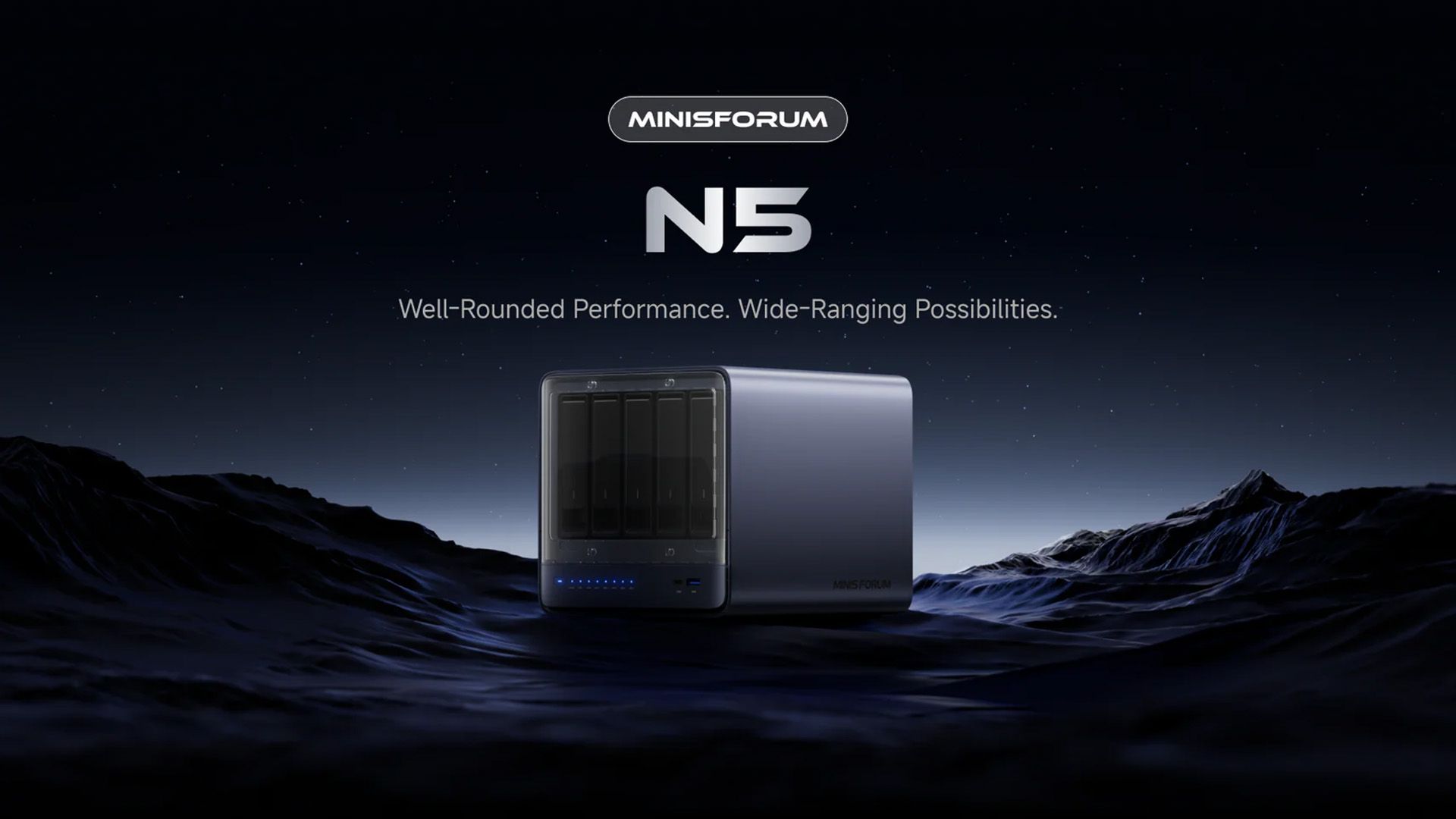
Minisforum Launches AI-Powered N5 Max NAS with OpenClaw Pre-Installed
Key Facts
- What: Minisforum announced the N5 Max flagship NAS featuring AMD's Ryzen AI Max+ 395 (Strix Halo) processor and OpenClaw pre-installed for local AI LLM execution.
- When: Announcement made March 11, 2026; the product is described as "to-be-launched."
- Processor: AMD Ryzen AI Max+ 395, part of the Strix Halo family designed for high-performance AI workloads.
- Capability: Successfully runs built-in OpenClaw for local AI large language models, marking a claimed breakthrough in NAS AI integration.
- Company: Minisforum, in partnership with AMD on the processor platform.
Lead paragraph
Minisforum has unveiled its upcoming N5 Max AI NAS, a flagship network-attached storage device that comes pre-installed with OpenClaw software and is powered by AMD’s Ryzen AI Max+ 395 processor. The system is designed to run local AI large language models (LLMs) directly on the device, eliminating the need for cloud processing. According to the company’s announcement on March 11, 2026, the N5 Max successfully executes OpenClaw’s built-in local AI capabilities, positioning it as a significant step forward for AI-enabled consumer and small-business storage solutions.
Body
The N5 Max represents Minisforum’s push into the growing intersection of network storage and artificial intelligence. Traditionally, NAS devices have focused on data storage, file sharing, and media serving. By integrating a high-end AMD Strix Halo processor and specialized AI software, Minisforum aims to transform the NAS from a passive storage appliance into an active computing platform capable of running sophisticated AI workloads locally.
At the heart of the N5 Max is AMD’s Ryzen AI Max+ 395. This flagship Strix Halo APU is built on advanced process technology and features a powerful integrated NPU (Neural Processing Unit) optimized for AI acceleration. The processor’s architecture is intended to deliver substantial performance for machine learning inference tasks while maintaining reasonable power consumption for a device that may operate 24/7 in a home or office environment.
Minisforum has pre-installed OpenClaw on the N5 Max. While specific technical details about OpenClaw remain limited in public announcements, the company states the software enables users to program and execute AI workloads directly on the NAS hardware. The firm claims the combination has been confirmed to successfully run local AI LLMs, allowing users to deploy language models for tasks such as document summarization, intelligent search across stored files, automated content generation, or private chat interfaces without sending data to external servers.
This local AI approach addresses growing privacy concerns and reduces dependency on cloud services that can introduce latency, recurring costs, and potential data exposure. According to the official announcement, the N5 Max “marks a breakthrough in the NAS industry with built-in OpenClaw in local computing.”
The device is positioned as Minisforum’s new flagship NAS, suggesting it will offer substantial storage capacity through multiple drive bays, high-speed networking options (likely including 10GbE or faster), and comprehensive hardware expansion capabilities. However, detailed specifications regarding maximum drive support, RAM configuration, exact power consumption, or pricing have not yet been disclosed.
Impact
For developers and power users, the N5 Max could open new possibilities for building private AI applications. Running LLMs locally on a NAS means sensitive corporate documents, personal data, or proprietary information never leaves the premises. This is particularly appealing for small and medium businesses, research teams, and privacy-conscious consumers.
The integration of AMD’s latest Strix Halo platform also highlights the increasing role of x86-based AI acceleration in consumer and prosumer devices. AMD has been aggressively expanding its AI hardware offerings, competing with NVIDIA, Intel, and various Arm-based solutions. Success with the N5 Max could encourage other NAS manufacturers to adopt similar high-performance APUs rather than relying solely on lower-power embedded processors.
From an industry perspective, the N5 Max reflects the broader trend of bringing AI capabilities closer to the data. As datasets continue to grow and AI becomes more pervasive, processing intelligence at the storage layer can reduce bandwidth requirements and improve response times for certain workloads.
What's Next
Minisforum has not yet revealed a firm release date, pricing, or complete technical specifications for the N5 Max. The company describes the product as “to-be-launched,” indicating that while functional validation of the OpenClaw and Ryzen AI Max+ 395 combination has been achieved, the device is still in the final stages of preparation for market availability.
Prospective buyers should monitor Minisforum’s official channels for updates on exact configuration options, supported AI model sizes, software ecosystem details, and thermal/power specifications. Given the specialized nature of the hardware, early availability may be limited to direct sales through Minisforum’s website or select partners.
The success of this product could influence how future NAS devices are designed. If the N5 Max demonstrates reliable performance running local LLMs while maintaining acceptable noise levels and power draw, it may accelerate the adoption of AI-accelerated storage appliances across both consumer and enterprise markets.
Competitors in the NAS space, including Synology, QNAP, and TrueNAS hardware partners, will likely watch the N5 Max closely. The ability to run substantial local AI models could become a key differentiator as more users seek intelligent features in their storage infrastructure.
Technical Context
Strix Halo represents AMD’s high-end mobile and mini-PC focused platform, offering significantly more CPU cores, GPU compute units, and NPU performance than previous generations. The Ryzen AI Max+ 395 sits at the top of this lineup, making it a logical choice for a device that needs both strong general computing performance for NAS functions and dedicated AI acceleration.
OpenClaw appears to function as both an application framework and runtime environment optimized for this hardware. Its ability to run LLMs locally suggests support for popular open-source models, though exact model size limitations and performance metrics (tokens per second) have not been published.
The combination of a powerful x86 APU with pre-configured AI software could lower the barrier to entry for users who want local AI capabilities but lack the expertise to build such systems from scratch using discrete GPUs or multiple single-board computers.