
The short version
Intel's Heracles is a special-purpose chip that crunches numbers on fully encrypted data without ever decrypting it first, using a technology called fully homomorphic encryption (FHE). It's like a super-secure calculator that works on locked boxes without opening them, and it's 1,074 to 5,547 times faster than a high-end 24-core Intel Xeon processor for these encrypted math tasks. This breakthrough could make your online banking, medical records, and voting way safer by keeping data hidden even from the computers processing it.
What happened
Imagine you're sending a secret message in a locked safe to a friend. Normally, to read or use it, your friend has to unlock the safe—exposing the contents to anyone watching, like a sneaky hacker or even a glitchy system. That's how most computers handle encryption today: data stays locked while stored or traveling over the internet, but once it hits the processor (the brain of the computer), it gets unlocked into plain sight, making it vulnerable to "side-channel attacks" (like eavesdropping on power usage or memory peeks), DMA attacks (direct memory hacks), or hypervisor snooping (virtual machine spying).
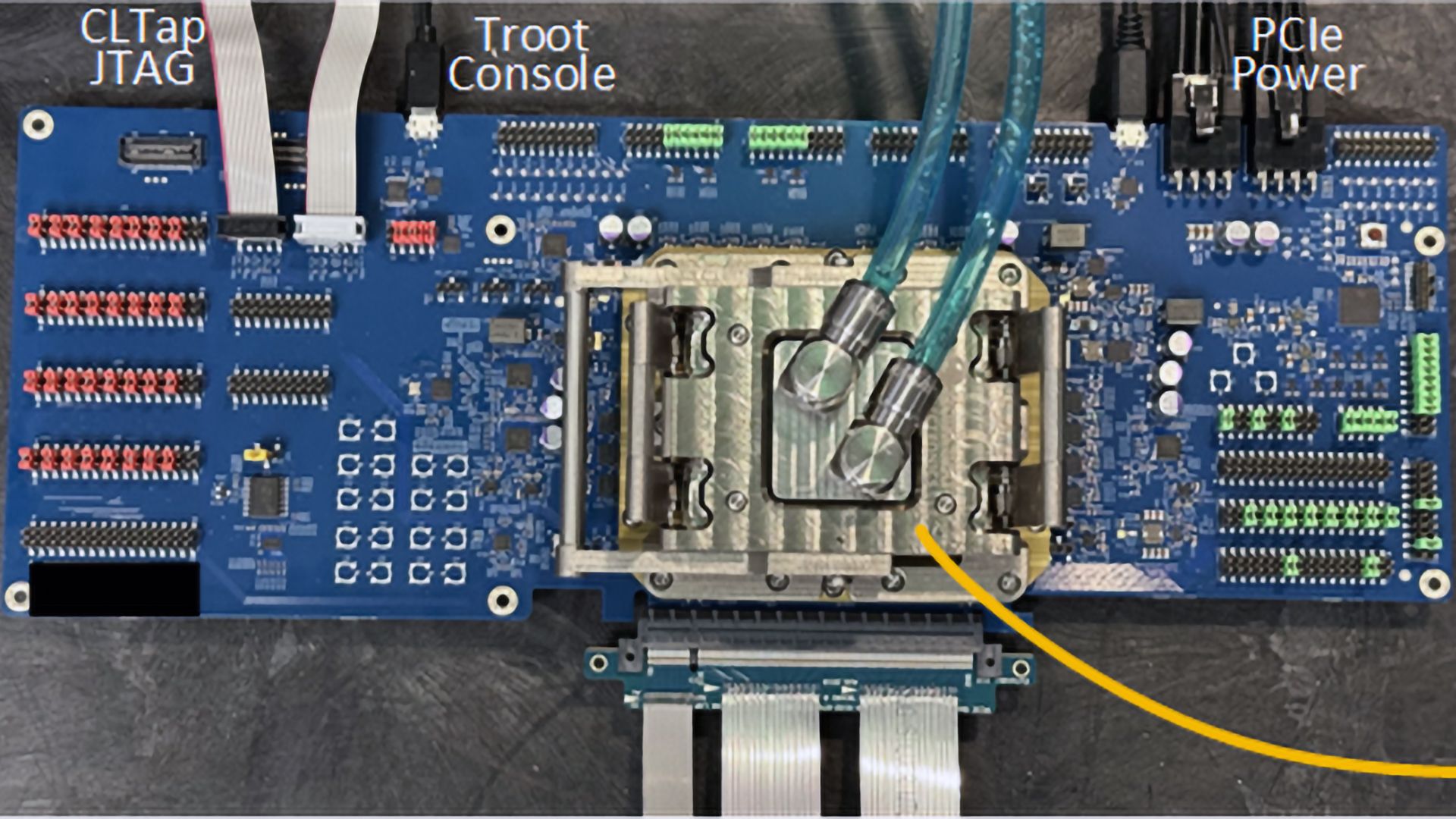
Intel just demoed a fix: their Heracles chip, unveiled last month at the International Solid-State Circuits Conference (ISSCC) and reported by IEEE Spectrum. This isn't a regular CPU that runs apps or your operating system—it's a narrow, laser-focused accelerator card that plugs into servers via PCIe, designed solely for FHE math. FHE lets computers do calculations—like adding up numbers or checking voter IDs—directly on encrypted data, spitting out encrypted results without ever seeing the plain info inside.
Think of it like a magic vending machine: you insert a locked box of ingredients (encrypted data), it mixes a cake inside the box without peeking, and hands back a locked box of cake. Heracles handles the wild math FHE needs—massive integers, polynomial juggling, and transforms called number-theoretic transforms (NTT) and inverse NTTs—which overwhelm everyday CPUs and GPUs. It breaks huge encrypted numbers into bite-sized 32-bit chunks for parallel processing, supports key operations like automorphisms and bootstrapping (to clear "noise" from repeated math), and works with major FHE schemes: BGV, BFV, and CKKS.
Tech specs? It runs at 1.20 GHz on Intel's 3 process tech, spans 197 mm², draws 176W (needs liquid cooling), packs 48 GB of super-fast HBM3 memory in two stacks for terabytes-per-second bandwidth, 64 MB scratchpad memory, huge register files, and custom data paths. Its heart is an 8192-way SIMD engine: 64 tile-pairs in an 8x8 mesh, each with 128 parallel lanes optimized for modular add/subtract/multiply and butterfly ops. Peak performance: 29.5 TOPS (trillion operations per second) for butterflies, 9.8 TOPS for modular arithmetic, and multi-terabit/s for transforms.
Benchmarks blow minds: At 1.2 GHz, it nails a critical FHE transform in 39 microseconds—2,355 times faster than a 3.5 GHz Intel Xeon. Across seven FHE ops, it's 1,074x to 5,547x quicker than a 24-core Intel Xeon W7-3455 'Sapphire Rapids' (2.50–4.80 GHz). Real-world example: Verifying a encrypted voter ID and ballot match took 15 milliseconds on a Xeon server; Heracles did it in 14 microseconds.
Why should you care?
Data breaches hit 1 in 4 Americans yearly, leaking bank details, health records, or votes—costing billions and eroding trust. Right now, even "secure" cloud services like Google or AWS decrypt your data to analyze it, risking insider hacks or nation-state spying. Heracles flips this: processing stays blind, so your info never flashes plaintext on any chip.
For you? Safer online shopping (fraud checks without exposing card numbers), private AI health apps (diagnoses on encrypted symptoms), anonymous voting (government tallies without seeing choices), or secure finance (banks compute loans on hidden incomes). It slashes FHE's old speed bottleneck—previously too slow for real use—potentially making privacy-by-default the norm, not a luxury.
What changes for you
Not overnight—Heracles is a server-side accelerator for data centers, not your laptop. But as it rolls out:
- Apps get stealthier: Cloud AI (like personalized ads or medical advice) could run on your encrypted data. No more "trust us, we won't peek."
- No speed hit for privacy: Tasks that took seconds now microseconds—faster logins, instant fraud alerts.
- Cheaper secure services: Purpose-built speed means less energy/compute waste; providers pass savings (source doesn't confirm pricing, so not yet available).
- Everyday wins: Vote privately (encrypted ballot matching in 14μs vs. 15ms), bank securely (loan calcs on locked finances), or share health data confidently (encrypted diagnoses).
- Broader ripple: Competes with general CPUs/GPUs; could inspire phone chips for on-device encrypted AI. Intel's edge? In-house fabs, PCIe plug-and-play.
No consumer pricing or release date yet—it's a demo, likely enterprise-first (e.g., servers from Dell/HP).
Frequently Asked Questions
### What is fully homomorphic encryption (FHE), and why is it a big deal?
FHE is encryption that lets computers do math—like adding or multiplying—directly on locked data, outputting locked results without unlocking anything. It's a big deal because normal encryption forces decryption for processing, exposing data to hacks; FHE keeps it hidden end-to-end, perfect for untrusted clouds or shared servers.
### How much faster is Heracles than regular chips?
Insanely: 1,074 to 5,547 times faster than a 24-core Intel Xeon W7-3455 (2.5–4.8 GHz) across seven FHE operations. One key transform: 39 microseconds vs. Xeon's much slower time (2,355x speedup at 3.5 GHz). Voter ID check: 14 microseconds vs. 15 milliseconds.
### Can I buy a Heracles chip for my PC?
Not yet—it's a PCIe accelerator card for servers, using liquid cooling and aimed at data centers. No consumer version or pricing announced; expect enterprise adoption first, trickling to services you use.
### How does Heracles compare to CPUs, GPUs, or other FHE chips?
Way specialized: Regular CPUs/GPUs choke on FHE's huge numbers and transforms; Heracles' 8192-way SIMD, 48GB HBM3, and NTT-optimized tiles crush them (e.g., 29.5 TOPS butterflies). Vs. others like Galois' Basalisc (async clocking), Heracles uses 32-bit slices for parallelism—Intel's first public FHE demo.
### When will this be in apps I use, like banking or voting?
No timeline given, but speedups make real-world FHE viable now. Could hit secure clouds/services in 1–3 years; watch for "FHE-powered" privacy features in AI tools or finance apps.
The bottom line
Intel's Heracles isn't just tech wizardry—it's a game-changer for keeping your data private in a world where everything's online. By making encrypted computing thousands of times faster (1,074–5,547x vs. top Xeons), it turns sci-fi privacy into everyday reality: banks crunching hidden finances, doctors analyzing locked health stats, or elections tallying secret votes without a single unlock. You won't plug it in yourself, but soon your apps could feel its impact—safer logins, fraud-proof shopping, and trustworthy AI, all without slowing down or costing extra. Privacy was the weak link; Heracles forges it into steel. Keep an eye on Intel— this could redefine trust in tech.
(Word count: 1,248)
Sources
- Tom's Hardware: Intel's Heracles Chip Computes Fully-Encrypted Data
- IEEE Spectrum: Intel's Heracles Chip Speeds Up FHE Computing
- IEEE Spectrum: Chips to Compute With Encrypted Data Are Coming
- Slashdot: Intel Demos Chip To Compute With Encrypted Data
- NCSU ECE: Intel HERACLES Seminar
- Hacker News Discussion