
Intel's Heracles Chip Computes Fully-Encrypted Data Without Decrypting It, Up to 5,547 Times Faster Than Xeon
Key Facts
- What: Intel demonstrated Heracles, a purpose-built accelerator for fully homomorphic encryption (FHE) that processes encrypted data without decryption.
- Performance: 1,074 to 5,547 times faster than a 24-core Intel Xeon W7-3455 "Sapphire Rapids" across seven FHE math operations; achieves 2,355x speedup on critical math transformation (39 microseconds vs. Xeon at 3.5 GHz).
- Architecture: 8192-way SIMD compute engine with 64 tile-pairs in an 8x8 mesh, 32-bit arithmetic lanes, 48 GB HBM3 memory, 176W TDP, fabricated on Intel 3 process at 1.2 GHz.
- Capabilities: Supports BGV, BFV, and CKKS FHE schemes; performs modular arithmetic, number-theoretic transforms (NTT), automorphisms, and bootstrapping.
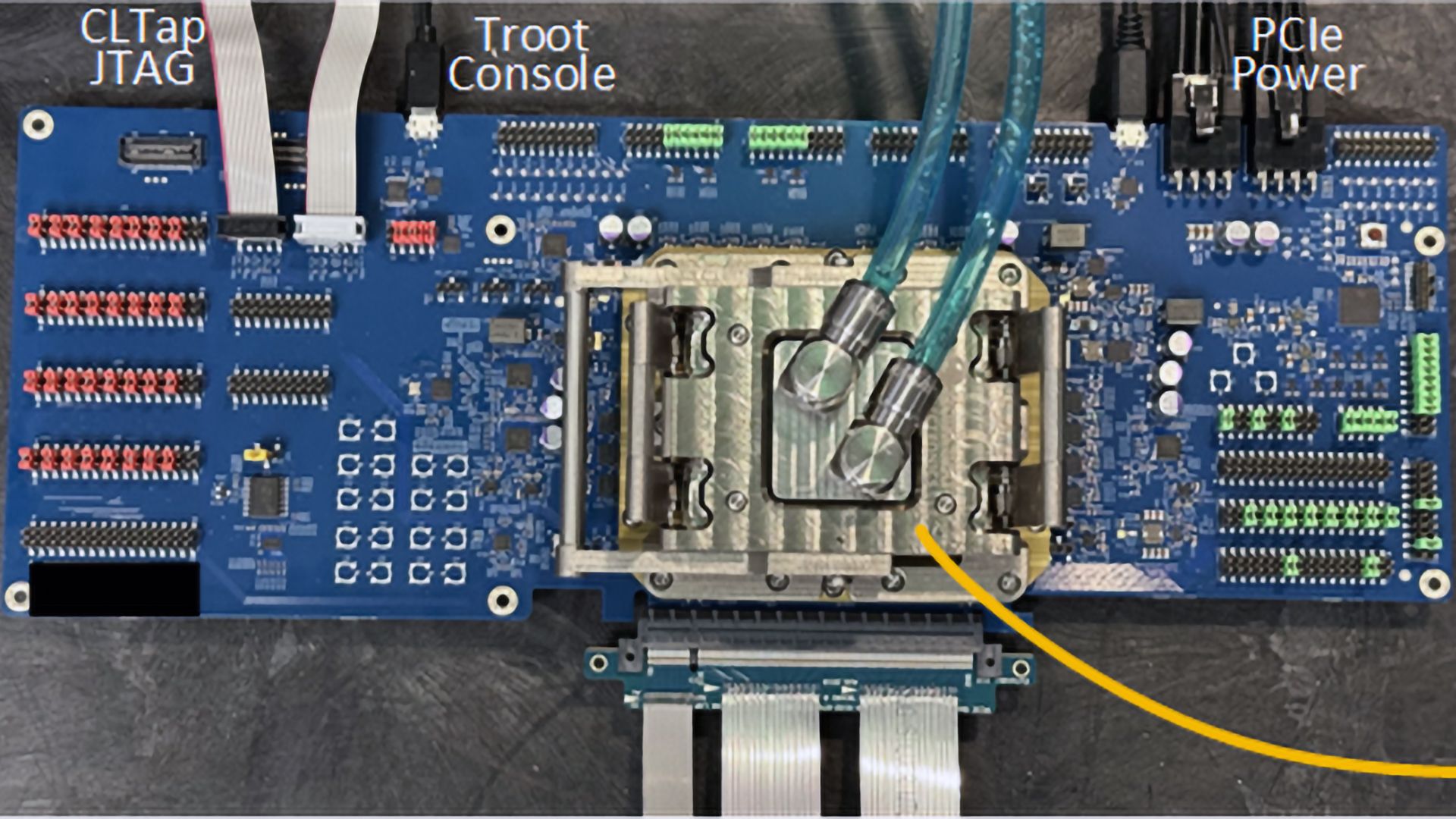
- Form Factor: PCIe accelerator card using liquid cooling, designed exclusively for FHE acceleration alongside standard servers.
Lead paragraph
Intel has developed and demonstrated a specialized accelerator chip called Heracles that can perform computations directly on fully encrypted data without ever decrypting it, addressing a critical vulnerability in modern data protection. The chip, unveiled last month at the International Solid-State Circuits Conference (ISSCC), delivers performance gains of 1,074 to 5,547 times compared to a 24-core Intel Xeon W7-3455 "Sapphire Rapids" processor across key fully homomorphic encryption (FHE) operations, according to the company. This breakthrough aims to enable secure cloud computing, privacy-preserving analytics, and other applications where data must remain encrypted throughout its entire lifecycle, including during active processing.
Body
Modern encryption protects data at rest and in transit, but conventional processors require decryption before computation, exposing information to side-channel attacks, DMA attacks, and hypervisor snooping. Fully homomorphic encryption solves this by allowing mathematical operations on ciphertext that produce an encrypted result. When decrypted with the proper key, the result matches what would have been obtained by operating on the original plaintext. However, FHE imposes enormous computational overhead, relying on extremely large integers, intensive polynomial calculations, and complex transformations that overwhelm general-purpose CPUs and GPUs.
Intel's Heracles accelerator is not a general-purpose x86 CPU and cannot run standard software or operating systems. It is purpose-built exclusively to accelerate FHE mathematics. According to reporting by IEEE Spectrum and Tom's Hardware, the chip operates at 1.2 GHz and was fabricated using Intel's Intel 3 process technology. It occupies a die area of 197 mm² and has a thermal design power of 176W, requiring liquid cooling in its current PCIe card implementation.
The architecture features an 8192-way SIMD compute engine composed of 64 tile-pairs arranged in an 8×8 mesh. Each tile-pair contains 128 parallel arithmetic lanes, with each lane processing 32-bit arithmetic slices. This design supports modular addition, subtraction, multiplication, and specialized butterfly operations essential for number-theoretic transforms (NTT) and inverse NTTs. These transforms are fundamental to FHE but demand heavy data movement and precisely coordinated permutations.
Heracles also incorporates support for automorphisms and bootstrapping operations, which are necessary to manage accumulated cryptographic noise and enable deeper, more complex computational chains. The chip includes 48 GB of HBM3 memory across two stacks to deliver the massive bandwidth required for parallel execution, along with 64 MB of internal scratchpad memory, large register files, and dedicated data staging buffers.
Performance specifications are impressive for the targeted workload. At peak, Heracles reaches approximately 29.5 TOPS for butterfly primitives and 9.8 TOPS for modular arithmetic, with multi-terabit-per-second throughput for transform operations. Intel reports that the accelerator completes FHE’s critical math transformation in just 39 microseconds — a 2,355-fold improvement over an Intel Xeon CPU running at 3.5 GHz. Across seven key FHE operations, the speedup ranges from 1,074x to 5,547x compared to the 24-core Xeon W7-3455 running between 2.50 GHz and 4.80 GHz.
The accelerator supports major FHE schemes including BGV, BFV, and CKKS, and offers programmability across different parameter sets and security levels. This flexibility makes it suitable for a variety of privacy-preserving applications, from secure machine learning to encrypted database queries.
In one practical demonstration highlighted by IEEE Spectrum, a voting privacy scenario showed dramatic improvement. Using FHE to match an encrypted voter ID and ballot without decryption, the process took 15 milliseconds on an Intel Xeon server CPU but only 14 microseconds on Heracles.
Technical Context and Competitive Landscape
FHE has long been considered theoretically powerful but practically limited due to performance overheads that can reach thousands or tens of thousands of times slower than plaintext computation. Previous efforts in the industry have included software optimizations, GPU acceleration, and other specialized hardware projects. Intel's approach decomposes FHE’s huge numbers into short 32-bit data words, differing from other designs such as the Galois Basalisc chip, which uses asynchronous clocking to allow different circuit types to operate at optimal speeds.
The development reflects growing industry interest in confidential computing and privacy-enhancing technologies. Major cloud providers and governments are increasingly seeking solutions that allow processing of sensitive data — such as medical records, financial information, or classified intelligence — without exposing plaintext to the computing infrastructure. Heracles represents Intel's entry into a niche but strategically important segment of accelerator technology.
Impact
For developers and organizations working with sensitive data, Heracles could dramatically reduce the performance penalty associated with FHE, making previously impractical applications viable. Privacy-preserving machine learning, secure multiparty computation, and encrypted search become more realistic when acceleration reaches these levels.
The technology has particular relevance for regulated industries and government applications where data sovereignty and privacy requirements are paramount. By keeping data encrypted even during active computation, organizations can potentially use third-party cloud infrastructure with greater confidence that their information remains protected from both external attackers and the cloud provider itself.
However, as noted in discussions on platforms like Hacker News, important questions remain about the overall performance penalty compared to plaintext computation and the level of trust required in both the encryption scheme and the hardware accelerator itself.
What's Next
Intel has not yet announced commercial availability, pricing, or broader deployment timelines for Heracles. The current implementation exists as a PCIe accelerator card designed to work alongside standard servers. Further work will likely focus on integration improvements, software tooling, developer ecosystems, and potential scaling to larger systems.
The demonstration at ISSCC suggests Intel is actively advancing its confidential computing roadmap. Industry observers expect continued development in FHE accelerators from multiple vendors as the technology matures. Future generations may offer even higher performance, lower power consumption, or integration into broader CPU platforms.
As FHE hardware improves, it could fundamentally change how organizations approach data security in cloud and distributed computing environments, potentially unlocking new applications that were previously considered too computationally expensive.