
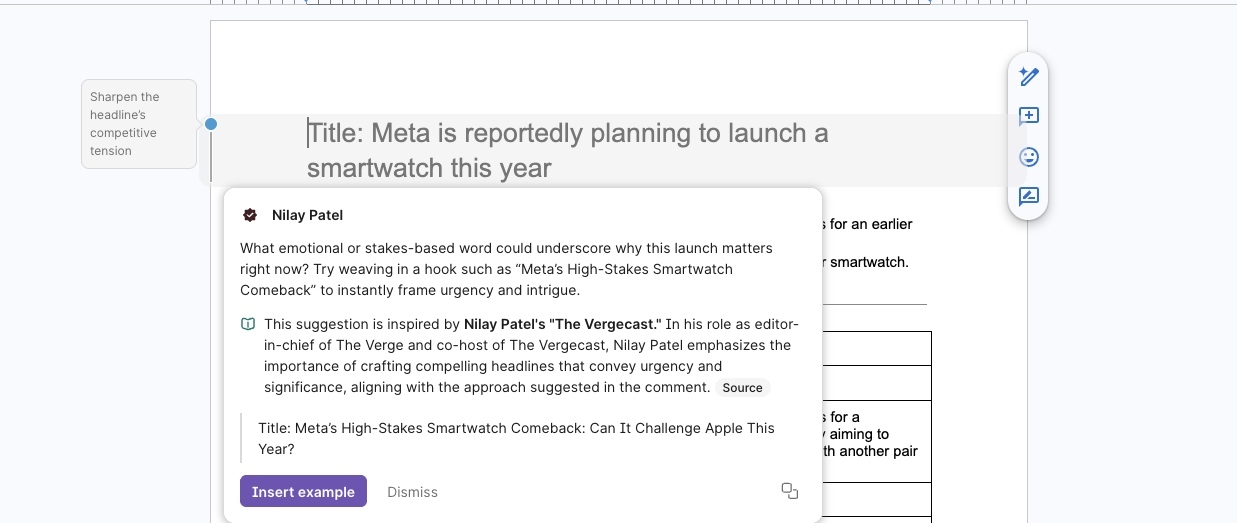
Grammarly Disables Controversial 'Expert Review' AI Feature
Key Facts
- What: Grammarly (owned by Superhuman) has disabled its Expert Review feature, which used AI to generate edit suggestions "inspired by" real writers and experts without their permission.
- When: Disabled March 11, 2026, following public backlash; the company previously offered only an opt-out email address.
- Why: The feature drew widespread criticism for cloning experts' styles and identities without consent, with experts including Verge staff members affected.
- Next Steps: Superhuman will "reimagine" the feature to give experts real control over participation or non-participation.
- Response: Superhuman CEO Shishir Mehrotra and Director of Product Management Ailian Gan issued public apologies, acknowledging the company "missed the mark."
Lead paragraph
Grammarly has disabled its AI-powered Expert Review feature after intense criticism for generating writing suggestions styled after real experts and journalists — including staff at The Verge — without obtaining their permission. The company, owned by Superhuman, announced the decision on March 11, 2026, stating it will reimagine the tool to provide users with more useful feedback while giving experts meaningful choice about whether their work and identity are used in future AI systems. Superhuman’s leadership issued apologies, admitting the initial approach failed to respect the agency of the very thought leaders the feature claimed to channel.
Background of the Feature
The Expert Review feature was designed to help users improve their writing by offering suggestions "through the lens of industry-relevant perspectives," according to company statements reported across multiple outlets. It analyzed a user’s text and provided edits framed as coming from prominent voices in relevant fields. Grammarly claimed the suggested experts depended on the substance of the writing being evaluated.
However, the implementation sparked immediate controversy when writers discovered their names and writing styles were being used to power the AI suggestions without prior consent. Reports emerged that the system created AI clones based on publicly available work — in some cases even using the identities of deceased academics — raising serious questions about consent, intellectual property, and the ethics of training AI on individuals' professional reputations.
The backlash intensified when Verge staff members learned their editor-in-chief and other writers were among those whose personas had been incorporated. This led to direct coverage by The Verge, which first reported on the opt-out-only approach and later on the full disablement of the feature.
Company Response and Apologies
In a statement to The Verge, Ailian Gan, Superhuman’s director of product management, said: “After careful consideration, we have decided to disable Expert Review as we reimagine the feature to make it more useful for users, while giving experts real control over how they want to be represented — or not represented at all.”
Superhuman CEO Shishir Mehrotra echoed this in a LinkedIn post, writing: “We built the agent to help users tap into the insights of thought leaders and experts, and to give experts new ways to share their knowledge and reach new audiences. Based on the feedback we’ve received, we clearly missed the mark. We are sorry and will do things differently going forward.”
The company initially responded to criticism by creating an email inbox at expertoptout@superhuman.com for writers to request removal. However, it quickly acknowledged that this reactive opt-out system was insufficient. The full disablement represents a more significant course correction.
Mehrotra placed the decision in the context of Superhuman’s broader mission, noting the company’s vision is to solve the “last mile of AI” by bringing large language models into users’ existing workflows. He emphasized the importance of user and expert agency, stating it is critical “that we continue to seek the best ways to help people feel agency over technology and that they can shape it to meet their needs.”
Industry Context and Ethical Concerns
The incident highlights growing tension in the AI industry around the use of real individuals’ identities, writing styles, and professional reputations to train or power generative tools. Multiple reports documented cases where living and deceased academics were cloned without permission, with some professors expressing dismay at discovering AI versions of themselves offering writing advice under their names.
This case stands out because it involved high-profile journalists and writers who were able to quickly amplify their objections through major tech publications. Coverage from The Verge, Platformer, Futurism, and others framed the feature as crossing an ethical line by impersonating writers without consent.
The controversy also reflects broader debates about whether opt-out mechanisms are adequate when dealing with personal identity and creative work. Many in the writing and academic communities argue that explicit opt-in consent should be required before an individual’s voice or expertise is used to train AI systems marketed under their name.
Impact on Developers, Users, and the Industry
For users of Grammarly’s products, the immediate impact is the loss of the Expert Review capability while the company reworks it. Some may have appreciated the feature’s ability to provide perspective-based editing suggestions, but the public outcry suggests many others found the unauthorized use of experts’ identities unacceptable.
The decision sends a signal to the wider AI industry about the reputational risks of deploying features that appropriate individuals’ professional identities without clear permission. Companies racing to add novel AI capabilities to productivity tools are now on notice that simply scraping publicly available content may not be sufficient justification when real names and reputations are attached to the output.
For experts and writers, the episode demonstrates that public pressure can force changes in corporate behavior. The shift from a pure opt-out system to a complete disablement while “reimagining” the feature with “real control” for experts represents a partial victory for those who argued the original implementation was unethical.
What's Next
Superhuman has not provided a timeline for when or in what form a reimagined Expert Review feature might return. The company has committed to being “transparent about how we improve from here” and to giving experts genuine choice about participation.
It remains unclear whether future versions will require explicit opt-in consent before using an expert’s name or style, or if they will find ways to offer generalized “industry perspective” suggestions without directly attributing them to living individuals. The company’s statements suggest it still sees value in connecting users with expert insights through AI, but must now balance that goal against ethical and legal considerations around consent and identity.
The incident may also influence how other AI companies approach similar “personality” or “expert lens” features in writing assistants, email tools, and productivity software. As the industry continues to integrate large language models more deeply into everyday work tools, questions of consent, attribution, and intellectual property are likely to remain central.
Sources
- The Verge - Grammarly says it will stop using AI to clone experts without permission
- Platformer - Grammarly turned me into an AI editor against my will and I hate it
- Futurism - Grammarly Is Pulling Down Its Explosively Controversial Feature That Impersonates Writers Without Their Permission
- The Verge - Grammarly will keep using authors’ identities without permission unless they opt out
- Technology.org - Grammarly Built AI Clones of Real Professors — Some Are Already Dead