
Oracle's 4.5GW OpenAI Deal: A Technical Deep Dive into AI Hyperscale Data Center Strategy
Executive summary
Oracle has confirmed that its multi-gigawatt agreement with OpenAI to deliver 4.5 gigawatts of dedicated AI data center capacity remains fully on track despite the reported cancellation of a specific 600 MW expansion at the Abilene, Texas Stargate campus. The partnership with Crusoe Energy for the Abilene site continues, with two buildings already operational and the remainder progressing on schedule. This development highlights the extreme modularity and geographic diversification now required for next-generation AI infrastructure. The 4.5 GW commitment represents one of the largest single-customer data center reservations in history, underscoring the shift from single-campus mega-projects to distributed, multi-site AI superclusters.
Technical architecture
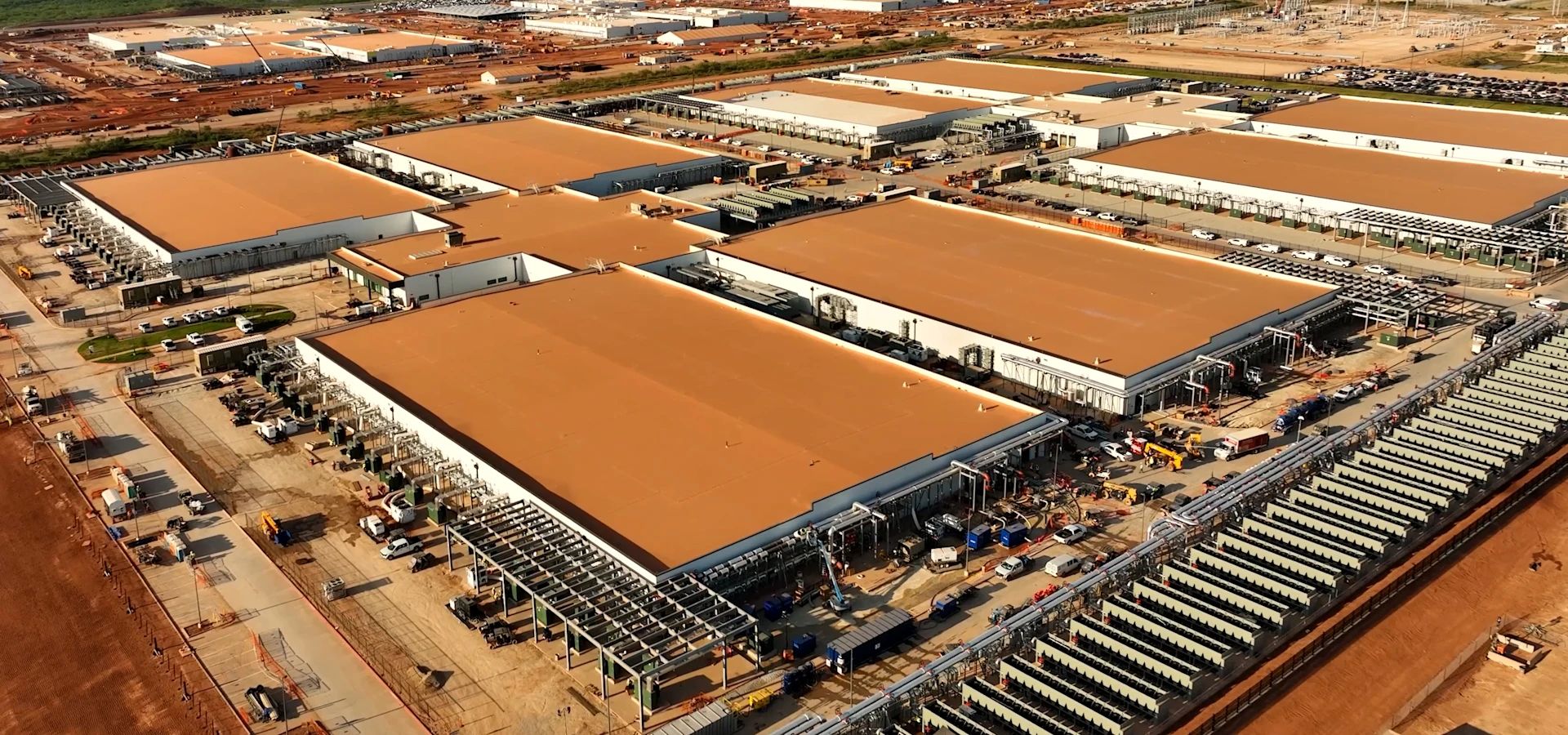
The Oracle-OpenAI agreement centers on Oracle Cloud Infrastructure (OCI) operating within Crusoe-developed facilities. Crusoe’s Abilene campus spans roughly 1,000 acres and currently comprises eight data center buildings. Two of these buildings are fully operational and running production AI workloads, while the remaining six are in various stages of construction.
From an architectural standpoint, these facilities are designed as hyperscale AI training and inference clusters. Key characteristics include:
- Power density: Modern AI clusters targeting 4.5 GW total capacity typically require 50–100+ kW per rack when using high-TDP GPUs/accelerators (NVIDIA H100/H200/Blackwell or AMD MI300X equivalents). At 4.5 GW, assuming ~60 kW average per rack, this equates to roughly 75,000 racks across the entire portfolio.
- Power delivery architecture: Expect heavy use of medium-voltage direct current (MVDC) or 48V rack-level power distribution to reduce copper losses, combined with advanced uninterruptible power supplies and lithium-ion battery energy storage systems (BESS) for grid stability.
- Cooling systems: Given the Texas location, the design likely combines direct liquid cooling (DLC) for high-power GPUs with hybrid air-assisted rear-door heat exchangers. Crusoe has historically emphasized low-carbon approaches, including potential integration of natural gas-powered generation with carbon capture or behind-the-meter renewable sourcing.
- Networking fabric: Ultra Ethernet Consortium (UEC) or NVIDIA NVLink/NVSwitch-derived fabrics are probable for intra-cluster communication, with high-radix Ethernet switches for the broader 4.5 GW supercluster. Photonic interconnects will be critical for scaling beyond single-building domains, addressing the “next big AI bottleneck” noted in recent industry commentary.
- Modular expansion: The decision to redirect the additional 600 MW to other sites rather than expanding Abilene demonstrates a flexible, campus-agnostic architecture. This allows Oracle and OpenAI to optimize for local power availability, grid interconnection timelines, and regional incentives.
The broader Stargate project, originally announced with significant White House visibility, is evolving from a monolithic Texas-centric vision into a national distributed AI infrastructure platform.
Performance analysis
Specific performance benchmarks for the Abilene deployment or the 4.5 GW portfolio have not been publicly disclosed. However, we can contextualize the scale:
| Metric | Abilene Current | Full 4.5 GW Target | Comparison (est.) |
|---|---|---|---|
| Operational buildings | 2 | N/A (multi-site) | — |
| Total capacity | ~1–2 GW (est.) | 4.5 GW | ~3–4× current largest single AI cluster |
| Rack count (est. @ 60 kW/rack) | ~15,000–30,000 | ~75,000 | Larger than most hyperscaler GPU fleets |
| Expected peak FLOPS | Not disclosed | >100 EFLOPS (FP8) | Comparable to multiple Frontier-class systems |
No official MLPerf or internal training throughput numbers have been released for Oracle-hosted OpenAI workloads. Industry observers note that Oracle’s strategy relies on tight integration between Crusoe’s physical plant and OCI’s software-defined infrastructure layer, including Sovereign Cloud controls and high-performance block storage optimized for checkpointing massive models.
Technical implications
This episode reveals several important shifts in the AI infrastructure ecosystem:
- Financing and risk allocation: The reported breakdown in negotiations over the 600 MW expansion highlights the enormous capital intensity of AI data centers. A single 600 MW project can require $4–8 billion in capex depending on power and cooling design. The move toward multi-site diversification reduces single-point execution risk.
- Grid and power constraints: Securing 4.5 GW of reliable power across multiple U.S. locations is non-trivial. Regions near Detroit (newly mentioned) may offer different transmission headroom and renewable profiles than Texas.
- Accelerator vendor dynamics: Bloomberg’s reporting that Meta may take over part of the Abilene expansion—with Nvidia facilitating—suggests continued tension between AMD-based OCI offerings and NVIDIA’s dominant ecosystem. OpenAI’s workloads are known to be heavily optimized for CUDA; any shift in hardware mix has deep software implications.
- Operator specialization: Crusoe’s role as developer and Oracle’s role as operator/cloud provider creates a layered stack. This model may become more common as traditional hyperscalers struggle to keep pace with OpenAI, Anthropic, xAI, and Meta’s aggressive buildouts.
Limitations and trade-offs
- Schedule risk: Even with two buildings live, delivering the full 4.5 GW by original timelines remains challenging given current U.S. transformer lead times (often 2–3 years) and high-voltage equipment shortages.
- Power purchase complexity: Long-term PPAs, behind-the-meter generation, and potential use of natural gas with carbon capture introduce both reliability benefits and ESG trade-offs.
- Interconnect latency: Distributing capacity across multiple states increases cross-site latency for very large training runs, potentially requiring sophisticated model parallelism and checkpoint synchronization strategies.
- Vendor lock-in vs. flexibility: Oracle gains significant revenue visibility, but OpenAI may face constraints if future models require hardware not natively supported in the OCI/Crusoe stack.
Expert perspective
From a senior infrastructure perspective, Oracle’s rapid confirmation that the 4.5 GW deal is intact is significant. The ability to absorb a 600 MW campus-level change without derailing the larger program demonstrates architectural maturity and contractual flexibility that many observers doubted. This distributed model may prove more resilient than single-campus “Stargate” visions, though it increases the complexity of unified orchestration and fabric management. The real test will be whether Oracle can deliver consistent exaflop-scale training performance at competitive utilization rates compared to pure-play hyperscalers.
Technical FAQ
### How does the revised Oracle-OpenAI approach compare to single-campus designs like xAI’s Memphis Colossus?
Single-campus designs (e.g., xAI’s 100k+ H100 cluster in Memphis) offer lower cross-rack latency and simpler operational semantics but face extreme power and cooling challenges at one location. Oracle/OpenAI’s multi-site 4.5 GW strategy trades some performance predictability for better risk distribution and faster incremental capacity ramp.
### What are the likely networking requirements for a 4.5 GW distributed AI cluster?
Expect heavy reliance on Ultra Ethernet, RDMA over Converged Ethernet (RoCE), and emerging CXL-based memory pooling. Photonic switching and optical circuit switches will be essential for dynamic topology reconfiguration across campuses. Cross-site synchronization will likely use high-bandwidth wide-area networking with specialized compression and asynchronous checkpointing.
### Is the Crusoe-Oracle stack compatible with standard OCI tooling for AI workloads?
Yes. Oracle has positioned the Crusoe facilities as an extension of OCI, offering familiar APIs for GPU instances, object storage for datasets, and managed services. However, at this scale, OpenAI is expected to run largely on bare-metal or custom orchestration layers rather than standard OCI virtual machines.
### How significant is the potential shift from AMD to NVIDIA hardware at the Abilene site?
If Meta assumes part of the capacity and standardizes on NVIDIA, it could reduce available AMD MI300X capacity for OpenAI. This would have software implications given OpenAI’s historical CUDA optimization but could also accelerate availability of Blackwell-based clusters.
References
- Oracle statement on X (March 2026)
- Bloomberg and Reuters reporting on the Abilene expansion adjustment
- Original Oracle-OpenAI 4.5 GW agreement announcement (July 2025)