
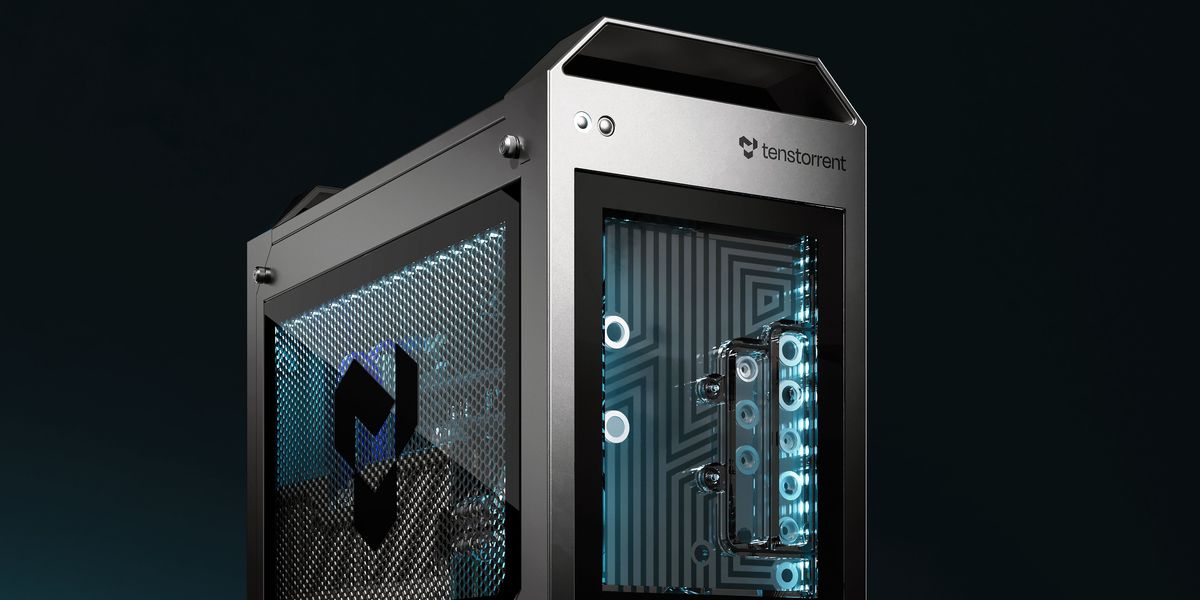
- What: Tenstorrent announced the QuietBox 2, a high-performance local AI workstation.
- Performance: Runs Meta’s Llama 3.1 70B at nearly 500 tokens per second.
- Specs: 4 Blackhole RISC-V accelerators, 384GB total memory, 1,400W power draw.
- Pricing: Expected retail price of $9,999.
- Availability: Slated for release in the second quarter of 2026.
Tenstorrent has unveiled the QuietBox 2, a $9,999 AI workstation designed to bring "frontier-level" local inference to the home office without the power constraints of traditional hardware. Scheduled for a Q2 2026 launch, the liquid-cooled machine leverages four custom Blackhole RISC-V accelerators to run mid-sized models like Meta’s Llama 3.1 70B at nearly 500 tokens per second—outpacing the average response times of cloud-based models such as OpenAI’s GPT-5.2 and Anthropic’s Claude 4.6.
Solving the Local Inference Memory Gap
The rise of generative AI has created a massive hardware disparity: while developers want to train and run models locally for privacy and speed, standard PCs have proven inadequate. Typical high-end laptops only possess enough memory to host models with 8 to 13 billion parameters. Even the most advanced workstation PCs struggle to serve models exceeding 70 billion parameters, falling far short of frontier models that are presumed to exceed one trillion parameters.
Tenstorrent’s QuietBox 2 attempts to bridge this gap with a massive memory footprint. The system features 128 gigabytes of GDDR6 memory—the specialized high-bandwidth memory typically found in high-end GPUs—plus 256 gigabytes of DDR5 system memory, totaling 384 GB. This configuration provides sufficient headroom to load OpenAI’s GPT-OSS-120B locally, providing a level of performance previously reserved for enterprise-grade server racks.
“The 128 gigabytes of GDDR that we have with our AI accelerators really defines how big of a model you can run at a reasonable speed,” says Milos Trajkovic, co-founder and systems engineer at Tenstorrent. Trajkovic noted that matching this memory capacity using consumer hardware would require four Nvidia RTX 5090 graphics cards—a configuration that is physically and electrically impractical for most users.
High Performance Without Tripping Breakers
A primary engineering hurdle for local AI is power consumption. Nvidia recommends a 1,000-watt power supply for a single RTX 5090 card; consequently, a quad-GPU setup could pull upwards of 4,000 watts under load. Such a draw would instantly trip a standard 15-amp, 120-volt circuit found in most residential and office buildings.
The QuietBox 2 solves this by capping its total draw at 1,400 watts at full load. This allows the machine to be used anywhere a standard desktop might be plugged in. To keep the hardware stable within this thermal envelope, Tenstorrent utilizes a closed-loop liquid cooling system similar to those found in high-end gaming PCs. The unit even features customizable RGB lighting and a semi-transparent window, leaning into the "PC workstation" aesthetic despite its specialized internals.
The heart of the machine lies in its four Blackhole application-specific ICs (ASICs). Unlike traditional GPUs, these are RISC-V chips designed specifically for the matrix math required by AI workloads. Each Blackhole card contains 120 Tensix AI accelerators and 180 MB of on-chip SRAM, optimizing the system for high-speed inference of Large Language Models (LLMs).
The Competitive Landscape: Tenstorrent vs. Nvidia
Tenstorrent is positioning the QuietBox 2 as a more accessible alternative to Nvidia’s professional AI lineup. Nvidia’s DGX Spark and its larger sibling, the DGX Station (featuring the GB300), represent the current gold standard for desktop AI. While the DGX Station offers more memory—up to 748 GB—it carries a significantly higher price tag. One retailer has listed an MSI-built DGX Station for $85,000, nearly 8.5 times the price of the QuietBox 2.
There is also a difference in user philosophy. Nvidia’s Allyn Bourgoyne, director of product marketing, has stated that the company expects most DGX owners to use their devices as remotely accessed workstations via network jobs. Tenstorrent, however, is pushing for a more direct "one-on-one" experience. The QuietBox 2 includes an HDMI port and runs a standard Ubuntu desktop environment, allowing it to function as a primary PC while simultaneously serving as an AI powerhouse.
Impact on the AI Industry
For developers, researchers, and small AI labs, the QuietBox 2 represents a significant shift toward local data sovereignty. The ability to run 70B+ parameter models at lightning speeds without cloud latency or recurring API costs could democratize high-end AI development.
"A lot of even our internal developers have requested a QuietBox because they’re just so easy to deploy," says Chris Goulet, a thermal-mechanical engineer and team lead at Tenstorrent. "You just ship them the unit, they slap it on their desk, power it up, and they’re going."
This machine bridges the gap between the desktop PC and the data center, making trillion-parameter scale local inference a practical reality for the first time.
What’s Next
As the industry moves toward the Q2 2026 launch of the QuietBox 2, the focus will shift to software compatibility. While Tenstorrent’s RISC-V architecture offers superior power efficiency and price-to-performance ratios on paper, it must compete with the deeply entrenched Nvidia CUDA ecosystem.
Meanwhile, competitors are not standing still. AMD has recently expanded its Ryzen AI 400 Series portfolio to bring more AI capabilities to commercial notebooks, and Nvidia continues to refine its "personal supercomputer" vision. The success of the QuietBox 2 will likely depend on how effectively Tenstorrent can lure developers away from cloud-based inference and into the world of local, high-speed compute.