
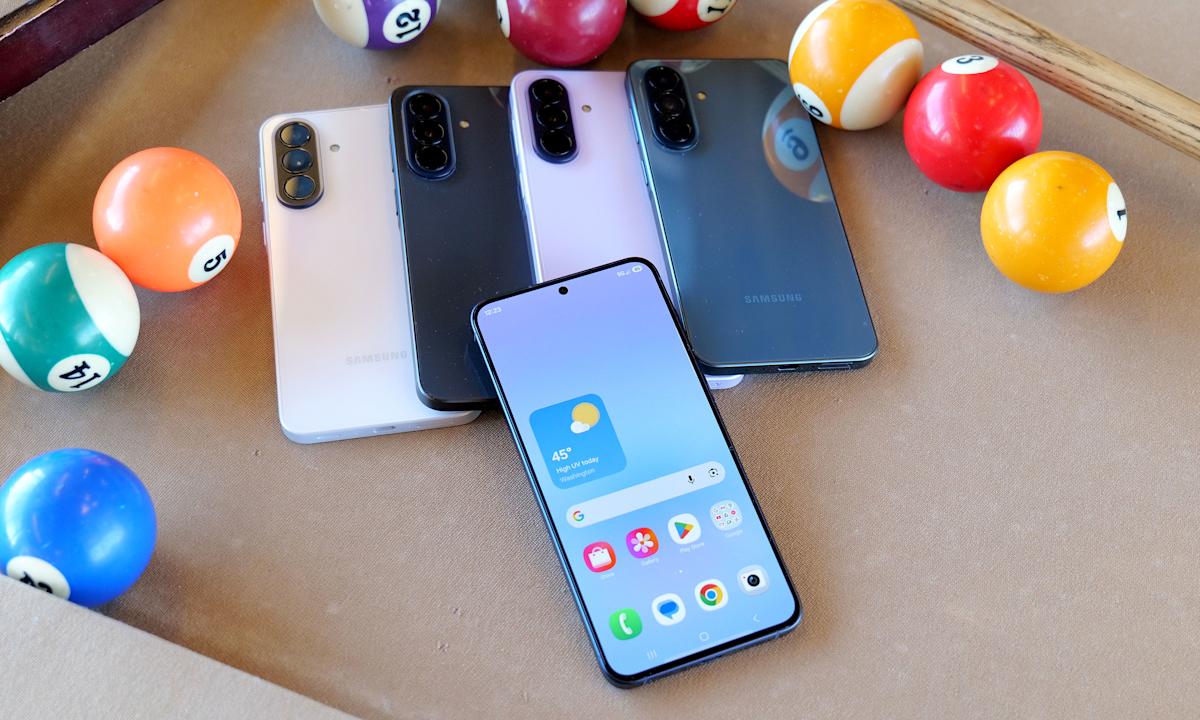
Samsung Galaxy A37 and A57: A Technical Deep Dive
Executive Summary
- Technical Summary: The Samsung Galaxy A37 and A57 are mid-range smartphones built on the Exynos 1480 and 1680 architectures, respectively, featuring 6.7-inch 120Hz AMOLED displays and a significant pivot toward on-device AI acceleration via upgraded NPUs.
- Silicon Parity: The A37's adoption of the Exynos 1480 marks a shift in Samsung’s strategy, bringing high-performance NPU capabilities—previously reserved for higher tiers—to the $450 price point to support Google’s "Circle to Search" and advanced generative editing.
- Power Delivery Shift: Both models feature 45W wired fast charging, technically surpassing the base Galaxy S26’s 25W limitation, signaling a breakdown in traditional flagship-to-mid-range hardware tiering.
- Longevity Commitment: Samsung has codified a 6-year OS and security update lifecycle for both devices, running Android 16/One UI 8.5 out of the box, extending the enterprise utility of mid-range hardware.
Technical Architecture
The Galaxy A37 and A57 represent a convergent design philosophy where the primary differentiators are no longer screen size or battery capacity, but rather material science, silicon throughput, and wireless protocols.
Silicon and Compute: The Exynos 1480 vs. 1680
At the heart of the A37 is the Exynos 1480. While specific transistor counts and clock speeds are not yet fully disclosed in the provided documentation, the architecture is confirmed to provide a "big jump in NPU performance" compared to the previous generation's Exynos 1380. This performance bump is critical for the local execution of Samsung’s One UI 8.5 AI features.
The A57 utilizes the Exynos 1680. Architecturally, this chipset serves as the "performance" tier of the mid-range lineup. While "snappiness" in general UI navigation is reported as similar between the two chips, the 1680 is likely optimized for higher sustained workloads and advanced image signal processing (ISP). This is evidenced by the A57’s exclusive "Best Face" camera tool, which requires the ISP and NPU to perform real-time facial expression analysis across multiple frames—a task that appears to be the primary computational differentiator between the 1480 and 1680.
Structural Engineering and Thermals
The most significant architectural divergence is found in the chassis:
- A37: Utilizes a high-grade plastic frame. While lighter, it lacks the thermal conductivity of metal.
- A57: Features an aluminum frame. This is a technical upgrade for two reasons: structural rigidity and heat dissipation. Aluminum acts as a passive heatsink for the Exynos 1680, which likely has a higher TDP (Thermal Design Power) given its increased performance profile.
Wireless Interconnects
A significant technical gap exists in the connectivity stack:
- A57: Supports Bluetooth 6 and Wi-Fi 6E. The inclusion of Wi-Fi 6E (6GHz band) reduces latency and interference in congested environments, making it more suitable for cloud-based AI tasks and high-bandwidth streaming.
- A37: Remains on Bluetooth 5.3 and standard Wi-Fi 6 (2.4GHz/5GHz).
Performance Analysis
The performance of these devices is best understood through their ability to handle "Trickle-Down AI"—features previously exclusive to the Galaxy S-series.
AI Benchmarking (Inferred)
The integration of Google’s "Circle to Search" and Samsung’s "Object Eraser" suggests that the Exynos 1480 and 1680 have crossed a specific TOPS (Tera Operations Per Second) threshold required for Google’s mobile AI stack. The A37’s snappiness in "Object Eraser" tasks indicates that Samsung has optimized the software-silicon abstraction layer (One UI 8.5) to utilize the NPU effectively even on 6GB RAM configurations.
Benchmark and Specification Comparison
| Feature | Galaxy A37 | Galaxy A57 | Pixel 10a (Reference) |
|---|---|---|---|
| Processor | Exynos 1480 | Exynos 1680 | Tensor G-series (Expected) |
| RAM | 6GB / 8GB | 8GB / 12GB | 8GB |
| Display | 6.7" AMOLED, 120Hz | 6.7" AMOLED, 120Hz | 6.3" Display |
| Charging (Wired) | 45W | 45W | ~18W-27W (Est.) |
| Main Camera | 50MP | 50MP | ~64MP |
| Ultra-Wide | 8MP | 12MP | ~13MP |
| Frame Material | Plastic | Aluminum | Aluminum/Plastic |
| Wireless Tech | BT 5.3 / Wi-Fi 6 | BT 6 / Wi-Fi 6E | BT 5.4 / Wi-Fi 7 (Est.) |
| Base Price (USD) | $450 | $550 | ~$499 |
Power and Charging Efficiency
The inclusion of 45W wired charging is a disruptive technical move. By exceeding the 25W cap of the base Galaxy S26, Samsung is prioritizing charging speeds as a "hero feature" for the A-series.
- Battery: 5,000mAh (Standard on both).
- Wireless Charging: Both models lack Qi/Qi2 support, a trade-off made to accommodate the 45W wired circuitry and keep the BOM (Bill of Materials) low.
Technical Implications
1. The Death of the "Premium" Charging Barrier
Historically, charging speed was a tier-one differentiator. By granting 45W to the A37/A57, Samsung is acknowledging that the mid-range user values "up-time" more than flagship users might value "wireless convenience." This forces a shift in how competitors (specifically Google and Apple) must spec their affordable lines.
2. Software Lifecycle as Hardware Value
The promise of 6 years of OS and security updates (Android 16 through Android 22) places a massive burden on the Exynos 1480/1680 NPUs. For these devices to remain functional in 2032, the current AI features must be efficient enough that future OS bloat doesn't render the hardware obsolete. This suggests that the Exynos 1480/1680 chips have more "headroom" than typical mid-range silicon of previous years.
3. One UI 8.5 and AI Localization
The "Best Face" tool on the A57 is a prime example of high-intent AI processing. Unlike translation, which can be offloaded to the cloud, Best Face requires frame-by-frame local analysis of facial landmarks. The exclusion of this feature from the A37—despite the A37's competent Exynos 1480—suggests either a RAM-specific bottleneck or a specific instruction set available only in the 1680.
Limitations and Trade-offs
- The Macro Lens "Tax": Both phones continue to feature a 5MP macro camera. From a technical perspective, this sensor adds little value compared to a high-quality crop from the 50MP main sensor and is largely a marketing inclusion to reach a "Triple Camera" spec.
- Bezel Asymmetry: The A37 features "slightly thicker" bezels. For developers and UI designers, this implies that the screen-to-body ratio is not consistent across the A-series, necessitating flexible UI layouts that don't rely on precise edge-to-edge tolerances.
- The "Navy" Constraint: The A57 is limited to a single color (Navy), suggesting a simplified supply chain for the more expensive model, likely to offset the costs of the aluminum frame and upgraded Wi-Fi/Bluetooth modules.
- No Wireless Charging: The lack of Qi support in 2026 for a $550 phone (A57) is a notable technical omission, especially as Qi2 becomes a standard in the industry.
Expert Perspective
The Galaxy A37 is the "winner" of this announcement not because it is the most powerful, but because it represents the most efficient use of Samsung's current supply chain. By utilizing the Exynos 1480—a chip that essentially brings last year’s flagship-adjacent performance to a $450 device—Samsung is effectively pricing Google’s Pixel "a" series out of the large-screen market.
Technically, the A57 is a "hard sell." The jump to Bluetooth 6 and Wi-Fi 6E is forward-looking, but for the average consumer, these benefits are invisible. The aluminum frame is the only tangible "premium" feel, yet the A37 manages to look nearly identical. For senior developers, the A37 is the "baseline" target for the next six years of Android development in the mid-range segment.
Technical FAQ
How does the Exynos 1480 handle generative AI compared to the Pixel 10a's Tensor?
While specific head-to-head NPU benchmarks are not yet available, the Exynos 1480 is designed for Samsung's One UI 8.5 stack. It excels at "Object Eraser" and transcription. The Pixel 10a will likely retain an edge in natural language processing (NLP) due to Google's specialized TPU (Tensor Processing Unit) design, but the A37’s 6.7-inch display gives it a distinct hardware advantage for visual AI tasks.
Is the 45W charging compatible with older Samsung Power Delivery (PD) bricks?
Yes, it follows the PPS (Programmable Power Supply) standard. However, to achieve the full 45W, users must use a 5A-rated USB-C cable and a charger that supports the specific 10V/4.5A or similar PPS profile. The base 25W chargers will still work but will negotiate at the lower speed.
Does the plastic frame of the A37 impact the IP68 rating?
No. Samsung has successfully achieved an IP68 rating (immersion up to 1.5m for 30 mins) using a plastic-to-glass adhesive bond. The upgrade from IP67 on the A36 indicates improved gasket sealing and acoustic membrane technology in the speaker ports and SIM tray.
What are the API implications of the "Best Face" tool on the A57?
"Best Face" appears to be a proprietary extension within the Samsung Camera Social API. Currently, there is no indication that this facial expression analysis is exposed to third-party developers via the Android Camera2 API, though transcription and translation services are likely accessible through Samsung's SDKs.
References
- Samsung One UI 8.5 Documentation (Technical Preview)
- Exynos 1480/1680 Platform Briefs
- IEEE Standard for Bluetooth 6.0 Connectivity
Sources
All technical specifications, pricing, and benchmark data in this article are sourced directly from official announcements. Competitor comparisons use publicly available data at time of publication. We update our coverage as new information becomes available.