
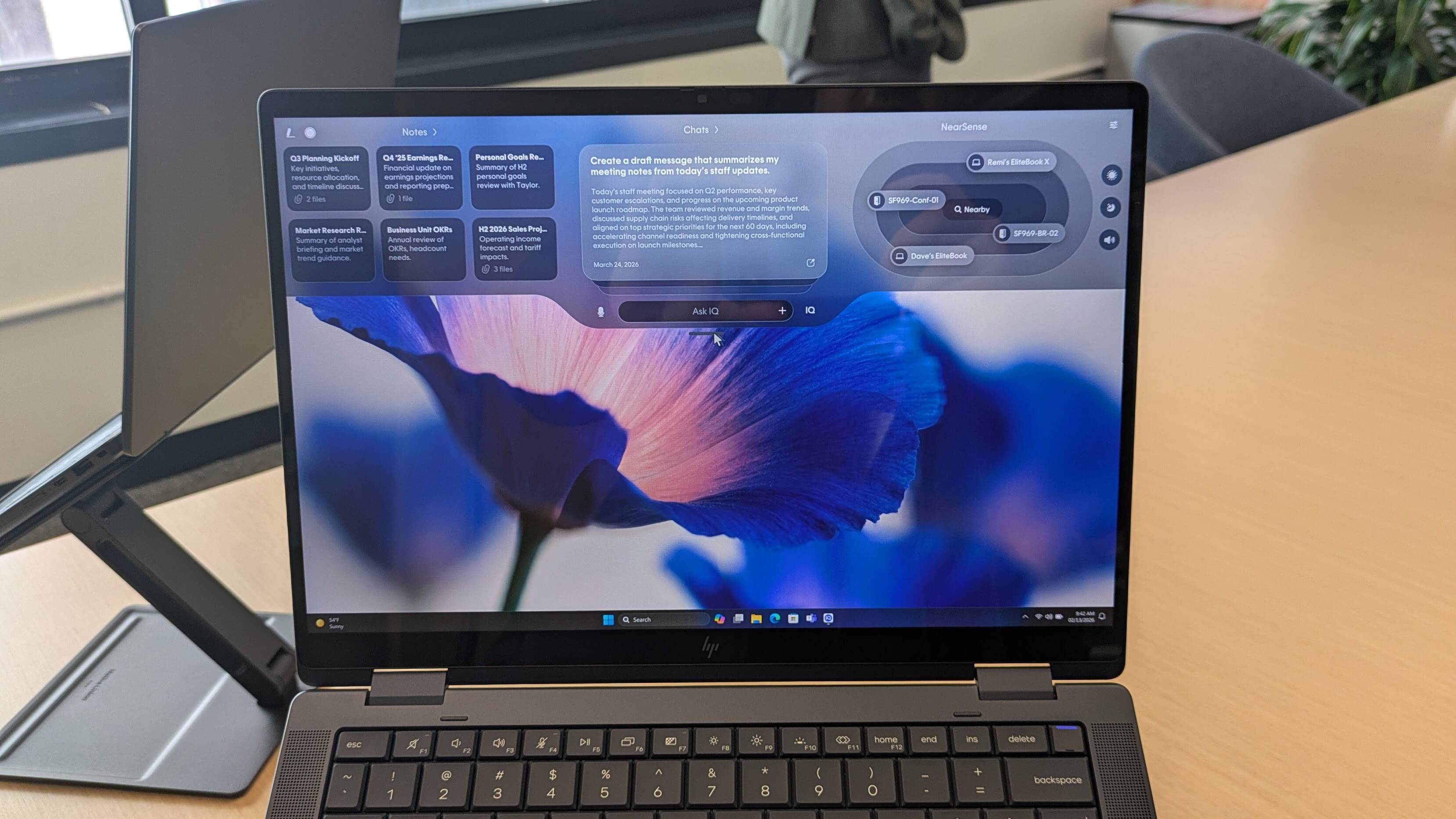
Our Honest Take on HP IQ: A Privacy Minefield in a Productivity Wrapper
HP is attempting to transition from a hardware vendor to an "intelligence architect" with the announcement of HP IQ. By embedding a local Large Language Model (LLM) directly into its 2026 EliteBook and ProBook lineups, HP is making a play for the small-to-medium business (SMB) market that remains wary of sending sensitive data to the cloud.
However, the headline feature—a "fly on the wall" AI that records in-person meetings via laptop microphones—walks a razor-thin line between "useful assistant" and "HR nightmare." While the technical ambition of local inference is commendable, the implementation details suggest a product that prioritizes ecosystem lock-in over user etiquette.
Verdict at a Glance
- What’s genuinely impressive: The commitment to local-first AI. Using a 20B parameter model (
gpt-oss-20b) on-device with 24GB of RAM minimum ensures that sensitive "board meeting" data stays off third-party servers. - What’s disappointing: The blatant disregard for recording transparency. Unlike digital meeting bots (e.g., Fireflies, Otter) that announce their presence in a Zoom call, HP IQ’s in-person recording is invisible to everyone except the laptop owner.
- Who it’s for: SMBs and privacy-conscious executives who need AI summarization but are legally or culturally prohibited from using cloud-based LLMs.
- Price/Performance verdict: Likely a premium tier cost. By mandating a minimum of 24GB of RAM across the "AI PC" lineup, HP is effectively raising the floor price for business-standard laptops.
What’s Actually New
Strip away the "AI PC" branding, and you find three specific advancements that move the needle for HP:
- The "gpt-oss-20b" Local Implementation: HP isn't just skinning a cloud API. They are deploying a 20-billion parameter model—trained as recently as September 2025—to run locally. This is a significant step up from the lightweight 3B or 7B models usually seen in local demos, providing enough "reasoning" power to handle complex document analysis and meeting synthesis without latency or data egress.
- Hardware-Level Proximity Awareness (NearSense): Using a fusion of Wi-Fi, Bluetooth, and microphones, HP has created a room-mapping system that claims to be accurate enough to know if you are inside a glass-walled conference room or just outside it. This isn't just "AirDrop for Windows"; it’s an automated handshake with HP Poly conferencing hardware.
- The 24GB RAM Floor: HP is the first major OEM to explicitly state that 16GB is no longer enough for a "pro" AI experience. By setting the minimum at 24GB for HP IQ, they are resetting the industry standard for what a workstation requires to handle background LLM tasks.
The Hype Check
The Claim: HP IQ makes your PC "more valuable than ever before" by providing a layer of intelligence that stretches across devices.
The Reality: Mixed. While the "NearSense" feature promises to automate logins and file sharing, it is heavily dependent on the HP ecosystem. If your office uses Logitech cameras or Dell monitors, the "intelligence" of HP IQ hits a wall. The claim of being a "fly on the wall" is also a bit of marketing flair for what is essentially a high-end voice recorder paired with a local transcription engine.
The Privacy Claim: Matt Brown (HP Head of Product) suggests that recording in-person meetings is fine because "online meetings are routinely recorded these days."
The Rebuttal: This is a false equivalence. In a Zoom or Teams call, every participant receives a visual and audible notification that recording has started. HP IQ’s in-person recording has no such safeguard. Unless you are staring at your colleague's EliteBook screen, you have no way of knowing your "off the record" coffee chat is being ingested by a 20B parameter model. HP’s "recommendation" to ask for permission is a weak substitute for built-in software guardrails.
Real-World Implications
- For the CTO: This is a compelling argument for a refresh cycle. If your legal team has banned ChatGPT due to data leak concerns, a local-only HP IQ environment offers a viable "sandbox" for AI productivity.
- For HR/Legal: This is a potential liability. Without a physical "recording" light or a mandatory notification system, HP IQ could inadvertently lead to violations of "two-party consent" recording laws in various jurisdictions.
- For the End User: The ability to walk into a room and have your laptop automatically pair with the Poly Video Bar is a genuine quality-of-life improvement. It removes the "first five minutes of the meeting" struggle with cables and settings.
Limitations They’re Not Talking About
- The "No Audio/No Transcript" Omission: HP claims they don't store the audio or full transcript to preserve privacy. While this sounds good in a press release, it’s a functional nightmare. If the AI hallucinates a "top concern" that wasn't actually said, the user has no way to verify the summary against the original source audio.
- The Internet Polling "Ghost": The local model can poll the internet for live data (weather, stocks). HP says IT departments can disable this, but there is no mention of how an individual user will know when their "local" model is suddenly talking to the web.
- The September 2025 Knowledge Cutoff: Even "new" AI is old. A model trained in late 2025 will struggle with context regarding events that happened "this morning" unless the internet polling feature is active, creating a tension between being "current" and being "secure."
How It Stacks Up
HP is playing a different game than Microsoft or Apple.
- Vs. Microsoft Copilot: Copilot is cloud-heavy and integrated into the OS. HP IQ is local-heavy and integrated into the hardware. HP IQ is arguably more secure for sensitive documents, but Copilot has a deeper reach into your emails and calendar.
- Vs. Apple Intelligence: Apple uses a hybrid approach (on-device + Private Cloud Compute). HP IQ is leaning harder into the "on-device" promise for the SMB sector, but lacks the seamless mobile integration Apple enjoys (until their promised Android compatibility arrives).
- Vs. Third-Party Apps (Ollama, Fireflies): HP’s advantage is the "it just works" factor. While you can run a 20B model via Ollama, you won't get the automated room mapping and Poly hardware integration that HP IQ provides out of the box.
Constructive Suggestions
To make HP IQ a gold standard for the enterprise, we suggest the following:
- Implement a Physical/Visual Tally: HP laptops should include a dedicated LED (similar to a webcam light) that illuminates when HP IQ is recording audio. Trust is built through transparency, not "best practice" recommendations.
- Verification Mode: Allow users to opt-in to keeping a temporary, encrypted transcript for 24 hours. Summaries without the ability to "fact-check" the AI are dangerous in a business setting.
- Cross-OEM NearSense: If HP wants NearSense to be a "standard," they should work with the Windows ecosystem to make it compatible with non-HP peripherals. Ecosystem lock-in is the enemy of the modern, flexible office.
Our Verdict
Who should adopt now: HP-centric offices that already use Poly hardware and have strict data sovereignty requirements. The productivity gains from local summarization and auto-conferencing are tangible.
Who should wait: Companies in highly litigious environments or regions with strict privacy laws. The current lack of "recording" notifications is an unresolved social and legal friction point.
Who should skip: Organizations that use mixed-vendor hardware. Without the HP ecosystem (EliteBooks + Poly bars), IQ is just another LLM in a market already saturated with them.
FAQ
Should we switch from Dell/Lenovo to HP just for IQ?
Only if you are also invested in the Poly ecosystem. The "NearSense" features are the only unique hardware-software bridge here. If you just want a local LLM, you can achieve 80% of the same functionality on any high-spec PC using open-source tools.
Is it worth the price premium for 24GB RAM?
Yes. AI workloads are "memory hungry." Trying to run a 20B parameter model on 16GB of RAM while also running Chrome, Slack, and Excel would lead to a frustrating, sluggish experience. HP is right to set a higher hardware floor.
Does "GPT-OSS" mean it's as good as GPT-4?
No. While based on OpenAI architecture, a 20B parameter local model will not have the vast general knowledge or complex reasoning of a multi-trillion parameter cloud model like GPT-4o. It is a specialized tool for summarization and document analysis, not a creative partner.
Sources
All technical specifications, pricing, and benchmark data in this article are sourced directly from official announcements. Competitor comparisons use publicly available data at time of publication. We update our coverage as new information becomes available.