
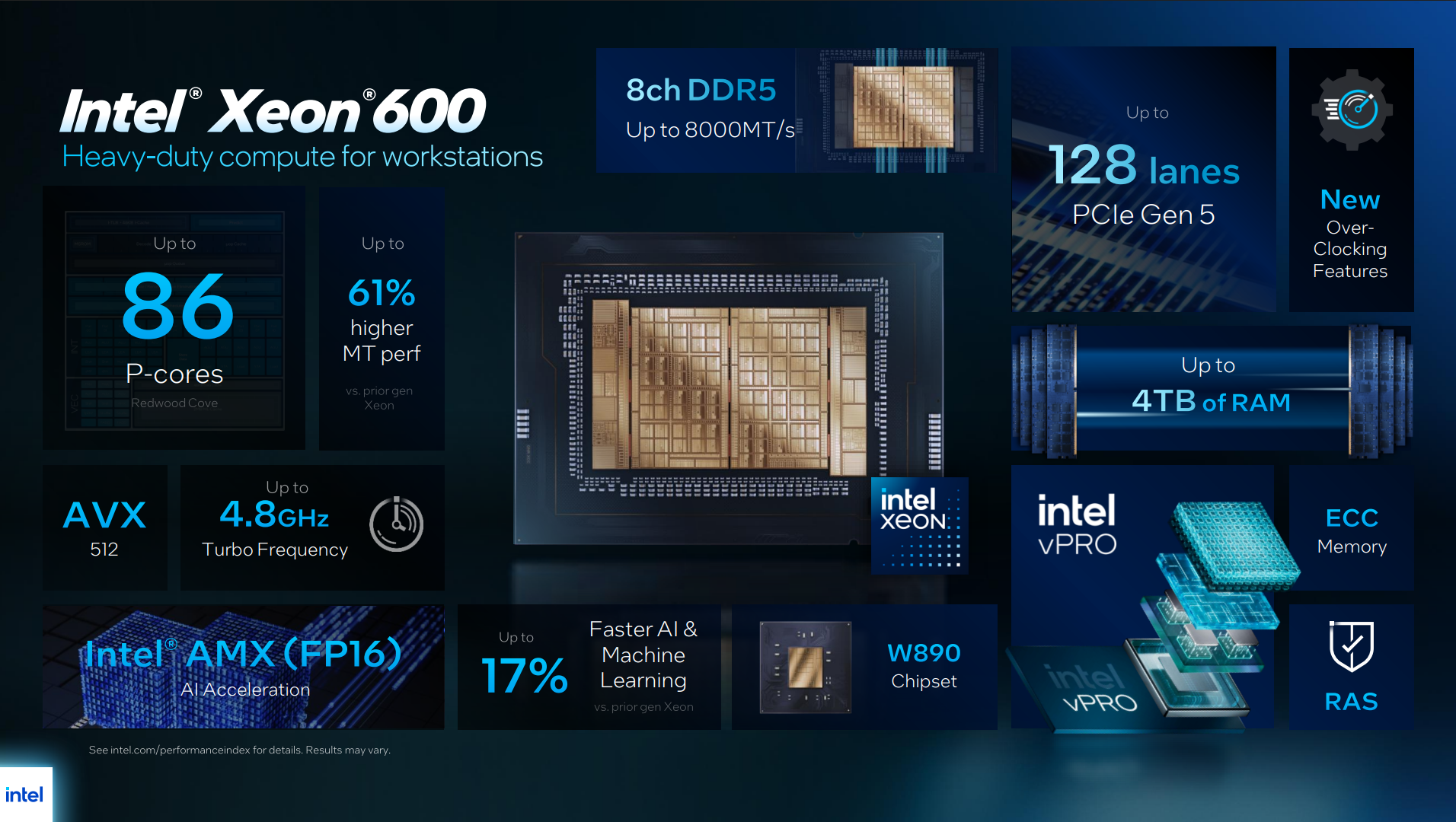
- What: Intel officially released Xeon 600 workstation CPUs (Granite Rapids-WS) and the vPro Panther Lake platform.
- Key Specs: Up to 86 cores, 128 PCIe 5.0 lanes, and support for 4TB of DDR5 memory.
- Performance: Up to 74% faster in rendering and 29% faster in AI-powered video upscaling.
- Availability: Standalone chips and integrated systems are scheduled for release in late March.
Intel officially launched its Xeon 600 workstation processors today, bringing the high-performance "Granite Rapids" architecture to the desktop to capture the surging demand for local AI development and heavy compute power. The release, paired with the announcement of an "all-new" vPro platform powered by upcoming Panther Lake CPUs, signals a definitive shift in Intel’s enterprise strategy to go "all-in" on hardware-accelerated artificial intelligence.
Granite Rapids Arrives for the Desktop
The Xeon 600 series, previously known by the codename Granite Rapids-WS, represents a massive leap for Intel’s workstation portfolio. Built on the Intel 3 process node, these chips are designed to handle the most grueling compute workloads, including complex simulations, high-fidelity rendering, and large-scale AI model development.
At the top of the stack, the new processors offer a staggering 86 cores. To support such high core counts, Intel has outfitted the platform with 128 PCIe 5.0 lanes and support for up to 4TB of DDR5 memory. This massive memory ceiling is specifically tailored for AI developers who need to keep large datasets or expansive LLMs (Large Language Models) in local memory rather than relying on slower storage or expensive cloud instances.
The platform utilizes the new Intel W890 chipset, which provides the necessary bandwidth to support the increased I/O requirements of modern data science and engineering workflows.
AI Performance and AMX Accelerators
Intel is positioning the Xeon 600 as an "AI developer's dream," largely due to the integration of Advanced Matrix Extensions (AMX). These built-in hardware accelerators are designed specifically to speed up tensor processing, the mathematical backbone of artificial intelligence.
According to Intel’s internal benchmarks, the flagship Xeon 698X demonstrated significant performance gains over previous generations:
- Rendering: Completed the Blender Junkshop render 74% faster than the Xeon w9-3595X.
- AI Upscaling: Delivered a 29% speed increase in Topaz Labs Video Upscaler.
These gains are attributed directly to the AMX accelerators, which allow the CPU to handle AI tasks that previously required dedicated GPU intervention. This makes the Xeon 600 a formidable option for "agentic AI" workflows, where CPUs must handle high-speed decision-making and data processing in real-time.
Panther Lake and the "All-New" vPro
While the Xeon 600 targets the high-end workstation market, Intel also used the announcement to preview the future of its business-class mobile and desktop computing: the vPro Panther Lake platform.
Intel described the upcoming Panther Lake CPUs as the foundation for an "all-new" vPro platform that is being built from the ground up for the AI era. While specific core counts for Panther Lake were not detailed, Intel claimed the new architecture would deliver a 76% boost in gaming performance—a metric often used as a proxy for the power of integrated graphics, which are increasingly utilized for local AI inference tasks in thin-and-light business laptops.
The Panther Lake rollout is part of Intel's broader "AI PC" initiative, aiming to bring NPU (Neural Processing Unit) capabilities to every level of the corporate fleet, from executive ultrabooks to entry-level office machines.
Impact on the Industry and Developers
For developers and data scientists, the release of the Xeon 600 represents a shift back toward localized, high-performance computing. As cloud costs for AI training continue to climb, the ability to run 86-core machines with 4TB of RAM under a desk becomes an attractive economic proposition.
"This changes how developers will iterate on local models," noted industry analysts following the launch. "By bringing server-grade Granite Rapids power to the workstation, Intel is shortening the feedback loop for AI training and simulation."
In the competitive landscape, this move places Intel in direct competition with AMD’s Ryzen AI 400 series. While AMD has made significant strides in integrated AI performance for consumer chips, Intel's Xeon 600 is a clear play for the "heavyweight" crown in the professional workstation segment.
What’s Next
Intel confirmed that the Xeon 600 series processors will be available as standalone "boxed" CPUs and within pre-built systems from major OEMs starting in late March.
As for Panther Lake, the company is expected to provide deeper technical specifications later this year as it prepares to transition its vPro platform to the new architecture. Investors and enterprise buyers will be watching closely to see if Panther Lake can maintain Intel's dominant market share in the corporate sector against rising competition from ARM-based alternatives and AMD’s expanded AI portfolio.