
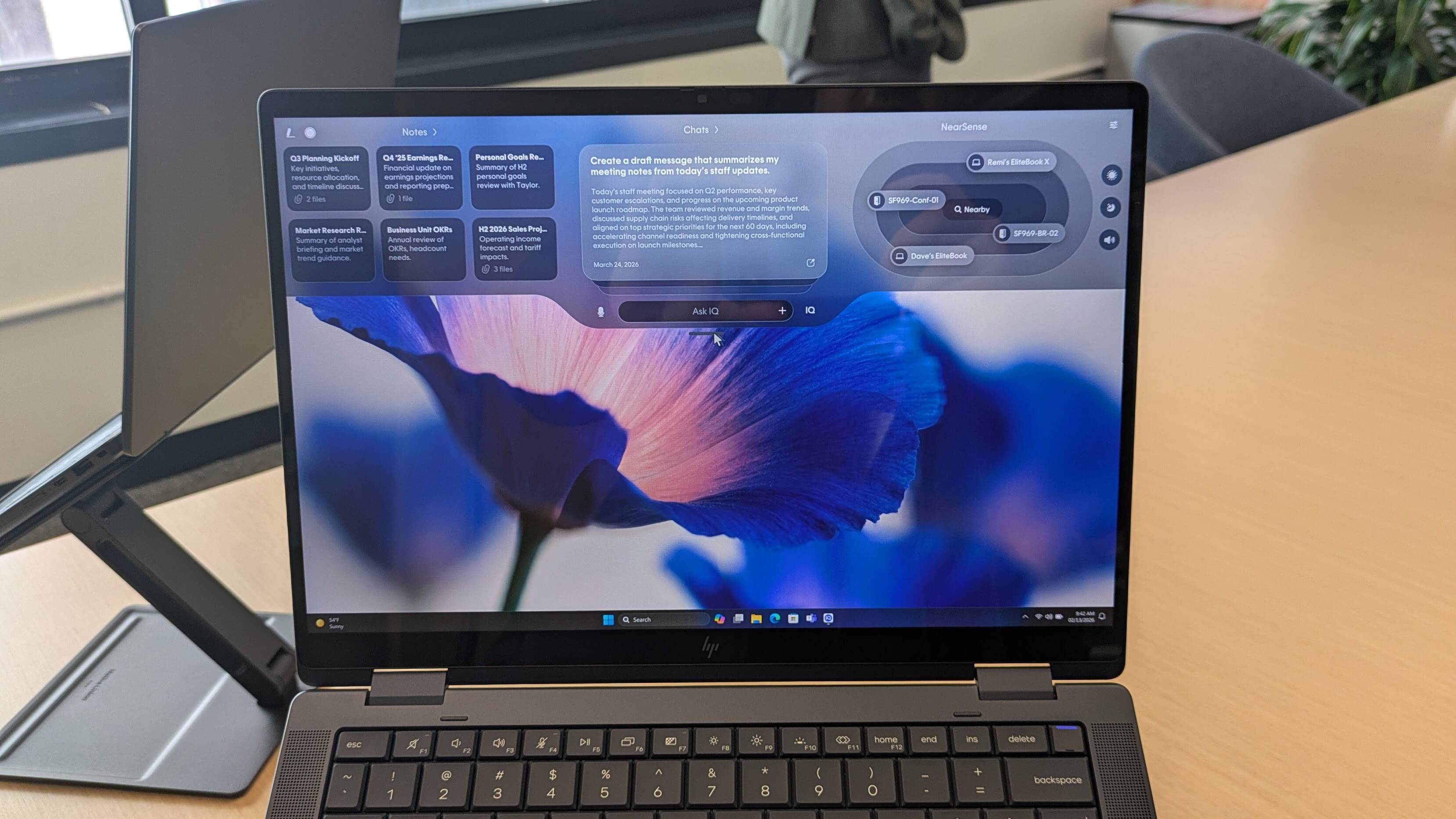
HP Launches HP IQ: The 'AI Fly on the Wall' That Records In-Person Meetings
- What: HP IQ, a local AI application suite for enterprise laptops.
- Core Tech: Powered by OpenAI’s gpt-oss-20b large language model (LLM).
- Hardware: Requires 2026 EliteBook or ProBook "AI PCs" with at least 24GB of RAM.
- Availability: Early access begins spring 2026; full rollout scheduled for H2 2026.
HP Inc. has unveiled HP IQ, a localized AI suite that transforms business laptops into an intelligent "fly on the wall" capable of recording and summarizing in-person meetings. Announced Tuesday, the application leverages OpenAI’s gpt-oss-20b model to bring advanced generative intelligence directly to the company’s 2026 EliteBook and ProBook AI PCs, bypassing the need for constant cloud connectivity for core tasks.
The launch signals HP’s aggressive move to differentiate its hardware in a crowded market dominated by Microsoft Copilot, Apple Intelligence, and Google Gemini. By focusing on local processing and proximity-based features, HP aims to capture the small business and enterprise segments looking for privacy-conscious productivity tools.
Three Pillars of HP IQ: Chat, Summarization, and Proximity
HP IQ is built upon three primary functional elements designed to streamline the modern workplace. According to Matt Brown, head of product for HP IQ, the goal is to create a "layer of intelligence" that makes AI PCs more valuable by providing powerful models natively inside the device.
The first component is a dedicated LLM interface that allows users to chat with the bot and grant it access to local documents for analysis. In a demonstration provided to The Register, an HP representative used the system to analyze a sensitive document and draft a board meeting overview. The tool reportedly performed these tasks with high speed and detail, utilizing the local hardware's processing power.
The second feature, the "meeting agent," is perhaps the most consequential. It uses the laptop’s built-in microphones to capture live, in-person conversations. Once a meeting concludes, the AI generates summaries and extracts specific action items. Users can also query the meeting data, asking the bot questions such as "what were the top concerns shared by the team?"
The third pillar, HP NearSense, focuses on hardware synergy. It allows users to share files via drag-and-drop with coworkers in the same room—a feature that directly mirrors Apple’s AirDrop. Furthermore, NearSense can automatically log a user into an HP Poly conferencing system or start a meeting on local video bars simply by detecting the user's proximity.
Technical Specifications and Hardware Demands
Running a 20-billion parameter model locally requires significant hardware overhead. HP has confirmed that HP IQ will initially be restricted to its 2026 EliteBook and ProBook models designated as "AI PCs."
A critical requirement for the software is a minimum of 24GB of RAM, a step up from the 8GB or 16GB typically found in standard office notebooks. HP reps noted that the technology utilizes a variety of sensors—including Wi-Fi, Bluetooth, and microphones—to map rooms and detect nearby users. The company claims the proximity detection is accurate enough to exclude users standing just outside a glass office door.
The roadmap for HP IQ includes expansion to desktops and Poly Studio Video Bars by the summer of 2026, with a broader range of IQ-enabled devices arriving in the second half of the year.
Impact: Productivity vs. Privacy
The introduction of an "AI fly on the wall" brings significant implications for workplace culture and privacy. While digital meeting assistants like Fireflies.ai or Otter.ai are common in virtual calls, HP IQ’s focus on physical, in-person recording represents a shift in how office interactions are documented.
"We see a big opportunity to help people thrive more in the workplace," Brown told The Register. However, the potential for "creepy" or unauthorized recording of coworkers is a primary concern. To mitigate this, HP recommends that users follow best practices by asking for permission before recording.
Notably, HP IQ does not store original audio recordings or provide full transcripts to the user. While this is positioned as a privacy safeguard, it also means users cannot verify the AI's summary against the original source audio within the application.
For developers and IT managers, the move toward local LLMs like gpt-oss-20b reduces latency and bandwidth costs associated with cloud-based AI. It also offers a more secure environment for handling sensitive corporate data that companies may be hesitant to send to external servers.
"This layer of intelligence will stretch across our devices... making them more valuable than ever before." — Matt Brown, HP Head of Product for HP IQ.
What's Next for HP IQ
HP has laid out a three-year roadmap for the IQ platform. Future updates are expected to include expanded proximity-based features, such as the ability to automatically pair with nearby headsets, cast screens to adjacent displays, or print to IQ-enabled printers without manual setup.
Furthermore, HP plans to make HP IQ compatible with Android devices in the near future. This cross-platform expansion would bring local file sharing and conferencing features to millions of smartphones, potentially creating a unified ecosystem that challenges the seamless integration found in the Apple/macOS environment.
Sources
- The Register
- HP Official Announcement (Referenced via The Register)
All technical specifications, pricing, and benchmark data in this article are sourced directly from official announcements. Competitor comparisons use publicly available data at time of publication. We update our coverage as new information becomes available.