
HP IQ: A Technical Deep Dive into the On-Device Enterprise LLM Ecosystem
Executive summary
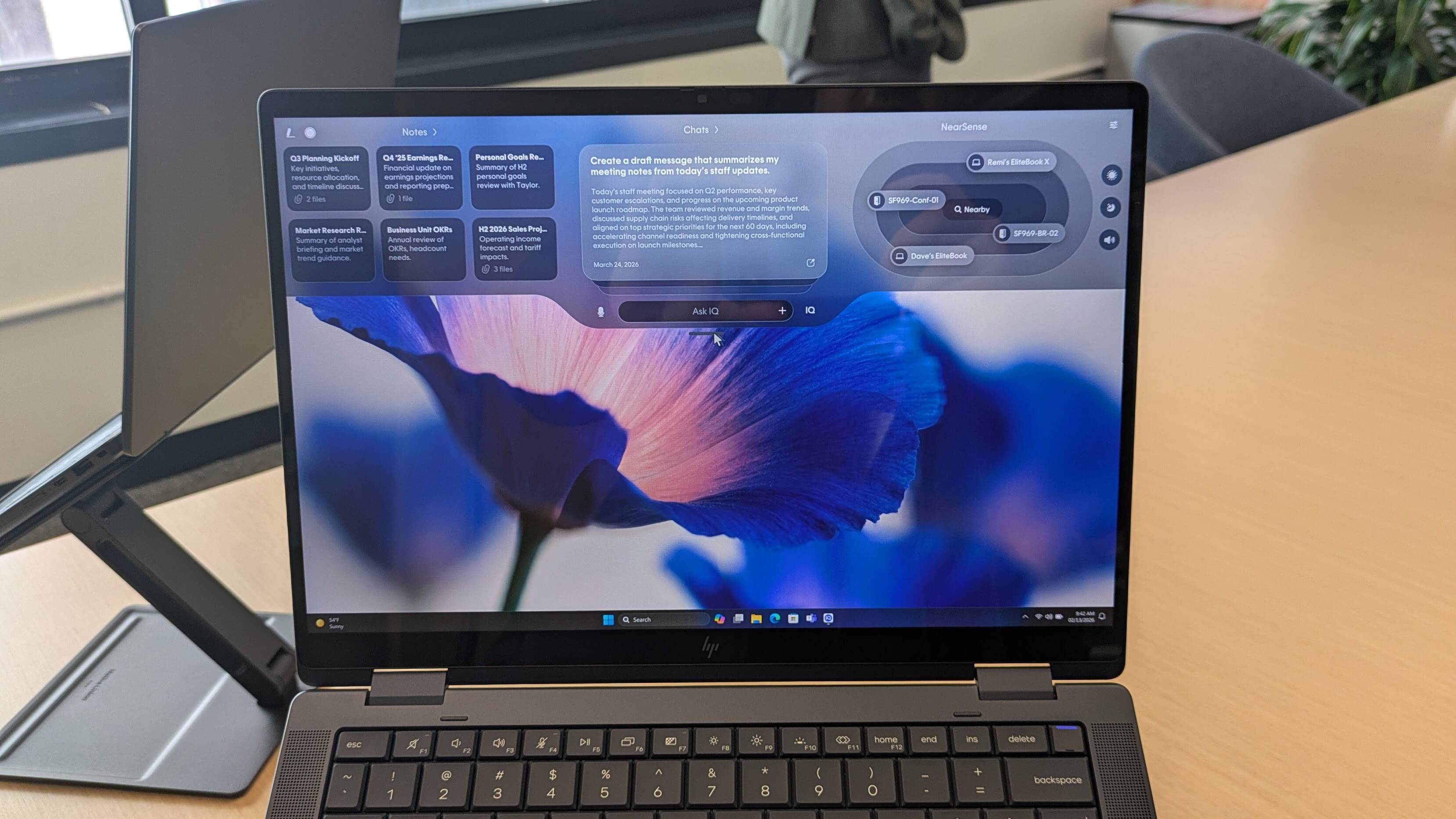
HP IQ is a local AI and collaboration suite leveraging OpenAI’s gpt-oss-20b model on 2026 EliteBook and ProBook hardware to provide on-device document analysis, in-person meeting summarization, and proximity-based device orchestration.
- Core Model: Powered by OpenAI’s
gpt-oss-20b, an LLM specifically trained (as of September 2025) for local execution and enterprise workflows. - Hardware Baseline: Requires a minimum of 24 GB of RAM and 2026-generation "AI PC" silicon to sustain local inference and real-time audio processing.
- Ecosystem Integration: Features "NearSense" technology, utilizing a multi-modal sensor stack (Wi-Fi, Bluetooth, Microphones) for sub-meter proximity detection and automated conferencing login.
- Privacy-Centric Architecture: Employs a local-first processing model that eschews cloud storage of raw audio or full transcripts, focusing instead on semantic summary extraction.
Technical architecture
The HP IQ architecture represents a shift from cloud-dependent AI assistants toward a high-performance local edge computing model. The system is built on three primary pillars: the local LLM runtime, the meeting agent, and the proximity-aware NearSense layer.
1. The Local LLM: gpt-oss-20b
The heart of the system is the gpt-oss-20b model, provided by OpenAI. While specific architectural details like layer counts or attention mechanisms are not yet disclosed, the "20b" nomenclature indicates a 20-billion parameter model—a significant size for on-device inference that explains the high RAM requirements.
HP has implemented a hybrid retrieval-augmented generation (RAG) style system:
- Local Processing: Document analysis and chat occur locally for sensitive data.
- Dynamic Polling: For real-time data (weather, stocks), the model polls the internet. IT administrators can disable this via global policy to ensure "air-gapped" performance.
- Context Window: The specific context window size for
gpt-oss-20bis not yet disclosed, though it is designed to handle multi-document board meeting preparation and lengthy meeting summaries.
2. Multi-Modal Meeting Agent
Unlike virtual meeting assistants (like Fireflies.ai or Otter.ai) that tap into digital audio streams, HP IQ utilizes the physical microphone array of the laptop to capture in-person conversations. This requires:
- Beamforming & Acoustic Echo Cancellation: Leveraging the 2026 "AI PC" hardware to isolate voices in a conference room setting.
- Semantic Distillation: The system does not generate or store a full transcript or raw audio. Instead, it processes audio buffers locally to extract action items and concerns, effectively using the LLM as a real-time semantic filter.
3. HP NearSense Proximity Stack
NearSense is a proprietary spatial awareness layer. It uses a fusion of sensors to map the environment:
- Bluetooth/Wi-Fi RSSI: For coarse proximity.
- Microphone/Acoustic Mapping: For precise "in-room" detection. This allows the system to distinguish between a user inside a room and a user standing just outside a glass door, a level of granularity usually requiring Ultra-Wideband (UWB) chips.
Performance analysis
The decision to mandate 24 GB of RAM as a minimum requirement highlights the computational intensity of running a 20B parameter model alongside standard enterprise applications.
Benchmark and Specification Comparison
| Feature | HP IQ (gpt-oss-20b) | Typical Cloud LLM (e.g., GPT-4o) | Local Competition (Ollama/Llama 3 8B) |
|---|---|---|---|
| Model Size | 20 Billion Parameters | Undisclosed (Trillions) | 8 Billion Parameters |
| Minimum RAM | 24 GB | N/A (Cloud-based) | 8-16 GB |
| Training Cutoff | September 2025 | Varies | Varies |
| Privacy Model | Local-first; no stored audio | Cloud-processed | Local-only |
| Proximity Tech | HP NearSense (Proprietary) | N/A | None (Standard OSS) |
| Inference Latency | Optimized for 2026 NPUs* | Network dependent | Variable based on GPU/NPU |
*Specific NPU TOPS (Trillions of Operations Per Second) requirements for HP IQ are not yet disclosed.
Hardware Readiness
The "AI PC" designation for the 2026 EliteBook and ProBook lineups suggests a specialized NPU (Neural Processing Unit) capable of handling the matrix multiplications required by gpt-oss-20b without offloading exclusively to the GPU, which would otherwise drain the battery during long meetings.
Technical implications
The launch of HP IQ signals a pivot in the enterprise AI strategy:
- Semantic Search over Transcripts: By choosing not to store transcripts, HP is betting on "Semantic Extraction." This reduces the storage overhead and minimizes the "creep factor" of recording, though it prevents users from verifying AI summaries against raw text.
- Hardware-Software Vertical Integration: NearSense represents a deep integration between HP’s laptop hardware and its Poly acquisition. The ability to automatically log into a Poly Studio Video Bar via local proximity sensing suggests a move toward a more "Apple-like" ecosystem for the enterprise.
- The End of the 8GB/16GB Business Laptop: HP's 24 GB RAM floor effectively sunsets lower-memory configurations for power users, setting a new baseline for the "AI PC" category.
Limitations and trade-offs
Despite the technical advancements, several trade-offs are evident:
- The "Fly on the Wall" Privacy Gap: Unlike virtual meeting tools that notify participants of a "recording bot," HP IQ relies on social etiquette (asking permission). There is no hardware-level visual indicator (like a webcam LED) that signals the microphone is being used for AI summarization.
- Model Obsolescence: With a September 2025 training cutoff, the model relies on internet polling for current events. This introduces a "privacy leak" potential if the LLM sends queries to external servers while analyzing internal documents.
- Ecosystem Lock-in: While HP mentions future Android compatibility, the core features like NearSense require 2026-era HP hardware and Poly conferencing systems, creating significant friction for heterogeneous hardware environments.
Expert perspective
From a technical standpoint, HP IQ is more than a simple chatbot; it is a Spatial AI OS. By combining an OpenAI-derived 20B model with proximity-based hardware orchestration, HP is solving the "last mile" problem of AI: moving it from the browser into the physical meeting room.
The 24 GB RAM requirement is the most honest indicator we have seen yet regarding the true cost of local, high-quality inference. Developers should watch the gpt-oss-20b performance closely—if HP can achieve sub-second latency for document analysis on a laptop, it may invalidate the need for cloud-based RAG for small-to-medium enterprise data.
Technical FAQ
How does gpt-oss-20b compare to Llama-based local models?
While Llama 3 (8B or 70B) is common in the open-source community, gpt-oss-20b is a middle-ground model optimized by OpenAI for HP's specific hardware. Its 20B parameter count suggests it likely outperforms 8B models in nuanced reasoning and meeting summarization but requires the 24GB RAM overhead that 8B models do not.
Is HP IQ backwards-compatible with 2025 AI PCs?
Currently, no. HP has stated that the early access program is limited to 2026 EliteBook and ProBook models. While they plan to expand to other HP notebooks and desktops by Summer 2026, the specific hardware sensors required for NearSense may limit full functionality on older devices.
How does the proximity detection handle "false positives" (e.g., people in the hallway)?
HP IQ uses "room mapping" during the initial setup. By combining Wi-Fi/Bluetooth signal strength with acoustic analysis, the system can determine if a user is behind a physical barrier like a glass door. If the acoustic signature doesn't match the "in-room" profile, the user is not registered as being in the meeting.
Does the meeting summarizer work offline?
The core meeting agent and summarizer function locally. However, if the user asks the bot for external context (e.g., "Summarize this meeting and compare it to today's market trends"), the system will poll the internet unless IT policies have disabled external access.
References
- HP IQ Early Access Documentation (Internal/Spring 2026 Release)
- OpenAI
gpt-oss-20bModel Specifications (September 2025 Training Cycle) - HP Poly NearSense Proximity API
Sources
- The Register
- [HP Newsroom (March 2026 Announcement)]
All technical specifications, pricing, and benchmark data in this article are sourced directly from official announcements. Competitor comparisons use publicly available data at time of publication. We update our coverage as new information becomes available.