
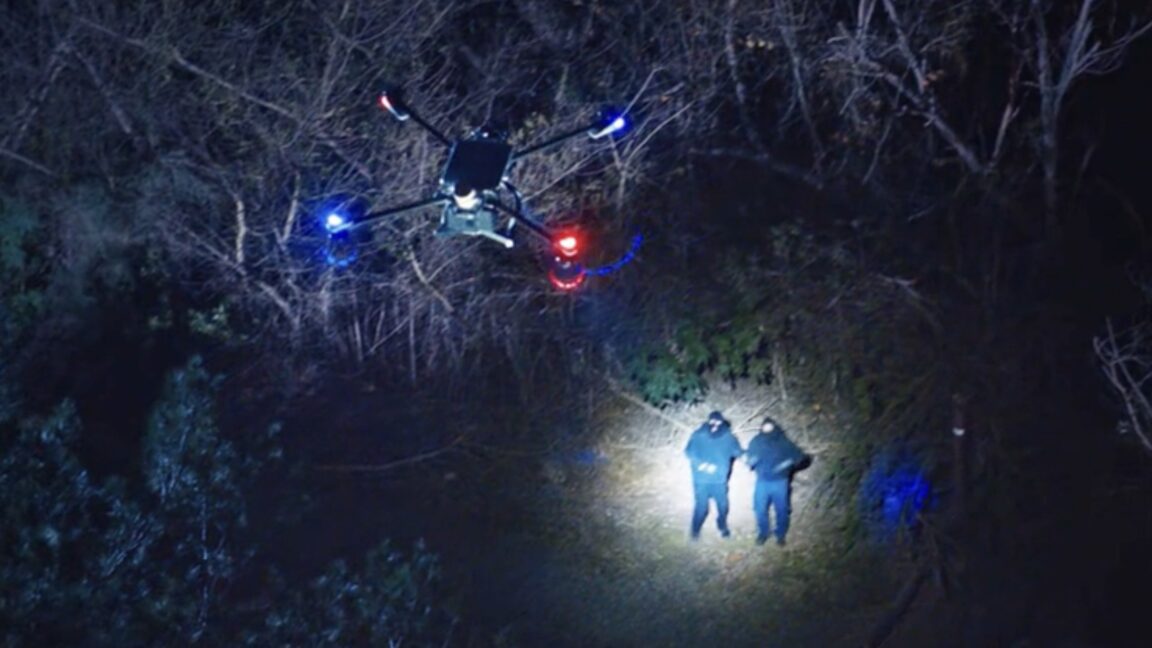
- What: BRINC launched "Guardian," an autonomous public safety drone.
- Key Specs: 60+ mph top speed, 60-minute flight time, and integrated Starlink connectivity.
- Medical Payload: Designed to carry Narcan, automated external defibrillators (AEDs), and flotation devices.
- Infrastructure: Operates via an automated "charging nest" with robotic battery swapping for 24/7 readiness.
- Timeline: Production is scheduled to begin later this year.
American drone manufacturer BRINC has unveiled "Guardian," a high-performance response drone designed to act as a primary first responder for emergency services. Capable of reaching speeds over 60 miles per hour and equipped with a dedicated Starlink connection, the Guardian is positioned as a cost-effective, autonomous alternative to traditional police helicopters.
The launch marks a significant technical milestone for the "Drone as a First Responder" (DFR) sector. According to BRINC, the Guardian is the world's first public safety drone to feature an integrated Starlink panel, ensuring that emergency operations can continue even in areas with compromised or non-existent cellular infrastructure.
A "Helicopter Killer" for Public Safety
The Guardian was engineered specifically to address the limitations of current police response times and hardware. While traditional police helicopters cost millions of dollars to purchase and thousands of dollars per hour to operate, BRINC’s system aims to provide similar aerial overwatch at a fraction of the cost.
With a top speed exceeding 60 mph, BRINC claims the Guardian is the first drone capable of pursuing vehicles in real-time. This speed, paired with a flight time of over an hour, allows the drone to arrive at the scene of a 911 call minutes before ground units. According to a report by GeekWire, the system is designed to "replace the police helicopter," providing departments with a more scalable and rapid way to manage pursuits and search-and-rescue operations.
“Drone as First Responder operations have been limited by camera capabilities, connectivity and contact charging,” said Blake Resnick, founder and CEO of BRINC, in a statement. “Guardian changes the paradigm, supporting true 24/7 operations and enabling advanced operations like vehicle pursuits.”
Beyond Surveillance: Life-Saving Payloads
Unlike previous generations of police drones that focused primarily on surveillance and photography, the Guardian is a multi-role utility aircraft. One of its most touted features is the ability to carry and deploy critical safety supplies.
The drone can be stocked with Narcan (naloxone) to treat opioid overdoses, automated external defibrillators (AEDs) for cardiac arrest victims, and flotation devices for water rescues. These supplies can be dropped directly to victims or bystanders, potentially saving lives during the critical "golden hour" before an ambulance can navigate traffic or terrain to reach the scene.
The inclusion of a Starlink panel directly in the drone’s body is a technical "first" that solves the persistent issue of signal loss. In rural areas or during natural disasters where cell towers are down, the Guardian maintains a high-bandwidth connection to its operators, allowing for 4K video streaming and precise remote control.
24/7 Autonomy via the "Charging Nest"
To facilitate 24/7 operations without constant human maintenance, BRINC introduced a specialized docking station called the “charging nest.” When the drone finishes a mission or runs low on power, it returns to this station.
Rather than waiting for a slow contact-charge, the nest utilizes a robotic system for fully automated battery swapping. According to TechCrunch, this allows the drone to be back in the air in minutes. This infrastructure is designed to be installed on rooftops or in strategic urban locations, creating a mesh network of response drones that can cover entire cities.
Impact on the Industry and Law Enforcement
The Guardian’s launch comes at a pivotal moment for the American drone industry. As law enforcement agencies face increasing pressure to modernize while managing budget constraints, the shift toward DFR programs is accelerating.
For developers and city planners, this technology represents a shift toward more integrated, autonomous urban infrastructure. For police departments, it offers a way to de-escalate high-speed chases—which are often dangerous for officers and the public—by tracking suspects from the air without the noise and massive overhead of a traditional helicopter.
"This is the drone I’ve wanted to build for a decade," Resnick added, emphasizing that the Guardian represents a "huge step for the American drone industry."
What’s Next
The Guardian is expected to enter production later this year. BRINC has already positioned itself as a leading domestic manufacturer, which may give it a competitive edge in the U.S. market as local and federal agencies increasingly look for alternatives to foreign-made hardware due to security concerns.
Future implications include the potential for AI-driven flight paths and advanced computer vision for automated suspect tracking, though BRINC currently emphasizes human-in-the-loop operation for critical decision-making. As the system rolls out, the primary focus will be on how effectively it can integrate with existing 911 dispatch systems to provide immediate aerial support.