
Our Honest Take on NVIDIA NeMo Agentic Retrieval: A High-Performance Powerhouse with a High "Thinking" Tax
The "one-shot" retrieval model is dying. For years, RAG (Retrieval-Augmented Generation) has relied on a single vector search: user asks a question, retriever pulls top-k chunks, LLM answers. NVIDIA’s latest announcement regarding the NeMo Retriever Agentic Retrieval Pipeline signals a shift toward iterative, multi-step discovery. By securing the #1 spot on the ViDoRe v3 leaderboard and #2 on BRIGHT, NVIDIA has proven that "thinking" before and during retrieval beats raw semantic matching.
However, as an analyst, I see a clear trade-off here: NVIDIA has traded architectural simplicity and low latency for benchmark-topping accuracy.
Verdict at a glance
- What’s genuinely impressive: The pipeline’s ability to top two vastly different leaderboards (ViDoRe for visual layouts and BRIGHT for deep reasoning) using the same architecture proves their "generalization" claim isn't just marketing fluff.
- What’s disappointing: The reliance on high-compute models (like Opus 4.5) to drive the agentic loop suggests that while this is the "best" retriever, it is currently too expensive and slow for high-volume, real-time applications.
- Who it’s for: Enterprises dealing with complex, multi-page visual documents (PDFs, charts) or "needle-in-a-haystack" reasoning tasks where accuracy is worth a 5–10 second latency penalty.
- Price/Performance: High-end. You are paying a significant "reasoning tax" in tokens to get these results.
What’s actually new: From "One-and-Done" to the ReACT Loop
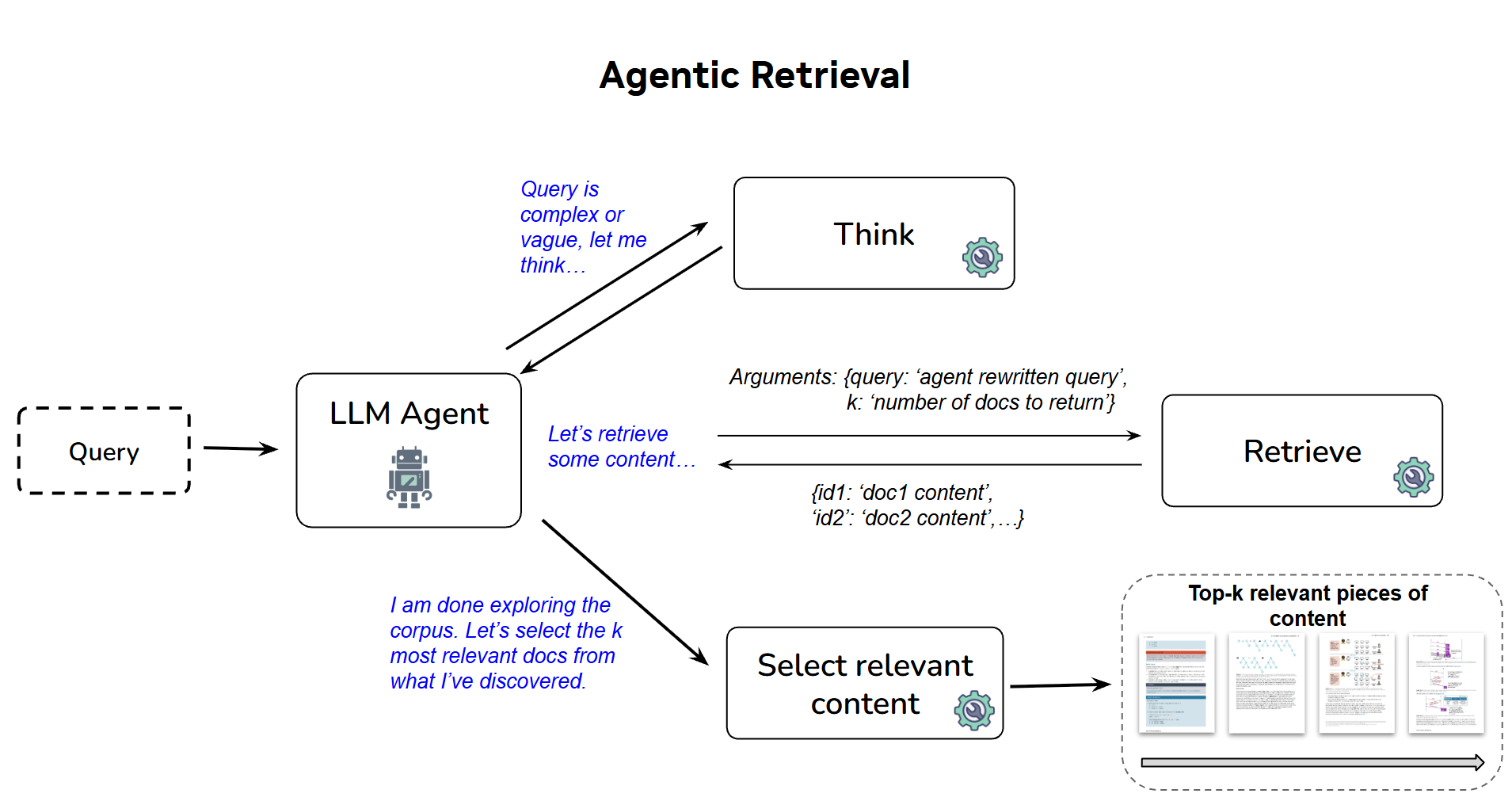
The industry has been stuck in a "semantic similarity" rut. NVIDIA’s new pipeline moves away from static embedding lookups toward a ReACT (Reason-Act) architecture.
Strip away the jargon, and here is what actually changed:
- Iterative Refinement: Instead of one query, the agent uses a
thinktool to plan and aretrievetool to explore. If the first results are garbage, the agent rephrases and tries again. - Tool-Based Retrieval: The retriever is treated as a function the LLM calls, rather than a pre-processing step.
- The "Singleton" Engineering Shift: Technically, the most interesting move is NVIDIA’s abandonment of the Model Context Protocol (MCP) for their internal testing. They found that the network overhead of MCP was too slow for high-scale evaluation and replaced it with an "in-process thread-safe singleton." This is a massive "lesson learned" for engineers: Modular microservices are great for flexibility, but in-process execution is still king for performance.
The hype check: Does "Generalizable" hold up?
NVIDIA claims they avoided "dataset-specific heuristics." Usually, when a company tops a leaderboard, they've "overfit" their pipeline to that specific data.
- The Claim: One architecture to rule them all.
- The Evidence: The source shows the pipeline using Opus 4.5 + nemotron-colembed-vl-8b-v2 for ViDoRe (Visual) and Opus 4.5 + nemotron-reasoning-3b for BRIGHT (Reasoning).
- The Verdict: The logic of the pipeline is generalizable, but the underlying models are still being swapped out to fit the task. This is a fair compromise, but it’s not a "single model" solution. It is a "single framework" solution.
Real-world implications
For the average developer, this pipeline is overkill. But for two specific sectors, this is a major unlock:
- Financial/Legal Analysis: If you need to find a specific clause buried in 500 pages of mixed tables and text, a "one-shot" retriever will miss it. An agentic loop that "persistent[ly] rephrases" until it finds the data is a game-changer.
- Complex Layout Parsing: ViDoRe v3 is a visual document benchmark. The fact that this pipeline hit #1 (69.22 score) means it can actually "understand" that a caption in the bottom right of page 40 relates to a chart on page 2.
Limitations they’re not talking about
While the blog post is transparent about engineering hurdles, it glosses over the "Agentic Tax":
- The Latency Problem: Agentic workflows are "notoriously slow." By adding multiple "think" and "retrieve" steps, a query that used to take 200ms might now take 5,000ms. NVIDIA mentions "Engineering for Speed," but they focus on GPU utilization, not the wall-clock time the end-user experiences.
- Cost Explosion: If your agent loops 4 times using Opus 4.5 (a top-tier, expensive model) before giving an answer, your RAG costs just increased by 400-800%.
- The "Final Results" Black Box: They mention falling back to Reciprocal Rank Fusion (RRF) as a "safety net." This suggests the agent can sometimes get lost in its own loop and fail to reach a conclusion, requiring a traditional algorithm to bail it out.
How it stacks up
Compared to a standard Dense Retrieval (which scored 64.36 on ViDoRe), the NeMo Agentic Retrieval (69.22) is a significant jump. It also beats the INF-X-Retriever on the visual benchmark but notably loses to it on the BRIGHT leaderboard (#1 vs NVIDIA's #2). This suggests that while NVIDIA is the new king of visual document retrieval, there is still room to improve on pure logical reasoning.
Constructive suggestions
To make this genuinely excellent for enterprise adoption, I’d like to see the NeMo team focus on:
- Small-Model Orchestration: Can this loop be driven by a 4-bit quantized Nemotron-3B instead of Opus 4.5? If NVIDIA can prove the architecture works with small, fast models, the "agentic tax" disappears.
- Early Exit Logic: Implement smarter "stop" conditions so the agent doesn't burn tokens on a 5-step loop when the first retrieval was actually sufficient.
- Observability Tools: Agentic loops are "black boxes." NVIDIA should release a visual debugger for the NeMo Retriever that shows why an agent decided to rephrase a query.
Our verdict
- Who should adopt now: Research teams and enterprises where accuracy is non-negotiable and budget is secondary to performance (e.g., high-end legal tech, medical research).
- Who should wait: Standard SaaS companies. The latency and cost of running an Opus-led agentic loop for basic customer support queries will kill your margins.
- Who should skip: Small startups with simple text-based datasets. Standard dense retrieval (like the
nemotron-colembed-vl-8b-v2alone) is already excellent and much faster.
FAQ
Should we switch from our current LangChain/LlamaIndex RAG to this?
Only if your current system is failing on complex, multi-step queries. NVIDIA’s pipeline is a specialized "high-reasoning" layer. You don't need to swap your whole stack, but you might consider routing "hard" questions to a NeMo Agentic pipeline.
Is it worth the price premium?
If you are processing complex PDFs (ViDoRe-style) where missing one data point costs the company money, yes. If you’re just searching a knowledge base for "how do I reset my password," absolutely not.
Can we run this on-premises?
Yes, NVIDIA's shift to a "singleton retriever" and their focus on NeMo NIM microservices (mentioned in the additional context) makes this much easier to deploy on H100/A100 clusters than the previous MCP-based architecture.
Sources
All technical specifications, pricing, and benchmark data in this article are sourced directly from official announcements. Competitor comparisons use publicly available data at time of publication. We update our coverage as new information becomes available.