
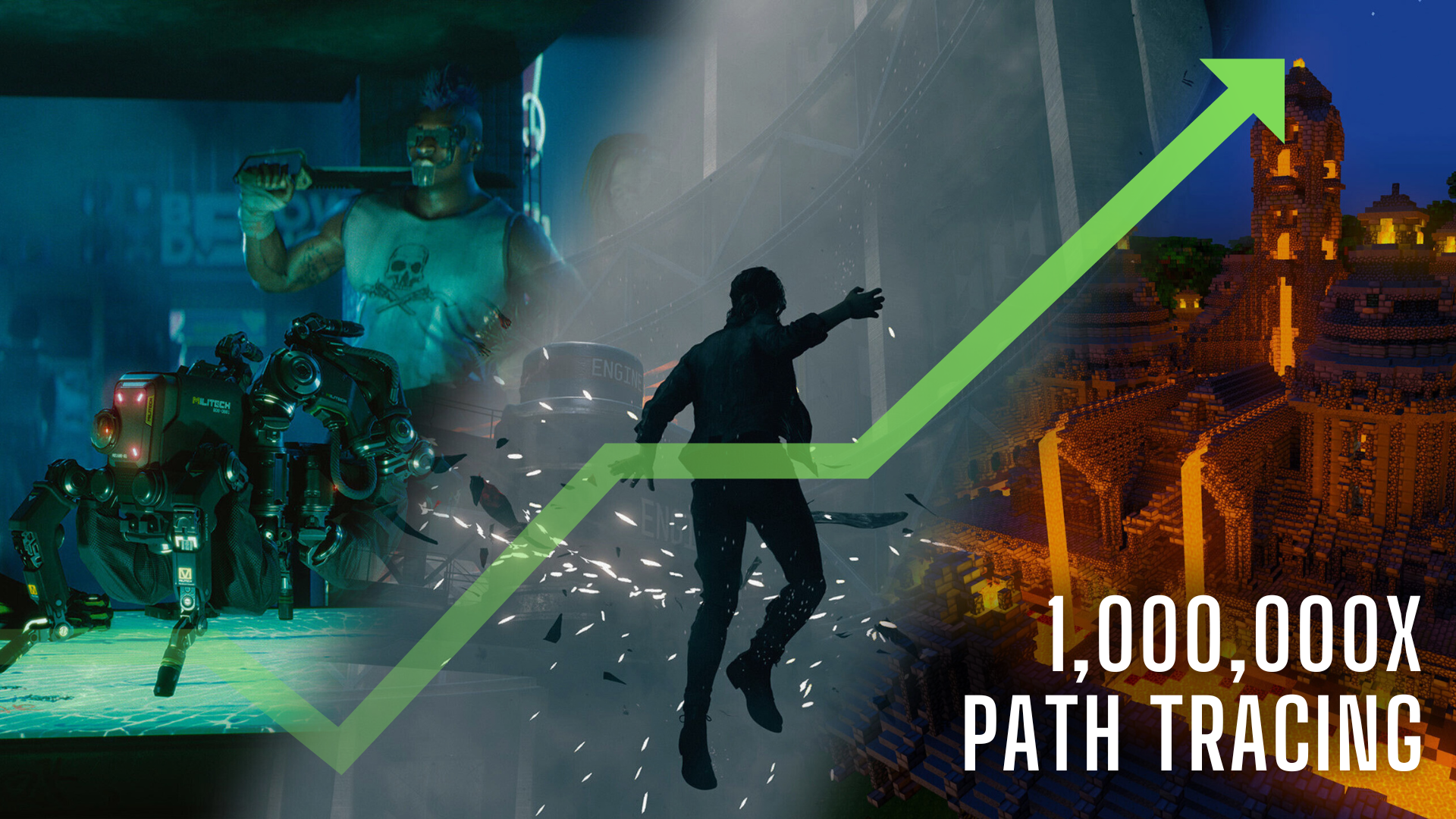
- The Goal: Nvidia aims to achieve 1,000,000x better path tracing performance in future GPUs compared to the Pascal (GTX 10-series) architecture.
- Current Progress: Today’s Blackwell-generation (RTX 50-series) GPUs have already achieved a 10,000x performance increase over Pascal through AI and hardware acceleration.
- The Catalyst: Nvidia VP John Spitzer declared Moore’s Law "dead," stating that future gains will rely almost entirely on AI-driven neural rendering rather than silicon alone.
- What’s Next: The upcoming "Rubin" GPU architecture, expected between 2027 and 2028, is positioned to lead this massive leap in graphical fidelity.
Nvidia has stunned the gaming and AI industries at GDC 2026 by announcing a roadmap toward a 1,000,000x improvement in path tracing performance. During a keynote presentation, John Spitzer, Nvidia’s VP of Developer and Performance Technology, revealed that the company is leveraging neural rendering and AI to transcend the physical limitations of silicon, aiming for real-time graphics that are "indistinguishable from real life."
Beyond Silicon: The Death of Moore's Law
The announcement centers on the realization that traditional hardware scaling is no longer sufficient to meet the demands of photorealistic rendering. Spitzer explicitly stated that Moore's Law is dead, noting that silicon advancements by themselves would not be enough to generate photorealistic visuals within a human lifetime.
To bridge this gap, Nvidia is betting everything on AI. According to the presentation, achieving true photorealism requires a "hundred or thousand times more computational power" than current hardware provides. Rather than trying to force more transistors to do the heavy lifting, Nvidia is shifting the burden to machine learning models trained on its own supercomputers.
"In the future, AI advances will take gaming GPUs to 1,000,000 times better path tracing performance when compared to the RTX 10 series," Spitzer noted during the GDC session. This shift signals a fundamental change in how frames are generated, moving from traditional rasterization and basic ray tracing toward a future where "neural rendering" is the default standard.
The 10,000x Leap: How Blackwell Set the Stage
The claim of a million-fold increase sounds astronomical, but Nvidia pointed to its current progress as proof of concept. When comparing the decade-old Pascal architecture (RTX 10 series) to the current Blackwell (RTX 50 series) GPUs, Nvidia claims it has already delivered a 10,000x bump in path tracing performance.
This massive leap was not achieved through raw clock speeds alone but through the evolution of dedicated hardware blocks:
- RT Cores: Specialized hardware for calculating light and shadow intersections.
- Tensor Cores: Machine learning accelerators that power AI-driven features.
- DLSS (Deep Learning Super Sampling): The use of AI to upscale images and generate entire frames, reducing the raw rendering load while increasing visual quality.
By using AI to piece together frame data and interpolate multiple frames in real-time, Nvidia has effectively decoupled perceived performance from raw silicon throughput.
Breaking the Geometry Barrier: 2 Trillion Triangles
To demonstrate the practical implications of these advances, Nvidia showcased a tech demo for the highly anticipated Witcher 4. The demo featured a staggering two trillion triangles in a single scene, rendered with realistic foliage and lighting simultaneously.
This was made possible by new technologies such as "RTX Mega Geometry," which Nvidia claims allows developers to build ray tracing structures up to 100x faster than previous methods. This technology enables full-fidelity path tracing with advanced detail and real-time tessellation, solving one of the biggest bottlenecks in modern game development: the sheer complexity of 3D assets.
Additionally, Nvidia introduced "ReSTIR" (recent spatiotemporal resampling algorithms), which helps the GPU manage millions of dynamic light sources without overwhelming the processor. These tools are already being integrated into titles like Resident Evil Requiem, which was cited as a leading example of the industry's rapid adoption of path tracing.
Impact: The End of the "Uncanny Valley"
For developers and gamers, this 1,000,000x performance target represents the final push to bridge the gap between digital environments and reality.
"Games would 'look like a film' while still running smoothly due to multiple frames being interpolated in real-time by AI," Spitzer explained.
This shift has profound implications:
- For Developers: Tools like Mega Geometry mean they no longer have to manually optimize every rock or leaf to save performance; the AI and specialized hardware handle the complexity.
- For the Industry: Nvidia’s aggressive AI-first strategy widens the gap with competitors like AMD and Intel, who are still catching up to Nvidia's hardware-accelerated ray tracing and upscaling ecosystems.
- For Users: The "Rubin" architecture, slated for 2027–2028, will likely be the first consumer hardware to bring these "million-fold" improvements to the home desktop, potentially making current ray tracing look primitive by comparison.
What's Next
While the 1,000,000x goal is a long-term target, the immediate future involves the rollout of the Rubin architecture. Expected to launch sometime between 2027 and 2028, Rubin will likely feature newer, faster, and more efficient hardware blocks designed specifically for neural rendering.
As Nvidia CEO Jensen Huang has previously suggested, the era of traditional rendering is winding down. In the coming years, we can expect every pixel on a screen to be, in some way, "imagined" or enhanced by an AI model, rather than just calculated by a transistor.