
NVIDIA NeMo Retriever Agentic Pipeline vs Traditional RAG: Which Should You Choose?
Overview
NVIDIA NeMo Retriever’s Agentic Pipeline is best for complex, reasoning-intensive enterprise searches and visual document parsing, while traditional semantic search remains more cost-effective for simple, single-domain similarity tasks. This new pipeline shifts the paradigm from a "one-and-done" query model to an iterative, agentic loop that has secured the #1 spot on the ViDoRe v3 leaderboard.
Feature Comparison Table
| Model / Pipeline | Context Handling | Performance Benchmarks | Standout Capability | Best For |
|---|---|---|---|---|
| NVIDIA NeMo Agentic Pipeline | Sifts through millions of documents via iterative retrieval | #1 on ViDoRe v3; #2 on BRIGHT | ReACT architecture with iterative query refinement | Complex, multi-part reasoning and messy enterprise data |
| Llama 3.1 (with NeMo NIM) | 8B, 70B, 405B options | Optimized for agentic workloads via NVIDIA NIM | High tool-calling capabilities and ecosystem integration | General purpose agentic RAG and developer customization |
| Traditional Semantic Search | Limited by single-vector similarity | Varies; struggles with complex reasoning | Low latency and high speed | Simple keyword or concept matching in curated datasets |
Note: For specific token-based pricing for NVIDIA NIM and Llama 3.1 deployments, check the latest official NVIDIA API Catalog or provider pricing as these fluctuate based on infrastructure.
Detailed Analysis
The Shift from Similarity to Reasoning
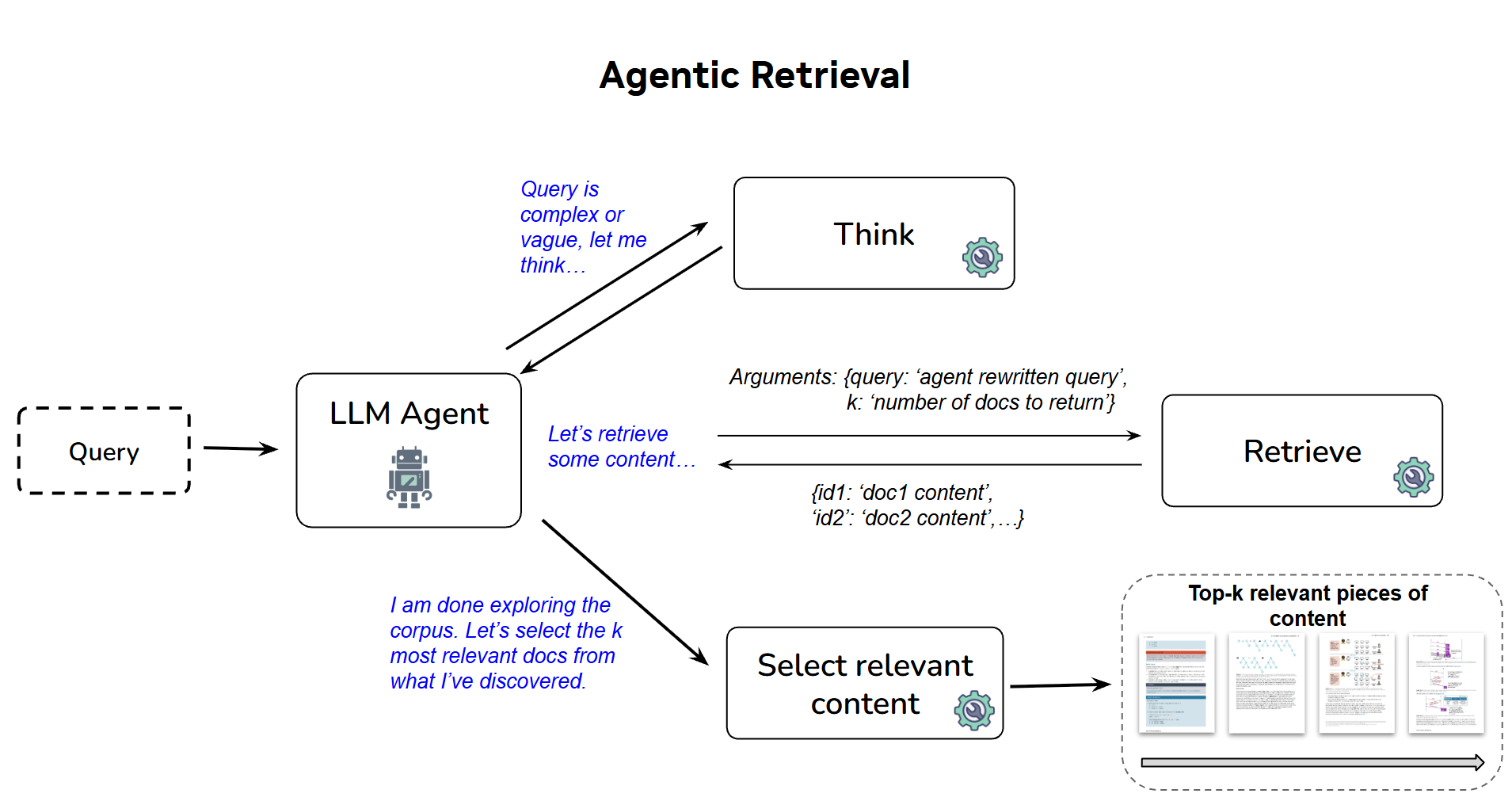
Traditional retrieval systems rely on dense retrieval (semantic similarity). While efficient, this "one-and-done" approach fails when queries require deep logical reasoning or understanding of complex visual layouts. NVIDIA's new pipeline introduces an agentic loop using the ReACT architecture.
Instead of returning a result immediately, the agent uses a "think" tool to plan its approach, a "retrieve" tool to explore the corpus, and iteratively refines its search queries based on what it finds. This allows the system to break down multi-part questions into simpler, manageable tasks—a feat traditional retrievers cannot accomplish.
Engineering for Scale: The Singleton Advantage
A common criticism of agentic workflows is their high latency. NVIDIA originally utilized the Model Context Protocol (MCP) to connect the LLM to the retriever. However, to solve for latency and "server freezes" under high volume, they moved to a thread-safe singleton retriever that lives in-process.
This architectural change is critical for enterprise adoption because it:
- Reduces network round-trip latency.
- Simplifies the lifecycle management of the GPU memory.
- Enables concurrent agent tasks to access shared embeddings through a reentrant lock.
Benchmark Dominance
The NeMo Retriever Agentic Pipeline has proven its generalizability by taking the top spot on the ViDoRe v3 (Visual Document Retrieval) leaderboard and #2 on the BRIGHT leaderboard. These results indicate that the model excels not just at text similarity, but at interpreting complex visual layouts and executing heavy reasoning tasks across multiple domains.
Pricing and Performance Verdict
| Metric | Improvement Level | Context/Notes |
|---|---|---|
| Accuracy | +50% Better | Compared to standard RAG models |
| Extraction Speed | 15x Faster | Specific to multimodal PDF extraction |
| Storage Efficiency | 35x Better | Critical for scaling to millions of documents |
| Implementation Cost | Moderate-to-High | Requires NVIDIA NIM microservices and GPU resources |
Verdict: The 35x improvement in storage efficiency and 50% gain in accuracy justify the higher compute costs of an agentic loop for mission-critical enterprise data. For high-volume, low-complexity tasks, the price-to-performance ratio may still favor standard semantic search.
Use Case Recommendations
Best for Enterprise Data
The pipeline is designed for "real-world enterprise applications" that lack curated, single-domain data. If your organization handles messy, unformatted documents or complex PDFs, the 15x faster multimodal extraction makes this a "must-upgrade."
Best for Complex Reasoning
If your users ask multi-step questions (e.g., "Compare the Q3 earnings of Company X with the sustainability report of Company Y and list the discrepancies"), the agentic rephrasing and breakdown capabilities are essential.
Best for High-Volume Production
The shift to the thread-safe singleton retriever makes this pipeline more suitable for production environments than earlier experimental agentic setups that relied on external MCP servers.
Verdict: Worth the Upgrade?
- Worth Upgrading? Yes, if you are currently hitting a ceiling with RAG accuracy or struggling with multi-step queries. The 50% accuracy boost is a meaningful improvement over standard semantic similarity.
- vs the Competition: While Meta’s Llama 3.1 offers excellent tool-calling, the NeMo Retriever pipeline's specific optimization for the ViDoRe (visual) and BRIGHT (reasoning) leaderboards gives it a specialized edge in document intelligence that general LLMs lack.
- Migration Effort: Moderate. Moving from a standard retriever to an agentic one requires implementing the ReACT loop. However, NVIDIA's move to an in-process singleton simplifies the infrastructure compared to previous multi-process MCP architectures.
Sources
- Hugging Face Blog: NVIDIA NeMo Retriever Agentic Retrieval
- NVIDIA Developer: NeMo Retriever Overview
- NVIDIA Technical Blog: Build an Agentic RAG Pipeline
All technical specifications, pricing, and benchmark data in this article are sourced directly from official announcements. Competitor comparisons use publicly available data at time of publication. We update our coverage as new information becomes available.