
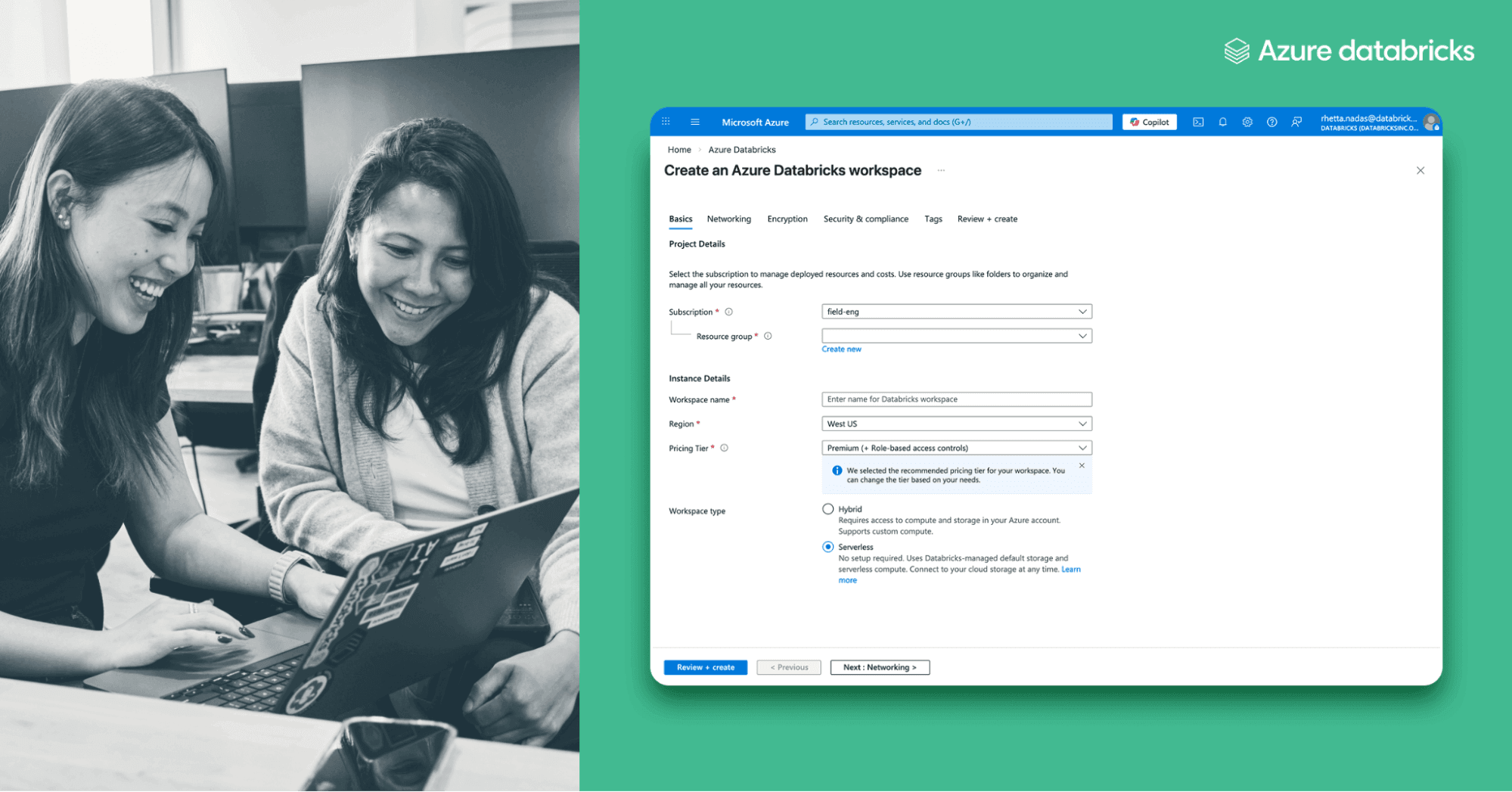
- What: General Availability (GA) of Serverless Workspaces in Azure Databricks
- When: Announced and available immediately
- Key Benefit: Reduces workspace deployment time from hours or days to seconds
- Core Features: Fully managed compute for notebooks, workflows, and Delta Live Tables (DLT)
- Partners: Jointly developed and supported by Databricks and Microsoft
Databricks and Microsoft have officially launched the General Availability (GA) of Serverless Workspaces for Azure Databricks, a milestone that effectively eliminates the infrastructure overhead previously required to launch large-scale data and AI projects. By shifting the burden of cluster management and VPC configuration to the provider, the update allows organizations to spin up entire data environments in seconds, according to official announcements from both companies.
The move marks a significant shift in the data engineering landscape, moving away from the "Classic" compute model—which required users to manage virtual machines and networking within their own cloud accounts—to a fully managed, serverless architecture. This transition is designed to accelerate the time-to-value for AI initiatives by removing the "infrastructure tax" that often stalls enterprise projects before they even begin.
Eliminating the "Infrastructure Wall"
For years, deploying a Databricks workspace on Azure involved complex networking requirements, including the setup of Virtual Private Clouds (VPCs), subnets, and security groups. According to Databricks’ technical documentation, these manual configurations often became a bottleneck for DevOps teams and data scientists. With the GA of Serverless Workspaces, Databricks and Microsoft have automated these layers.
Under the new serverless model, the compute resources reside in a Databricks-managed environment rather than the customer’s Azure subscription. This "Lakehouse" architecture allows for instant scaling and eliminates the need for users to monitor capacity or manage patching. According to the Databricks blog, this change enables "Workspaces in Seconds," allowing teams to focus on writing code and building models rather than troubleshooting environment connectivity.
The release also integrates seamlessly with the recently announced Azure Databricks Lakebase. Lakebase serves as a managed, serverless Postgres solution optimized for the Databricks platform, further separating compute from storage and allowing operational data to be written directly to lakehouse storage.
Technical Capabilities and Budget Guardrails
The GA status applies to several core components of the Databricks ecosystem. Users can now leverage serverless compute for:
- Notebooks: For interactive data exploration and model development.
- Workflows: For orchestrating complex data pipelines and jobs.
- Delta Live Tables (DLT): For building and managing reliable batch and streaming data pipelines.
A primary concern for enterprises moving to serverless models is the potential for runaway costs. To address this, Databricks has introduced built-in budget guardrails and clear cost visibility tools. According to Microsoft’s Community Hub, these controls allow administrators to set limits on usage, ensuring that the "pay-as-you-go" flexibility of serverless does not lead to unexpected financial overhead.
The system is designed to scale dynamically based on workload demands. When a job is finished or a notebook becomes idle, the compute resources are instantly released, ensuring that organizations only pay for the exact duration of their data processing tasks.
Competitive Landscape and Strategic Partnership
The launch of Serverless Workspaces on Azure is a direct response to the increasing competition in the cloud data warehouse and AI platform space. Snowflake, Databricks’ primary rival, has long championed a near-zero management approach. By bringing serverless capabilities to Azure—one of the most popular clouds for enterprise data—Databricks is closing the ease-of-use gap while maintaining its focus on open-source standards like Delta Lake and Spark.
The partnership between Microsoft and Databricks remains one of the strongest in the industry. Azure Databricks is a first-party service on the Azure portal, and the GA of serverless workspaces represents a deep engineering collaboration to optimize the service for the Azure global infrastructure. This release ensures that Azure remains a top-tier destination for Databricks users, matching the serverless capabilities recently rolled out on AWS.
Impact on Developers and Enterprise AI
For developers, the move to serverless means the end of the "cold start" problem and the elimination of complex bootstrap scripts. Data engineers can now deploy production-ready workspaces with a single click or API call, drastically reducing the lead time for new AI experiments.
The business impact is equally significant. "Serverless Workspaces transform data engineering from a logistics challenge into a pure innovation race," according to industry analysts observing the launch. For the first time, large-scale enterprises can give every department its own isolated data environment without incurring the massive management overhead traditionally associated with multi-workspace deployments.
This shift is particularly vital for generative AI (GenAI) projects, which often require sudden, massive bursts of compute power for fine-tuning models or processing large datasets for retrieval-augmented generation (RAG).
What’s Next for Azure Databricks
With Serverless Workspaces now in GA, the focus shifts to deeper integration with the Mosaic AI suite and more advanced automation. Databricks has hinted at further enhancements to the serverless fleet, including faster startup times for specialized GPU clusters and improved cross-region data sharing capabilities.
As more customers migrate from "Classic" to "Serverless" compute, the industry expects a surge in automated data pipelines and a decrease in the manual "babysitting" of data clusters. The roadmap suggests that Databricks will continue to push toward a "No-Ops" future where the underlying infrastructure becomes completely invisible to the end-user.