
Beyond Semantic Similarity: A Technical Deep Dive into NVIDIA NeMo Retriever’s Agentic Pipeline
Executive Summary
- NVIDIA NeMo Retriever’s Agentic Pipeline is a ReAct-based retrieval framework that utilizes iterative reasoning, query refinement, and a thread-safe in-process singleton architecture to achieve state-of-the-art results on multimodal and reasoning-heavy benchmarks.
- The pipeline secured the #1 spot on the ViDoRe v3 leaderboard (score: 69.22) and the #2 spot on the BRIGHT leaderboard (score: 50.90).
- By replacing traditional Model Context Protocol (MCP) server architectures with an in-process thread-safe singleton, NVIDIA reduced network serialization overhead and improved GPU utilization for large-scale evaluations.
- The system transitions retrieval from a "single-shot" vector lookup to an autonomous agentic loop capable of query decomposition and persistent rephrasing.
Technical Architecture: The Agentic Loop
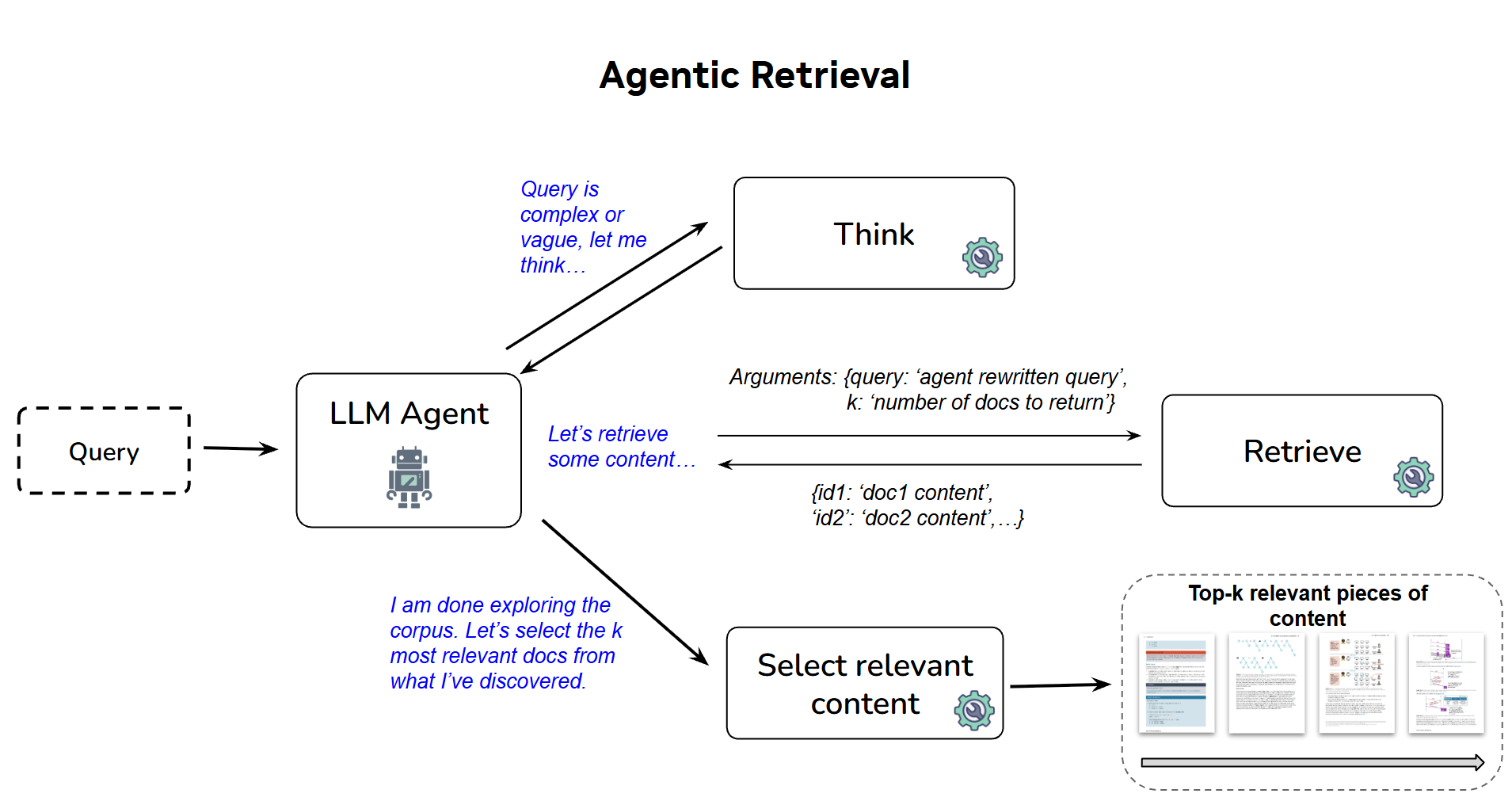
The fundamental shift in the NeMo Retriever pipeline is the move away from "one-and-done" semantic similarity lookups. Traditional Retrieval-Augmented Generation (RAG) typically involves encoding a query, searching a vector database, and returning the top-K results. NVIDIA’s new approach treats retrieval as a multi-step reasoning task governed by a ReAct (Reasoning and Acting) architecture.
The ReAct Framework in Retrieval
The pipeline operates through an iterative loop where an LLM (the agent) utilizes a specific toolset to explore a corpus. This loop consists of three primary stages:
- Planning (
thinktool): The agent analyzes the user prompt and formulates a search strategy. It decides whether the query is simple, requires multi-hop reasoning, or needs decomposition into sub-queries. - Execution (
retrievetool): The agent callsretrieve(query, top_k)to fetch documents. Unlike static systems, the agent can call this tool multiple times within a single session, adjusting thequeryparameter based on intermediate findings. - Synthesis (
final_resultstool): Once the agent determines it has sufficient information or has exhausted its search strategy, it calls thefinal_resultstool to output the most relevant documents, ranked by relevance.
Query Emergence Patterns
During testing, NVIDIA identified three successful search behaviors that emerged naturally from this agentic design:
- Dynamic Adjustment: The agent modifies its search parameters based on the specific terminology found in initial document snippets.
- Persistent Rephrasing: If a specific query yields low-relevance results, the agent autonomously re-runs the search using synonyms or different structural phrasings.
- Decomposition: Complex, multi-part questions are broken down into a series of simpler, targeted queries.
The Safety Net: Reciprocal Rank Fusion (RRF)
Agentic workflows face inherent risks, such as hitting maximum step limits or exceeding the LLM’s context window. To mitigate these "agent failures," the pipeline implements Reciprocal Rank Fusion (RRF) as a fallback. If the agent fails to reach a conclusion, the system scores documents based on their ranks across every retrieval attempt made during the agent's trajectory, ensuring a robust final output even when the reasoning loop is interrupted.
Performance Analysis
NVIDIA’s agentic approach prioritizes generalizability. The same underlying architecture was deployed across two vastly different benchmarks—one focused on visual document understanding and the other on deep logical reasoning.
ViDoRe v3 (Visual Document Retrieval)
The Visual Document Retrieval Benchmark (ViDoRe) tests a model's ability to parse complex layouts, charts, and figures. The NeMo Agentic Pipeline achieved the top spot using a combination of Opus 4.5 as the reasoning engine and nemotron-colembed-vl-8b-v2 for embeddings.
| Pipeline | Benchmark Score (ViDoRe v3) | Rank |
|---|---|---|
| NeMo Agentic (Opus 4.5 + nemotron-colembed-vl-8b-v2) | 69.22 | #1 |
| Dense retrieval (nemotron-colembed-vl-8b-v2) | 64.36 | N/A |
| INF-X-Retriever (INF-Query-Aligner + nemotron-colembed-vl-8b-v2) | 62.31 | N/A |
| INF-X-Retriever (Standard) | 51.01 | N/A |
BRIGHT Benchmark (Reasoning-Intensive Retrieval)
The BRIGHT benchmark focuses on queries that require significant world knowledge and logical deduction. Here, the pipeline utilized the nemotron-reasoning-3b model to secure second place.
| Pipeline | NDCG@10 (BRIGHT) | Rank |
|---|---|---|
| INF-X-Retriever | 63.40 | #1 |
| NeMo Agentic (Opus 4.5 + nemotron-reasoning-3b) | 50.90 | #2 |
Note: While INF-X-Retriever currently holds the #1 spot on BRIGHT, the NeMo pipeline demonstrates superior performance on ViDoRe, suggesting higher multimodal generalizability.
Engineering for Scale: The Singleton Pattern
One of the most significant technical hurdles for agentic retrieval is latency. Traditional architectures often use the Model Context Protocol (MCP), where the LLM communicates with a retriever via an external server. While modular, this introduces several bottlenecks:
- Network Serialization: Every tool call requires data to be serialized, sent over a network, and deserialized.
- Orchestration Overhead: Managing the lifecycle of separate client/server processes increases the risk of "silent misconfigurations" or server freezes.
- Memory Management: Loading massive corpus embeddings into GPU memory across multiple server instances is inefficient.
The In-Process Singleton Solution
To achieve "leaderboard-scale" throughput, NVIDIA replaced the MCP server with a thread-safe singleton retriever that lives in-process.
Key Technical Details:
- One-Time Load: The singleton loads the model and corpus embeddings into GPU memory exactly once.
- Reentrant Locking: Access is protected by a reentrant lock, allowing multiple concurrent agent tasks to query the retriever safely.
- Zero-Copy Communication: By living in the same process, the LLM agent and retriever exchange data without network overhead, drastically reducing latency per "thought" in the ReAct loop.
# Conceptual implementation of the thread-safe singleton retriever
class SingletonRetriever:
    _instance = None
    _lock = threading.RLock()

    def __new__(cls):
        with cls._lock:
            if cls._instance is None:
                cls._instance = super(SingletonRetriever, cls).__new__(cls)
                cls._instance._initialize_retriever()
        return cls._instance

    def _initialize_retriever(self):
        # Load nemotron-colembed-vl-8b-v2 and corpus embeddings
        self.model = load_model("nemotron-colembed-vl-8b-v2")
        self.corpus = load_corpus_embeddings()

    def retrieve(self, query: str, top_k: int):
        with self._lock:
            # Perform vector search
            return self.model.search(query, self.corpus, top_k)
Technical Implications
From Semantic Lookup to Logic Execution
This announcement signals the end of the "embedding-only" era of RAG. For enterprise applications, the ability to reason about why a document is relevant is becoming as important as the vector distance itself. The integration of reasoning models (like nemotron-reasoning-3b) directly into the retrieval loop allows for a more nuanced handling of complex queries.
Multimodal Primacy
The success on ViDoRe v3 highlights that the future of retrieval is visual. By using the nemotron-colembed-vl-8b-v2 model, the pipeline demonstrates that layout and visual hierarchy are critical features for generalizable search, moving beyond simple text-based "chunking."
Limitations and Trade-offs
- Computational Cost: Agentic workflows are inherently more expensive than dense retrieval. Every "step" in the ReAct loop consumes LLM tokens, which can lead to significant costs when using high-end models like Opus 4.5.
- In-Process Memory Constraints: While the singleton pattern reduces latency, it requires the application process to have direct access to the GPU resources holding the embeddings. This may complicate microservice architectures that prefer decoupled, stateless components.
- Latency vs. Accuracy: The iterative nature of the loop means that the "time to first result" is higher than a standard RAG system. This architecture is best suited for complex research tasks rather than ultra-low-latency chatbots.
Expert Perspective
The true innovation here is not just the leaderboard rankings, but the emphasis on generalizability. In the AI field, it is common to see "SOTA" (State of the Art) results achieved through hyper-specialized heuristics that fail in real-world scenarios. NVIDIA’s decision to use a consistent architecture across ViDoRe (multimodal) and BRIGHT (reasoning) suggests a robust, "production-ready" design.
The engineering move to abandon MCP in favor of a thread-safe singleton is particularly telling. It shows that NVIDIA is moving past the "research prototype" phase of agentic AI and focusing on the telemetry and throughput required for enterprise-scale deployment.
Technical FAQ
How does the pipeline handle context window limitations during long agent trajectories?
The pipeline uses a Reciprocal Rank Fusion (RRF) safety net. If an agent trajectory becomes too long and hits context limits or maximum steps, the system aggregates all retrieved documents from the various steps and ranks them based on their cumulative performance across the trajectory, ensuring a valid result is still returned.
Why was the Model Context Protocol (MCP) server replaced?
The MCP server introduced a "compounding tax" on experiment velocity. The network round-trips added significant latency, and managing separate client/server processes led to frequent orchestration errors and sub-optimal GPU utilization. Moving to an in-process singleton provided the same shared access benefits without the serialization overhead.
What embedding model was used for the ViDoRe #1 ranking?
The pipeline used nemotron-colembed-vl-8b-v2, which is optimized for visual document understanding, allowing the agent to effectively parse layouts and charts.
Is the reasoning model (e.g., nemotron-reasoning-3b) separate from the agent LLM?
In the described architectures, the agent can use different models depending on the task. For the BRIGHT benchmark, the pipeline utilized nemotron-reasoning-3b, while for ViDoRe, it leveraged Opus 4.5. The framework is designed to be modular regarding the LLM "brain" driving the ReAct loop.
References
- NVIDIA NeMo Retriever Documentation
- ViDoRe v3 Leaderboard
- BRIGHT Leaderboard (Reasoning-intensive Retrieval)
- ReAct: Synergizing Reasoning and Acting in Language Models (Paper)
Sources
- Hugging Face Blog: Beyond Semantic Similarity: Introducing NVIDIA NeMo Retriever’s Generalizable Agentic Retrieval Pipeline
- NVIDIA Developer: NeMo Retriever Overview
- NVIDIA Technical Blog: Build a RAG Agent with NVIDIA Nemotron
All technical specifications, pricing, and benchmark data in this article are sourced directly from official announcements. Competitor comparisons use publicly available data at time of publication. We update our coverage as new information becomes available.