
Databricks Serverless Compute Delivers Up to 70% Cost Savings, 2x Faster Performance
Key Facts
- What: Databricks expands serverless compute across Notebooks, Lakeflow Jobs, and Spark Declarative Pipelines (formerly DLT), automating infrastructure management.
- Performance: Performance-optimized mode starts in seconds and typically runs twice as fast as classic clusters.
- Cost Savings: Up to 70% savings in Standard mode versus performance-optimized workloads; over 50% savings for non-Spark workloads.
- Reliability: Versionless runtime has completed 25 DBR upgrades across more than 4.5 billion workloads with 99.998% success rate.
- Simplicity: Users choose only between "fast" or "cost-efficient" modes; AI automatically handles instance types, scaling, Photon usage, and optimizations.
Databricks is removing one of the biggest headaches in data engineering by making serverless compute the default for notebooks, jobs, and pipelines. The company’s latest updates eliminate the need for teams to manage VPCs, instance types, runtime upgrades, and cluster tuning — tasks that can consume up to 20% of engineers’ time.
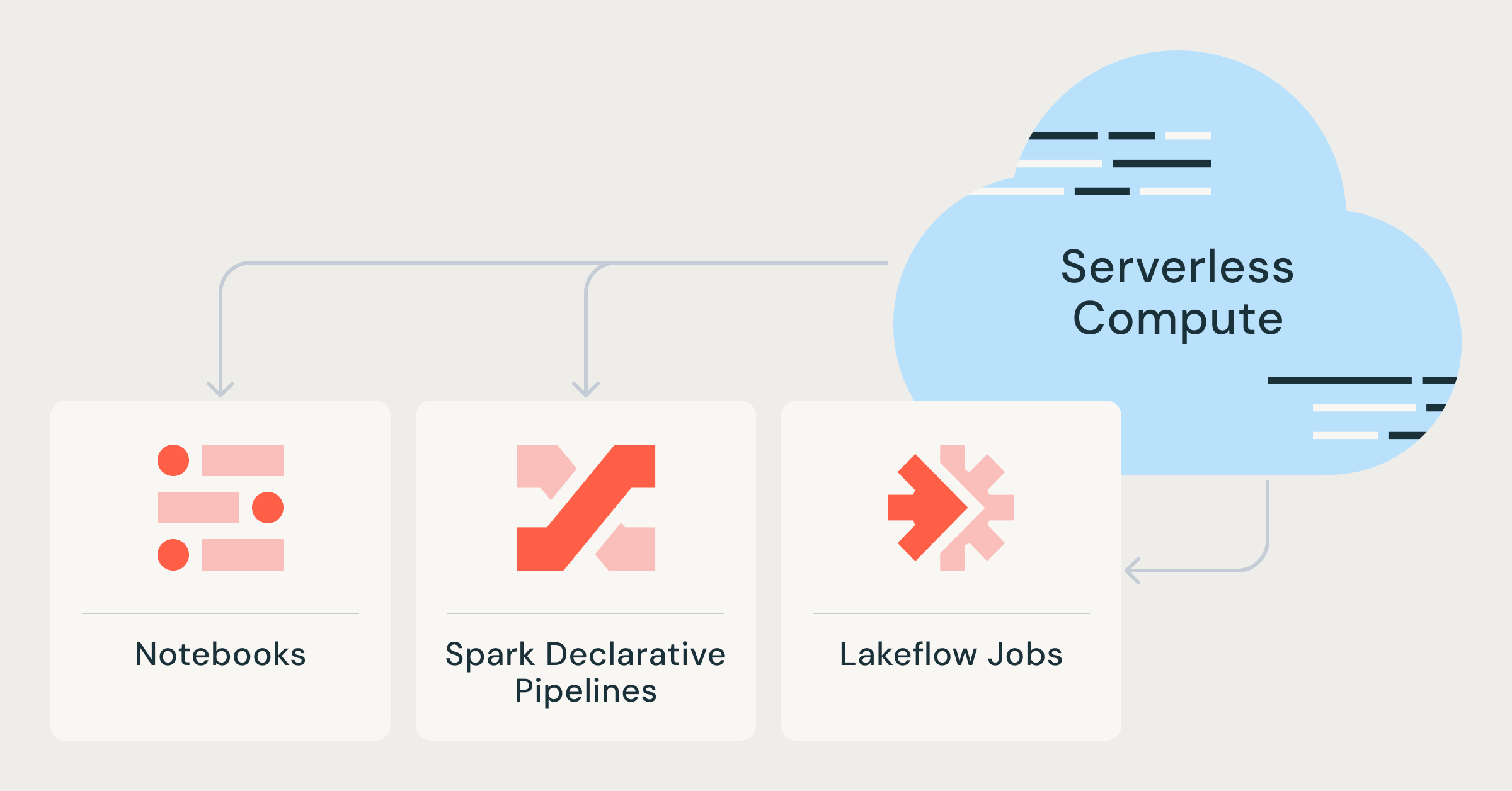
The expansion of serverless compute to Notebooks, Lakeflow Jobs, and Spark Declarative Pipelines (SDP) marks a significant shift in how organizations build and operate data platforms. Instead of wrestling with infrastructure, data teams can now focus on delivering business value as Databricks handles networking, security hardening, runtime upgrades, and continuous performance optimization behind the scenes.
The Infrastructure Management Burden
Traditional Spark clusters demand extensive operational overhead. Teams must configure networks with VPCs, gateways, and private endpoints. Security and compliance require constant vulnerability management, encryption oversight, and data exfiltration protection. Performance tuning involves right-sizing instances, managing utilization, maintaining instance pools, and optimizing Delta Lake tables.
Runtime maintenance adds another layer of complexity. With two long-term support Databricks Runtime (DBR) releases per year, engineering teams typically spend weeks evaluating upgrades for stability, performance, and compatibility.
According to Databricks, serverless compute flips this model. Foundational tasks including networking, security, lifecycle management, and runtime upgrades are handled automatically and continuously optimized by the platform. This allows teams to adopt the latest performance improvements faster while reducing operational toil.
Core Principles of Databricks Serverless Compute
Databricks serverless compute operates on three core principles: simplicity, performance, and being maintenance-free.
The experience is deliberately simple. Users only choose whether they want workloads to run fast (Performance-optimized mode) or cost-efficiently (Standard mode). The platform then automatically fine-tunes infrastructure to meet the selected goal without requiring users to select instance types, scale factors, or autoscaler settings.
Performance comes from Databricks’ optimized infrastructure and a new autoscaler. Serverless compute starts in seconds, loads dependent libraries from cache in seconds, and typically runs twice as fast as classic clusters. Performance-optimized workloads leverage warm pools of machines and aggressive resource scaling to minimize processing time.
The maintenance-free aspect delivers high fault tolerance. Serverless compute automatically scales both horizontally and vertically to prevent out-of-memory errors, shields users from cloud outages, and fails over to available instance types. The versionless approach has proven highly reliable, executing 25 DBR upgrades across more than 4.5 billion workloads with a 99.998% success rate over the past year.
AI-Driven Automatic Optimization
A key innovation is Databricks’ use of AI to automatically select and optimize infrastructure based on historical workload data. The system detects which settings would most benefit each workload and enables them automatically.
For example, Photon acceleration is used only when the specific workload benefits from it. For non-Spark workloads, the platform provisions smaller VMs on the fly instead of defaulting to full Spark clusters. This intelligent resource selection delivers over 50% cost savings and more than 33% faster startup times compared to classic clusters.
The introduction of performance modes for Lakeflow Jobs and Spark Declarative Pipelines gives users clear control over priorities. Standard mode prioritizes cost efficiency with up to 70% savings compared to performance-optimized workloads. Performance-optimized mode focuses on speed, starting in seconds and running typically twice as fast.
These capabilities integrate with Lakeflow, Databricks’ end-to-end data engineering solution that combines managed connectors, declarative pipelines, and workflow orchestration on serverless compute with Unity Catalog governance.
Impact on Data Engineering Teams
"Serverless compute offers 70% cost savings with the Standard performance mode compared to Performance-optimized workloads, and over 50% cost savings for Non-Spark workloads."
This shift has profound implications for data teams. By eliminating infrastructure management, organizations can redirect engineering effort from maintenance to building data products that drive revenue and innovation. The ability to choose between cost and performance modes gives teams flexibility across different workload priorities — from batch reporting to mission-critical real-time pipelines.
For developers and data engineers, the changes mean faster iteration cycles. Notebooks start quicker, jobs complete faster, and pipelines require far less tuning. The high reliability of versionless upgrades reduces the risk associated with adopting new runtime features.
The competitive landscape makes these improvements particularly relevant. As organizations race to implement AI and machine learning initiatives, the speed and cost-efficiency of underlying data infrastructure becomes a strategic advantage. Databricks’ serverless approach aims to reduce the operational barriers that have historically slowed data teams.
What’s Next for Serverless Data Engineering
Databricks continues to expand serverless capabilities across its platform. The company has positioned Lakeflow — which includes Lakeflow Connect, Lakeflow Declarative Pipelines (the successor to DLT), and Lakeflow Jobs — as its comprehensive solution for modern data engineering.
Future enhancements are expected to further leverage AI for optimization while maintaining the simplicity that has become the hallmark of the serverless offering. The platform’s ability to continuously learn from workload patterns suggests performance and cost efficiency will keep improving over time without requiring user intervention.
For organizations still managing traditional Spark clusters, the message is clear: the operational model for data engineering is evolving. Teams that embrace serverless compute can expect significant reductions in infrastructure management overhead while gaining better performance and cost predictability.
The broader industry trend toward serverless data infrastructure reflects a maturing market where differentiation increasingly comes from developer experience and total cost of ownership rather than raw cluster management features.
As AI workloads grow more demanding, the ability to run data pipelines with minimal operational overhead while maintaining high performance and reliability will likely become table stakes for enterprise data platforms.
Sources
- The Evolution of Data Engineering: How Serverless Compute is Transforming Notebooks, Lakeflow Jobs, and Spark Declarative Pipelines
- Announcing the General Availability of Databricks Lakeflow
- Serverless Compute for Notebooks, Jobs and Lakeflow Declarative Pipelines - Data + AI Summit 2025
- What’s New in Lakeflow Declarative Pipelines: July 2025
- Modernize your Data Engineering Platform with Lakeflow on Azure Databricks