
Title: NVIDIA TensorRT Edge-LLM: A Technical Deep Dive into Edge-First LLMs for Physical AI
Executive Summary
- TensorRT Edge-LLM is a high-performance C++ inference runtime optimized for LLMs, VLMs, and hybrid architectures on NVIDIA DRIVE AGX Thor and Jetson Thor platforms, now supporting Mixture-of-Experts (MoE), Hybrid Mamba-2-Transformer models, Cosmos Reason 2, and Qwen3-TTS/ASR.
- It enables low-latency, power-constrained deployment of massive reasoning models by activating only subsets of parameters in MoE, reducing KV cache overhead via Mamba states, and providing dual-mode (/think vs /no_think) hybrid reasoning.
- Key new capabilities include native multimodal voice dialogue with Qwen3-TTS/ASR, spatio-temporal reasoning and 3D localization via Cosmos Reason 2, and end-to-end trajectory planning with NVIDIA Alpamayo using flow matching and FP8 Vision Transformers.
- This marks a shift from modular AV/robotics stacks to production-ready, reasoning-based Vision-Language-Action (VLA) models that run entirely at the edge.
Technical Architecture
TensorRT Edge-LLM functions as a specialized, low-level inference engine built for embedded platforms with strict power, thermal, and real-time constraints. Unlike cloud-oriented runtimes, it is written in C++ and heavily leverages NVIDIA’s TensorRT stack, including custom CUDA kernels, optimized attention variants, and platform-specific scheduling for the Thor architecture (which integrates Grace CPU + Blackwell GPU architecture on a single module).
Mixture-of-Experts (MoE) Support
The latest release adds full MoE acceleration, specifically targeting models such as Qwen3 MoE. In MoE architectures, each token is routed to a small subset of “expert” feed-forward networks rather than activating the entire parameter set. TensorRT Edge-LLM implements highly optimized routing kernels and expert-parallel execution that minimize data movement on the Jetson/DRIVE Thor memory hierarchy.
This allows a model with hundreds of billions of total parameters to maintain an active parameter footprint comparable to a dense model of 7–13B parameters during inference. The runtime handles dynamic expert loading, load-balancing across experts, and quantization (including FP8 and INT4) to fit within the tight memory envelopes of automotive-grade SoCs.
Hybrid Mamba-2-Transformer Architecture (Nemotron 2 Nano)
A major architectural addition is optimized support for NVIDIA Nemotron 2 Nano, which uses a Hybrid Mamba-2-Transformer design. Traditional Transformer layers suffer from quadratic KV cache growth with context length. Mamba-2 (a State Space Model) replaces many layers with linear-time recurrent state updates, dramatically reducing memory traffic.
TensorRT Edge-LLM provides hand-tuned kernels for:
- Mamba state updates
- Selective scan operations
- Hybrid layer interleaving between Mamba and attention blocks
This enables very long context windows (reportedly suitable for complex RAG or agentic workflows) while staying within device memory limits typical of 32–64 GB automotive platforms.
The system supports two operational modes via system prompts:
- Deep reasoning mode (/think): Performs full Chain-of-Thought (CoT) generation. The model achieves 97.8% on MATH500 in this mode.
- Conversational reflex mode (/no_think): Bypasses reasoning traces for sub-200ms response times in voice interactions.
Multimodal and Physical Reasoning Components
- Qwen3-TTS and Qwen3-ASR: Fully optimized speech models enabling end-to-end, low-latency voice dialogue. The “Thinker-Talker” framework separates reasoning (Thinker) from speech synthesis/generation (Talker), allowing the system to maintain low-latency conversational reflexes while still having access to deep reasoning when needed.
- Cosmos Reason 2: An open planning model for physical AI. It adds native spatio-temporal reasoning, 3D localization, and long-context video understanding. TensorRT Edge-LLM accelerates the vision encoder and temporal attention layers, making it suitable for humanoid robots and embodied agents that must understand 3D scenes from multiple camera feeds in real time.
- NVIDIA Alpamayo: An end-to-end trajectory planning VLA model. It replaces traditional modular perception-planning-control stacks with a single model that performs:
- Multicamera context encoding via FP8-accelerated Vision Transformers
- Flow matching trajectory decoding
- Explainable decision-making (via attention visualization or token-level interpretability)
All components are optimized for FP8 precision where possible, delivering substantial speedups and memory savings on the Blackwell-class Tensor Cores inside Thor platforms.
Performance Analysis
While the source material does not publish exhaustive benchmark tables, several key performance indicators are highlighted:
- MATH500: 97.8% accuracy in /think mode with Nemotron 2 Nano — competitive with much larger cloud models.
- Latency: /no_think conversational mode is optimized for “immediate” response, targeting human-like conversational latency (<300 ms end-to-end including ASR/TTS).
- Memory Efficiency: Hybrid Mamba-2-Transformer significantly reduces KV cache footprint compared to pure Transformer models of similar capability.
- Power Envelope: Explicitly designed for strict automotive power budgets (DRIVE AGX Thor is targeted at <300W for full AV stacks).
Benchmark Comparison (inferred from architectural claims and typical edge LLM performance):
| Model / Configuration | Architecture | Active Params (approx) | MATH500 | Context Handling | Target Platform | Notes |
|---|---|---|---|---|---|---|
| Qwen3 MoE (Edge-LLM) | MoE + TensorRT kernels | ~13B active | Not disclosed | Long context | Jetson/DRIVE Thor | Expert routing optimized |
| Nemotron 2 Nano | Hybrid Mamba-2-Transformer | ~8B effective | 97.8% | Very long (RAG) | DRIVE AGX Thor | Dual /think mode |
| Llama 3.1 8B (baseline) | Dense Transformer | 8B | ~85% | Limited by KV | Same | Higher memory use |
| Cosmos Reason 2 | Spatio-temporal VLM | Not disclosed | N/A | Video + 3D | Jetson Thor | Physical reasoning focus |
Note: Exact FPS, tokens/second, and power numbers are not yet disclosed in the announcement.
Technical Implications
This release accelerates the transition from modular autonomous systems to end-to-end reasoning-based Vision-Language-Action (VLA) models. By moving high-fidelity reasoning, planning, and voice interaction to the edge, developers can:
- Reduce cloud dependency and associated latency/privacy concerns.
- Enable true “System 2” reasoning in safety-critical loops.
- Simplify software stacks — a single optimized model can replace separate perception, prediction, planning, and HMI modules.
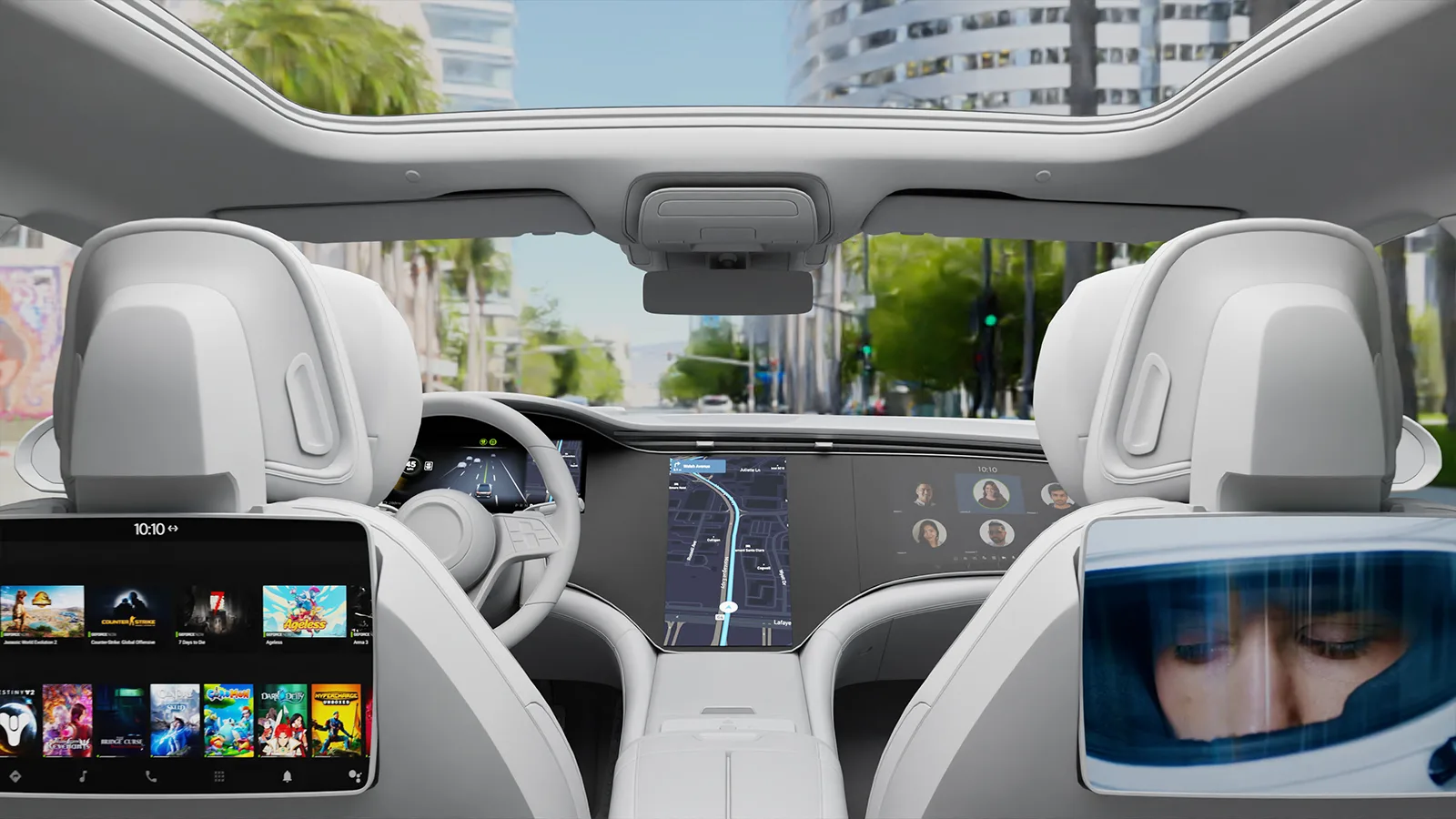
- Support next-gen applications such as empathetic in-cabin AI, proactive robotic companions, and explainable AV decision systems.
The ecosystem impact is significant: partners including Bosch, ThunderSoft, and MediaTek have already adopted TensorRT Edge-LLM for in-car assistants and cabin monitoring. It also strengthens NVIDIA’s position in the emerging “Physical AI” market alongside humanoid robotics and industrial automation.
Limitations and Trade-offs
- Model Size Ceiling: Even with MoE and Mamba, the most capable models still require careful distillation or quantization. Extremely large MoEs (>400B total parameters) may remain impractical on current Thor modules.
- Determinism and Safety: Reasoning models can exhibit hallucinations. For automotive use, additional safety wrappers, formal verification, or hybrid classical + neural planning layers will likely still be required.
- Benchmark Transparency: The announcement focuses on qualitative capabilities and one headline metric (97.8% MATH500). Detailed latency, throughput, power, and ISO 26262 ASIL metrics are not yet public.
- Development Complexity: Building reliable VLA pipelines with flow matching, multicamera fusion, and hybrid reasoning requires significant expertise in both classical robotics and modern generative AI.
Expert Perspective
TensorRT Edge-LLM represents a meaningful maturation of edge AI infrastructure. By deeply integrating support for MoE routing, Mamba-2 state handling, FP8 Vision Transformers, and dual-mode reasoning, NVIDIA is closing the gap between the capabilities demonstrated in cloud research and what can be deployed in a 300W autonomous vehicle or battery-powered robot.
The most significant contribution may be the “Thinker-Talker” framework and /think vs /no_think orchestration. This provides a practical mechanism to reconcile the conflicting requirements of high-fidelity reasoning and low-latency interaction — a long-standing challenge in embodied AI.
If NVIDIA follows through with comprehensive performance characterization and safety certification support, this runtime could become the de-facto standard for Physical AI development on embedded platforms, much like TensorRT became for computer vision a decade ago.
Technical FAQ
How does TensorRT Edge-LLM’s MoE support compare to cloud MoE frameworks like vLLM or DeepSpeed?
TensorRT Edge-LLM focuses on highly optimized, platform-specific kernels for the Thor architecture with aggressive quantization (FP8/INT4) and minimal memory movement. Cloud frameworks prioritize throughput across many GPUs; Edge-LLM prioritizes latency and power under strict real-time constraints. Expert routing latency is the critical metric here, which is not yet quantitatively compared in public data.
Can I run these models on previous-generation Jetson Orin or DRIVE Orin platforms?
The announcement specifically targets NVIDIA DRIVE AGX Thor and Jetson Thor. While some models may run on Orin with reduced performance, the new hybrid kernels, FP8 acceleration, and advanced MoE routing are optimized for the newer Blackwell-class Tensor Cores and memory subsystem. Backward compatibility details are not yet disclosed.
How does the Hybrid Mamba-2-Transformer affect long-context RAG performance at the edge?
It significantly improves it. By replacing many attention layers with linear-time Mamba states, the KV cache memory footprint grows much more slowly, enabling larger context windows within the same device memory. This makes on-device retrieval-augmented generation and long-horizon planning more practical than with pure Transformer models.
Is there support for custom model architectures or only the listed NVIDIA/Nemotron/Qwen models?
The runtime is designed to support Hugging Face model pipelines with custom TensorRT engine building. Developers can bring their own models, but maximum performance requires using the optimized kernels for MoE, Mamba, and FP8 ViT layers. Full custom architecture support level is not yet fully disclosed.
Sources
- Build Next-Gen Physical AI with Edge‑First LLMs for Autonomous Vehicles and Robotics | NVIDIA Technical Blog
- Getting Started with Edge AI on NVIDIA Jetson: LLMs, VLMs, and Foundation Models for Robotics | NVIDIA Technical Blog
- Industry partner references to Bosch, ThunderSoft, and MediaTek adoption of TensorRT Edge-LLM (NVIDIA announcements)
All technical specifications, pricing, and benchmark data in this article are sourced directly from official announcements. Competitor comparisons use publicly available data at time of publication. We update our coverage as new information becomes available.