
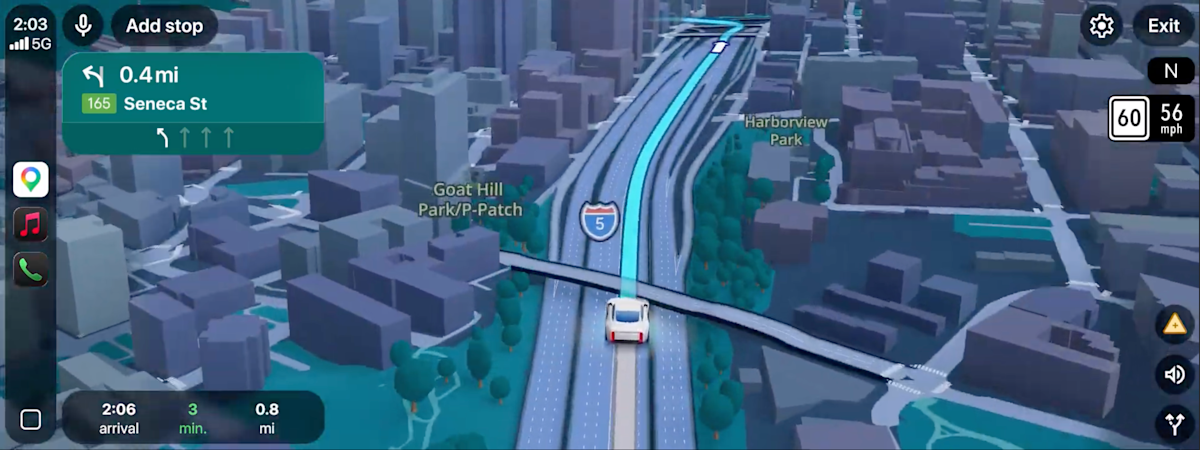
Google Maps Rolls Out 3D 'Immersive Navigation' Powered by Gemini
Key Facts
- What: Google Maps introduces "Immersive Navigation" with 3D rendering of surroundings during driving directions, powered by Gemini models
- Features: 3D views of landmarks and buildings, AI-highlighted road elements like crosswalks and traffic lights, more natural voice guidance, alternative route tradeoffs, Street View destination previews, and new "Ask Maps" Gemini chatbot
- Availability: Immersive Navigation rolling out today in the US on Android, iOS, CarPlay, Android Auto and cars with Google built-in; Ask Maps launching in the US and India on mobile with desktop support coming soon
- Significance: Google calls it the biggest update to driving directions in Maps in about a decade
Lead paragraph
Google is overhauling the driving experience in Maps with a new 3D "Immersive Navigation" mode powered by its Gemini AI models. Instead of traditional 2D maps, the app will now render surroundings in three dimensions using data from Street View and aerial imagery, aiming to help drivers better orient themselves and spot key turns. The update, which Google describes as the most significant change to driving directions in roughly ten years, also includes more natural voice guidance, smarter route suggestions and a new conversational "Ask Maps" feature.
Body
The core of the update is the shift from flat 2D maps to dynamic 3D views while navigating. According to the announcement, Gemini models decide how to render elements in the scene to reduce visual clutter. The system pulls from Google's extensive Street View database and aerial photos to generate realistic representations of buildings, overpasses and other landmarks. Google says the AI is also capable of intelligently highlighting important road features such as crosswalks, traffic lights and stop signs at the right moments to help drivers avoid missing exits or turns.
Voice guidance has also been improved to sound more conversational. Rather than reading out exit numbers or unfamiliar street names, the assistant might say "go past this exit and take the next one" when driving on highways. This change is expected to be particularly useful for drivers in foreign countries or unfamiliar areas.
The new intelligence extends to route planning. When Maps suggests an alternative path, it now explains the tradeoffs involved — for instance, noting that one route may take longer but will have less traffic. Before starting a trip, the app will also show a Street View preview of the destination and suggest parking options.
In addition to navigation improvements, Google is introducing "Ask Maps," a Gemini-powered chatbot accessible via a new icon in the app. Users can type natural language questions, and the system will draw on all of Maps' data to provide answers. Google pitched the feature as a way to get information that would previously require reading through many reviews.
Examples include asking for a place to charge a phone and get coffee without long lines, or finding personalized recommendations based on a user's past searches and saved locations. Results can include actionable options such as booking a restaurant or saving a spot directly from the chat.
Impact section
For drivers, the combination of 3D visualization and smarter guidance could reduce the cognitive load of navigating, particularly in complex urban environments or highway interchanges. The more natural voice prompts and explanatory route suggestions may help users make better-informed decisions rather than simply following directions.
The Ask Maps feature represents Google's broader push to integrate its Gemini chatbot across products. By making Maps data queryable through natural language, Google is attempting to transform the app from a simple routing tool into a more comprehensive travel assistant. Personalized results based on user history could increase engagement with the app's recommendation features.
The update comes as Google continues to add AI capabilities to its core consumer products following similar Gemini integrations in Gmail and Chrome. It also arrives amid growing competition in mapping and navigation services, where features like 3D views and conversational interfaces are becoming important differentiators.
What's next
Google is beginning the rollout of Immersive Navigation in the United States first, with broader availability expected over the coming months across Android and iOS devices as well as CarPlay, Android Auto and vehicles with Google built-in systems. The Ask Maps feature is launching initially on Android and iOS in the US and India, with support for the desktop version of Maps planned for the near future.
The company has not yet detailed specific timelines for international expansion beyond the initial countries or provided technical benchmarks for the Gemini models' performance in rendering maps. Further details on how users can control or customize the 3D experience were not disclosed in the initial announcement.
Sources
- Engadget - Google Maps brings a 3D map to your driving directions
- Google Blog - Ask Maps and Immersive Navigation: New AI features in Google Maps
- TechCrunch - Google Maps is getting an AI 'Ask Maps' feature and upgraded 'immersive' navigation
- Road & Track - Google Maps Just Got a Massive Makeover and New AI Features for Drivers
Note on verification: Some technical claims regarding the exact role of Gemini models and specific rendering capabilities are currently unverifiable through independent cross-referenced reporting and are attributed directly to Google's announcements as reported by Engadget and other outlets.