
Google Uses Gemini to Turn 5M Old News Reports Into Flash Flood Predictor
Key Facts
- What: Google created Groundsource, using Gemini to process over 5 million global news reports into a dataset of 2.6 million geo-tagged flood events for training flash flood prediction models.
- When: Announced March 12, 2026, with data now available through Google’s Flood Hub platform.
- Where: Risk predictions provided for urban areas in 150 countries; designed specifically for regions lacking advanced weather infrastructure.
- How: Gemini extracts and structures historical flood data from news articles; this dataset trains a model that ingests current weather forecasts to predict flash flood likelihood.
- Limitations: Predictions cover 20-square-kilometer areas and do not incorporate local radar data, making them less precise than systems like the US National Weather Service.
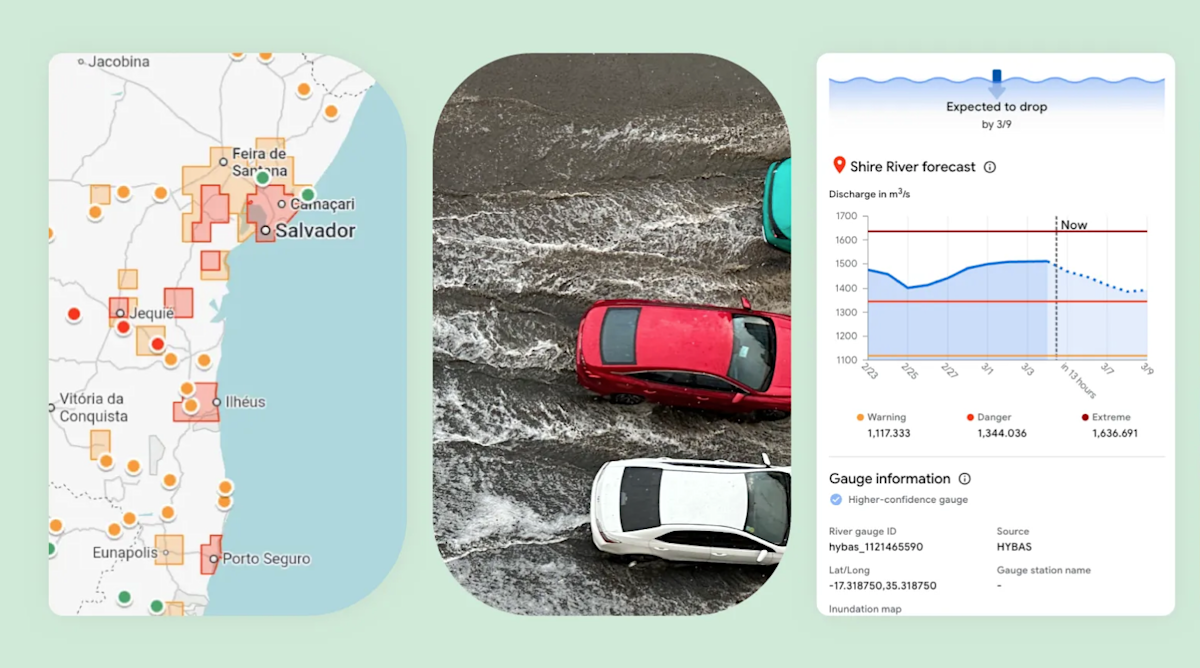
Google has developed a novel AI system that transforms millions of historical news articles into actionable flood intelligence, addressing one of the most dangerous gaps in weather forecasting. The company’s Groundsource methodology uses its Gemini large language model to analyze more than 5 million news reports, extracting a dataset of 2.6 million verified flood events. This data now powers flash flood risk predictions delivered through Google’s Flood Hub platform to urban areas across 150 countries.
The breakthrough tackles a longstanding problem in meteorology: flash floods are notoriously difficult to predict because deep learning weather models require extensive historical training data that simply doesn’t exist in many parts of the world. According to Google Research, the absence of reliable historical records has prevented AI from effectively forecasting these sudden, often deadly events.
How Groundsource Works
Google tasked Gemini with reading through 5 million news articles from around the globe and isolating legitimate flood reports. The model transformed unstructured text into a structured, geo-tagged chronological series of flood events — essentially creating a massive historical database from scratch.
This Groundsource dataset is then used to train a prediction model that combines the historical patterns with current weather forecasts to estimate flash flood probability in specific locations. It marks the first time Google has used a large language model for this type of work in weather and crisis prediction, the company confirmed.
The resulting predictions are now integrated into Google’s Flood Hub, a platform the company uses to share flood risk information with emergency response agencies and the public. One early user reported that the system helped their organization respond more quickly to localized weather events, though Google has not yet released comprehensive accuracy metrics.
Limitations and Design Choices
Despite its innovation, Groundsource has clear constraints. Predictions are currently limited to 20-square-kilometer areas, offering relatively coarse geographic resolution. The system also does not integrate local radar data — the kind of real-time precipitation tracking used by advanced national weather services.
However, this limitation is by design. Google built the platform specifically for regions that lack sophisticated weather-sensing infrastructure, where traditional forecasting methods are unavailable. In many developing countries and under-resourced urban areas, the choice between imperfect AI-powered predictions and no predictions at all is an easy one.
Google’s Broader AI Weather Ambitions
This project represents Google’s first use of a language model for weather-related forecasting, but the company has significant prior experience applying AI to meteorology. DeepMind’s WeatherNext 2 model has demonstrated exceptional accuracy in traditional weather prediction, setting a high bar within the Google family of AI systems.
Juliet Rothenberg, program manager on Google’s Resilience team, sees Groundsource as the beginning of a much larger effort. “We’re aggregating millions of reports,” she told reporters. “It enables us to extrapolate to other regions where there isn’t as much information.”
Rothenberg hopes the same methodology can eventually be applied to predict other challenging phenomena including heat waves and mudslides.
Impact on Emergency Response and Vulnerable Communities
“We’re still in the early days of seeing the impact of Groundsource, but that chain of events from a prediction in Flood Hub to boots on the ground is exactly what Flood Hub was built for.” — Juliet Rothenberg, Google Resilience team
This statement captures the real-world stakes. For the first time, many communities that previously had almost no warning for flash floods now have access to AI-generated risk assessments derived from decades of global news coverage. In an era of increasing extreme weather, this data gap closure could translate directly into lives saved and faster emergency deployments.
The approach also demonstrates a creative solution to one of AI’s biggest limitations: the need for high-quality training data. By using Gemini to mine unstructured public information, Google has effectively generated its own dataset where none existed. This technique could prove valuable across many domains where official records are incomplete.
Competitive Context
Google’s move comes as multiple tech giants pour resources into AI-powered weather and climate tools. While companies like DeepMind have focused on general weather forecasting with impressive results, Google’s use of Gemini to solve the specific historical data problem for flash floods represents a distinct approach. The 2.6 million event dataset is particularly significant — creating such a resource manually would have been prohibitively expensive and time-consuming.
What’s Next
Google is actively sharing the Groundsource-derived predictions with emergency response agencies in 150 countries. The company has not announced a specific timeline for expanding the system to other disaster types, though Rothenberg indicated heat waves and mudslides are under consideration.
As more real-world usage data accumulates, Google is expected to publish detailed accuracy benchmarks comparing Groundsource-powered predictions against actual flood occurrences. The company will likely also refine the geographic resolution and explore integration with additional data sources where available.
For developers and researchers, Google has indicated the dataset and methodology will be made available through academic and research channels, potentially accelerating progress in climate resilience technology globally.
The project underscores a broader truth about AI’s potential in climate adaptation: sometimes the most valuable breakthroughs come not from building bigger models, but from finding clever ways to unlock the knowledge already scattered across millions of public documents.
Sources
- Google built a flash-flood prediction tool using Gemini and old news reports
- Google is using old news reports and AI to predict flash floods | TechCrunch
- Groundsource: using AI to help communities better predict natural disasters
- Protecting cities with AI-driven flash flood forecasting
- Google Is Using AI to Fill a Flood Risk Data Gap - Heatmap News
- Google Research announcement on X (March 12, 2026)