
Headline:
Meta Introduces Parent-Managed WhatsApp Accounts for Children Under 13
Key Facts
- What: Meta is launching parent-managed accounts on WhatsApp that allow children under 13 to use the app under strict parental supervision.
- Features: Accounts are limited to messaging and calling only; Channels, Status updates, location sharing, disappearing messages in one-to-one chats, and Meta AI are unavailable.
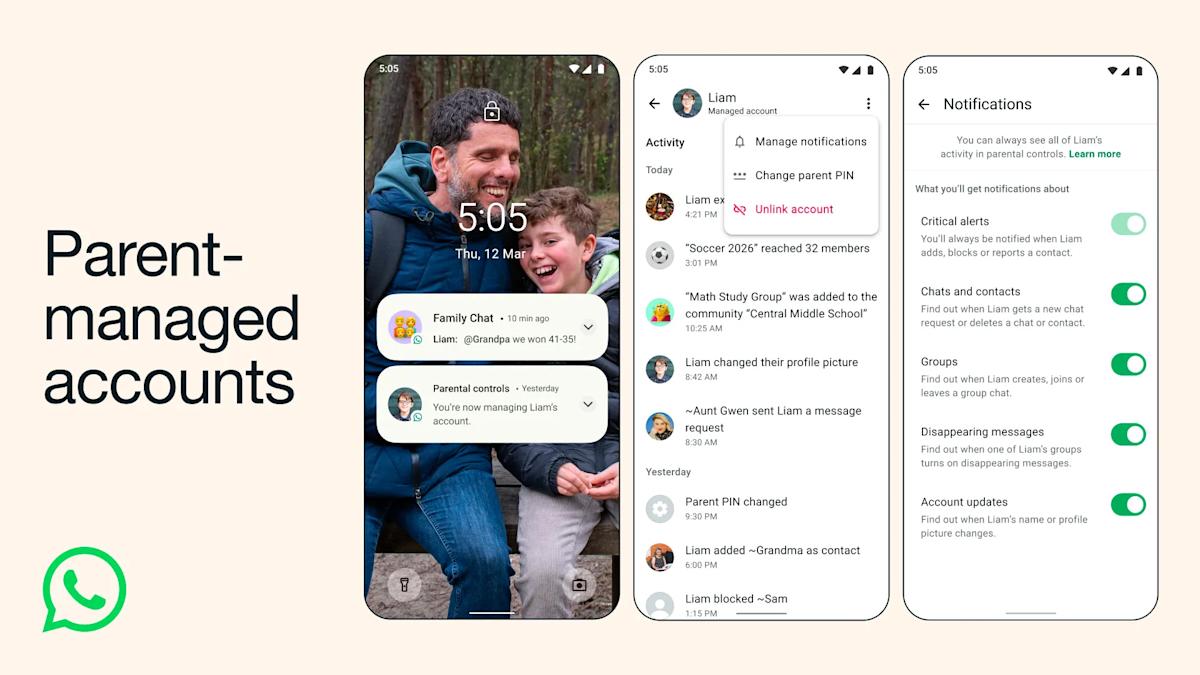
- Controls: Parents can approve contacts and groups, receive notifications for requests from unknown users, and manage all privacy settings via a linked parent account.
- Setup: Requires physically linking the parent’s and child’s devices; accounts are PIN-protected with changes restricted to the parent or guardian.
- Rollout: Gradual global rollout begins in the coming months; no minimum age is specified beyond under 13.
Lead paragraph
Meta announced it will allow children under 13 to use WhatsApp through new parent-managed accounts designed to provide safer messaging and calling experiences. The feature, developed in response to feedback from parents, gives guardians full control over who can contact their children and which groups they can join. The accounts maintain WhatsApp’s end-to-end encryption while adding multiple layers of parental oversight and restricting access to advanced platform features.
Body
The new parent-managed accounts represent a significant expansion of Meta’s age-appropriate safety tools. During registration, parents will see an option to create a managed account for pre-teens. To activate the account, the parent must place their phone next to the child’s device to establish the link. Once connected, the parent gains the ability to decide who can send messages, approve group memberships, and adjust privacy settings exclusively from their own device.
By default, only saved contacts can message the managed account. Message requests from unknown contacts are routed to a separate folder visible only on the parent’s device. Group invitations from strangers must also receive explicit parental approval before the child can view or join them. These requests appear as notifications to the parent, ensuring they remain informed of potential new interactions.
The accounts are PIN-protected, and only the parent or guardian can modify privacy settings. Children using these accounts will not have access to Meta AI, Channels, Status updates, or location sharing. Disappearing messages are disabled in one-to-one chats. According to reporting from multiple outlets including The Times of India and Gadgets 360, these restrictions were implemented partly due to prior concerns raised by online safety organizations about Meta AI’s interactions with minors.
This move aligns with Meta’s broader efforts to strengthen parental controls across its family of apps. In September, the company introduced teen accounts for 13- to 15-year-olds on Facebook and Messenger. The previous year, Instagram began requiring Under-16 teen accounts with similar supervisory features. WhatsApp’s parent-managed accounts extend these protections to an even younger audience that has historically been blocked from the platform due to its 13+ age rating on app stores.
Impact
For parents, the feature offers a controlled way to introduce WhatsApp to children who already use the app to communicate with family members. Many pre-teens have been using the service despite the age restriction, often with informal parental oversight. The new system formalizes that supervision and provides technical guardrails that were previously unavailable.
The decision also reflects growing regulatory and societal pressure on technology companies to protect younger users. By limiting functionality and requiring active parental management, Meta aims to reduce exposure to unwanted contact, group spam, and AI-generated content that has raised safety issues on other parts of its platforms.
End-to-end encryption remains intact for all conversations on these accounts, meaning Meta itself cannot access message content. This maintains WhatsApp’s core privacy promise while layering parental controls on top of the encrypted infrastructure.
What’s Next
Meta has not announced an exact timeline beyond a gradual rollout “in the coming months.” The company has not specified a minimum age below 13, leaving it to parents to determine suitability based on individual maturity and family needs.
The launch comes after Meta temporarily paused teen interactions with its AI chatbot characters at the start of 2026 following reports of inappropriate conversations with minors. The exclusion of Meta AI from parent-managed accounts appears to be a direct response to those concerns.
Industry observers expect the feature to be closely watched by regulators, child safety advocates, and competitors. How effectively parents adopt and use these controls will likely influence future decisions about age-appropriate access across social messaging platforms.
As Meta continues expanding its parental control ecosystem, the company faces the ongoing challenge of balancing user safety with the practical reality that many families already rely on WhatsApp for daily communication across generations.