
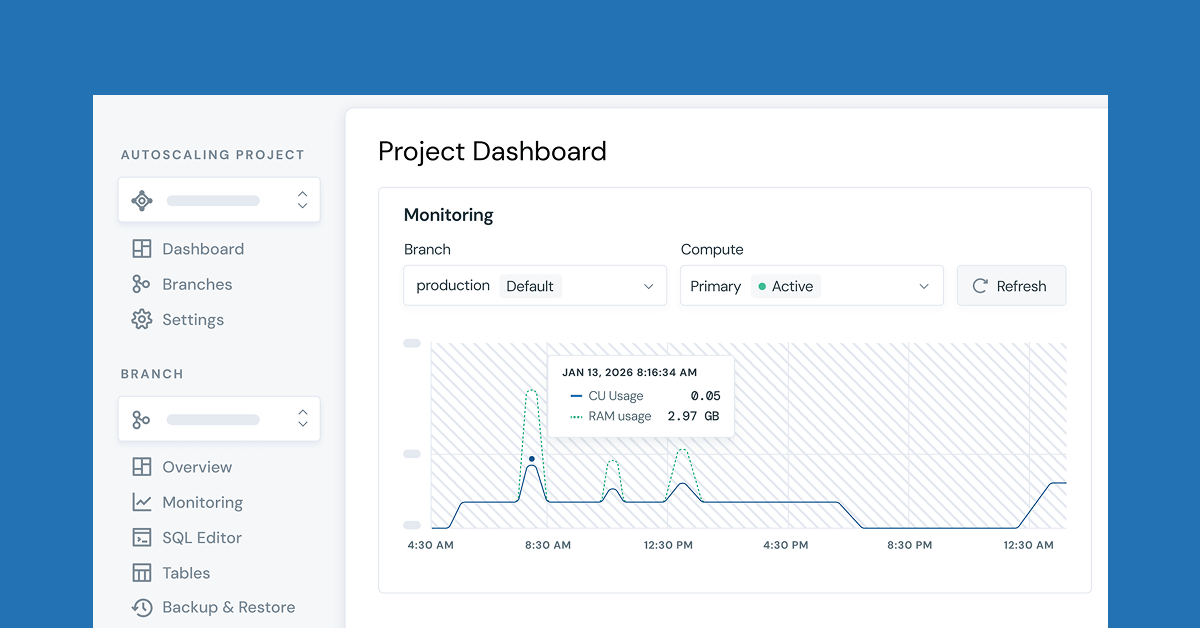
Beyond Provisioning: Databricks Releases Developer Guide to Lakebase Autoscaling
Key Facts
- Databricks published "Beyond Provisioning: The Developer’s Guide to Databricks Lakebase Autoscaling," offering practical guidance on its new autoscaling capabilities for Lakebase.
- Lakebase is a fully managed PostgreSQL-compatible operational database built for AI applications and agents, deeply integrated with the Databricks lakehouse.
- Autoscaling automatically adjusts compute resources within user-defined minimum and maximum limits based on workload, never dropping below the minimum or exceeding the maximum.
- The feature is currently available for computes up to 32 Compute Units (CU).
- Lakebase separates compute from storage, unlike traditional PostgreSQL deployments, enabling better scalability for AI workloads.
Lead paragraph
Databricks has released a comprehensive developer guide titled "Beyond Provisioning: The Developer’s Guide to Databricks Lakebase Autoscaling," detailing how to effectively use the autoscaling capabilities of its newly launched Lakebase database. Lakebase is a fully managed, PostgreSQL-compatible operational database designed specifically for AI applications and intelligent agents. By automatically adjusting compute resources in response to workload demands while maintaining strict minimum and maximum boundaries, the feature aims to eliminate the traditional trade-offs between over-provisioning and under-provisioning that have long plagued database operations.
What is Lakebase?
According to Databricks' announcements, Lakebase represents a new class of operational database built for the AI era. It combines the familiarity of PostgreSQL with deep integration into the Databricks lakehouse architecture. Unlike conventional PostgreSQL databases that tightly couple compute and storage, Lakebase separates these layers. This architectural choice allows storage to reside in low-cost data lakes while compute can scale independently and continuously.
The database is powered by Neon technology, which enables serverless-style operational capabilities within the lakehouse environment. This convergence of operational and analytical systems is particularly valuable for AI developers, as it reduces latency between AI models and the data they need for real-time decision making.
The Challenge of Traditional Provisioning
The new guide opens by highlighting the binary and often painful choice developers face with traditional databases: either over-provision resources, leading to unnecessary costs, or risk under-provisioning, which causes performance degradation during traffic spikes.
This problem is especially acute for AI applications and agentic workloads, which often exhibit highly variable and unpredictable compute demands. Training, inference, and autonomous agent operations can create sudden surges in database activity that are difficult to forecast using conventional capacity planning methods.
How Lakebase Autoscaling Works
According to Databricks documentation, Lakebase autoscaling allows compute to automatically adjust within developer-defined limits. The system continuously monitors workload patterns and scales resources up or down accordingly, but never drops below the configured minimum or exceeds the maximum Compute Units.
This bounded autoscaling approach provides predictability for cost management while still delivering the elasticity needed for modern AI applications. The feature is currently available for compute configurations up to 32 CU, with Databricks indicating that autoscaling represents the forward-looking direction for the product.
The guide reportedly walks developers through practical implementation patterns, best practices for setting appropriate min/max boundaries, monitoring techniques, and how to integrate autoscaling into CI/CD workflows and application architecture.
Integration with the Broader Databricks Platform
Lakebase is not a standalone database but deeply embedded within the Databricks ecosystem. This integration allows developers to leverage familiar lakehouse tools, governance features, and data management capabilities alongside their operational workloads.
The separation of compute and storage provides several advantages for AI development. Storage can take advantage of the cost efficiency and durability of data lakes, while compute resources can be spun up and down rapidly to match the bursty nature of AI agent interactions and real-time inference requirements.
As reported by TechTarget, this architectural approach "fosters AI development by separating compute from storage, unlike many PostgreSQL databases that couple them together."
Why This Matters for AI Developers
The launch of Lakebase and its autoscaling capabilities addresses a critical gap in the modern AI stack. Many organizations struggle to operationalize AI because of the friction between analytical data platforms and the operational databases required to serve models and agents in production.
By bringing operational data directly into the lakehouse with continuous autoscaling, Databricks aims to unify these previously siloed worlds. Developers can now build applications that combine real-time operational data with the rich analytical capabilities of the lakehouse without managing complex data synchronization pipelines.
InfoQ notes that "autoscaling is the newer option and is where new features are being built, while Databricks continues to add the existing capabilities currently available in the Provisioned version." This indicates that autoscaling represents the strategic future of the Lakebase product line.
Technical Context and Competitive Landscape
Lakebase enters a crowded market of managed PostgreSQL offerings, but differentiates itself through its lakehouse integration and AI-first design. Traditional cloud database services often require significant operational overhead for scaling, whereas Lakebase's autoscaling is designed to be largely hands-off after initial configuration.
The use of Neon technology brings proven serverless Postgres innovations into the Databricks environment. This includes features like instant scaling, branching for development workflows, and efficient resource utilization — all optimized for the unique demands of AI agents and applications.
For organizations already invested in the Databricks platform, Lakebase offers the potential to reduce architectural complexity by consolidating operational and analytical data stores.
Impact on Developers and Organizations
The availability of this developer guide and the underlying autoscaling technology should lower the barrier to adopting Lakebase for production AI workloads. Developers can move beyond manual capacity planning and reactive scaling to a more proactive, workload-driven approach.
Cost management becomes more predictable with clearly defined maximum compute limits, while application performance remains protected by minimum compute guarantees. This balance is particularly valuable for organizations building agentic AI systems, which often have unpredictable usage patterns.
The guide is expected to cover real-world scenarios, performance tuning recommendations, and integration examples that will help accelerate adoption across the Databricks customer base.
What's Next
Databricks has positioned autoscaling as the primary development focus for Lakebase going forward. While the Provisioned version will continue to receive updates to maintain existing capabilities, new features are being built primarily for the autoscaling experience.
The company is likely to expand the maximum compute limits beyond the current 32 CU threshold and introduce additional intelligence into the autoscaling algorithms as more usage data becomes available. Further integration with Databricks' AI and agent development tools is also anticipated.
Organizations interested in Lakebase can currently access it through the public preview announced earlier, with the new autoscaling guide providing the practical knowledge needed to implement it effectively.
Impact Section
For developers, Lakebase autoscaling represents a significant reduction in operational burden. Instead of spending time on capacity planning and infrastructure management, they can focus on building intelligent applications. The PostgreSQL compatibility means existing skills and tools transfer directly, lowering the learning curve.
For the broader industry, this launch signals continued convergence between data lakes, warehouses, and operational databases. As AI workloads become more prevalent, the ability to seamlessly blend transactional and analytical capabilities will become a competitive advantage.
The separation of compute and storage in an operational database context could influence how other cloud providers approach similar challenges, potentially accelerating innovation across managed database services.
Sources
- Beyond Provisioning: The Developer’s Guide to Databricks Lakebase Autoscaling
- Databricks Launches Lakebase: a New Class of Operational Database for AI Apps and Agents
- Announcing Lakebase Public Preview | Databricks Blog
- Databricks launches PostgreSQL Lakebase to aid AI developers | TechTarget
- Databricks Introduces Lakebase, a PostgreSQL Database for AI Workloads - InfoQ
- Autoscaling | Databricks on AWS