
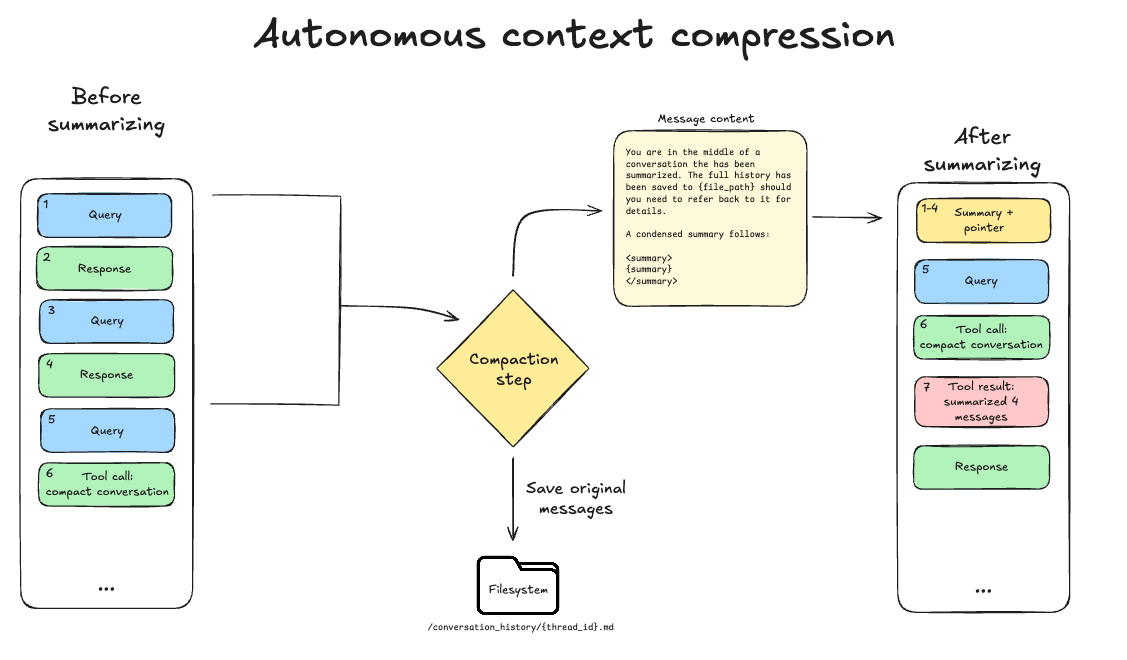
Autonomous Context Compression Tool Added to LangChain's Deep Agents SDK
Key Facts
- LangChain has introduced a new tool in its Deep Agents SDK (Python) and CLI that enables AI models to autonomously compress their context windows at optimal moments.
- The tool allows agents to replace older messages with compressed summaries, reducing token usage while preserving critical information.
- In related research on "Focus Agent" using Claude 3.5 Haiku on SWE-bench Lite, autonomous compression achieved 22.7% token reduction (14.9M to 11.5M tokens) with no loss in accuracy (60% success rate).
- The feature addresses growing challenges with long-context conversations, including redundant re-summarization, increasing costs, and the need for hierarchical summarization as context windows approach 1M tokens.
- Other industry approaches include OpenAI's /responses/compact endpoint (99.3% compression but opaque) and Anthropic's built-in Claude SDK compression.
LangChain has released a new autonomous context compression tool for its Deep Agents SDK and command-line interface, allowing large language model agents to intelligently manage and reduce their own working memory during extended interactions.
The feature, detailed in a blog post on the company's official site, marks a step toward more efficient memory management in agentic AI systems. By enabling models to decide when and how to compress older messages into concise summaries, the tool aims to mitigate ballooning context lengths that drive up costs and latency in production AI applications.
How Autonomous Context Compression Works
According to LangChain's announcement, context compression is defined as an action that reduces the information stored in an agent's working memory. Older messages are replaced by more compact representations—typically summaries or "knowledge blocks"—that retain essential learnings while pruning redundant raw interaction history.
This autonomous approach differs from traditional manual or periodic summarization methods. The agent itself determines opportune moments for compression based on conversation dynamics, rather than relying on fixed token thresholds or external orchestration. This capability is now available in both the Python Deep Agents SDK and the LangChain CLI.
The development aligns with broader industry efforts to tackle context management challenges. As noted in related research, conventional summarization approaches suffer from redundant re-summarization—where each compression cycle reprocesses the entire conversation prefix—and linearly growing costs as conversations lengthen. These issues become particularly acute as state-of-the-art context windows expand toward 1 million tokens.
Research Context and Performance
LangChain's tool builds upon concepts explored in academic and industry research on active context compression. A relevant arXiv paper titled "Active Context Compression: Autonomous Memory Management in LLM Agents" describes the "Focus Agent," which autonomously consolidates key learnings into persistent "Knowledge" blocks while pruning raw history.
In evaluations on five context-intensive instances from SWE-bench Lite using Claude 3.5 Haiku, the Focus Agent achieved a 22.7% token reduction—from 14.9 million to 11.5 million tokens—while maintaining identical task accuracy of 60% (3 out of 5 tasks solved). The evaluation used an optimized scaffold incorporating persistent bash and string-replacement editing, following industry best practices.
Comparative analysis from Factory.ai highlights different compression strategies currently available. OpenAI's /responses/compact endpoint delivers exceptional 99.3% compression ratios through opaque representations optimized for reconstruction fidelity. However, these compressed outputs lack interpretability, making it impossible for developers to verify what information was preserved. In contrast, Anthropic offers more transparent built-in context compression through the Claude SDK.
Factory.ai's evaluation framework underscores the importance of compression methods for real-world software engineering tasks, where preserving useful memory directly impacts agent performance.
Technical Challenges in Context Management
Long-running AI agents frequently encounter context window limitations despite impressive maximum token counts. As conversations progress, the accumulation of interaction history creates several problems:
- Redundant processing: Each compression trigger often requires re-summarizing previously processed content.
- Escalating costs: The computational burden of summarization grows with conversation length.
- Memory fidelity: Critical details can be lost or distorted through repeated compression cycles.
- Latency impact: Longer contexts directly translate to slower response times and higher API costs.
Autonomous compression addresses these by allowing the model to maintain a persistent knowledge store while actively withdrawing less relevant raw history. This creates a more sustainable approach to memory management that scales with extended agent deployments.
LangChain's implementation emphasizes agent autonomy—the model decides not only what to compress but when compression should occur. This represents a shift from rule-based systems toward more intelligent, self-regulating agent architectures.
Industry Implications
For developers building sophisticated AI agents, this tool offers a practical solution to one of the most persistent operational challenges in production environments. Reduced token consumption directly translates to lower inference costs and improved performance, particularly for agents engaged in complex, multi-turn tasks such as software development, research, or customer support.
The feature should be especially valuable for applications requiring long-term memory, where agents must maintain coherence across dozens or hundreds of interactions. By compressing context intelligently, agents can operate more efficiently while preserving task performance.
The announcement also reflects growing competition in the agent development ecosystem. As frameworks like LangChain, LlamaIndex, and others race to provide more sophisticated memory management capabilities, autonomous compression is likely to become a standard expectation rather than a novel feature.
Enterprise users particularly stand to benefit, as context management costs can become significant at scale. A 22.7% reduction in token usage, as demonstrated in the Focus Agent research, could translate to meaningful savings in large deployments.
What's Next
LangChain has not yet detailed a specific roadmap for expanding the autonomous compression capabilities, though the integration into both the Deep Agents SDK and CLI suggests broad availability for Python developers and command-line users.
Future iterations may incorporate more advanced compression techniques, improved knowledge representation formats, or tighter integration with specific large language models. The company may also explore hierarchical compression strategies that better handle extremely long contexts approaching or exceeding one million tokens.
As the broader AI industry continues refining agent architectures, autonomous context management is expected to evolve from a specialized tool into a core capability. Research into more interpretable compression methods—addressing the transparency limitations of approaches like OpenAI's compact endpoint—will likely remain an active area of development.
The LangChain team has positioned this release as part of ongoing efforts to make agentic systems more practical and cost-effective for real-world applications.