
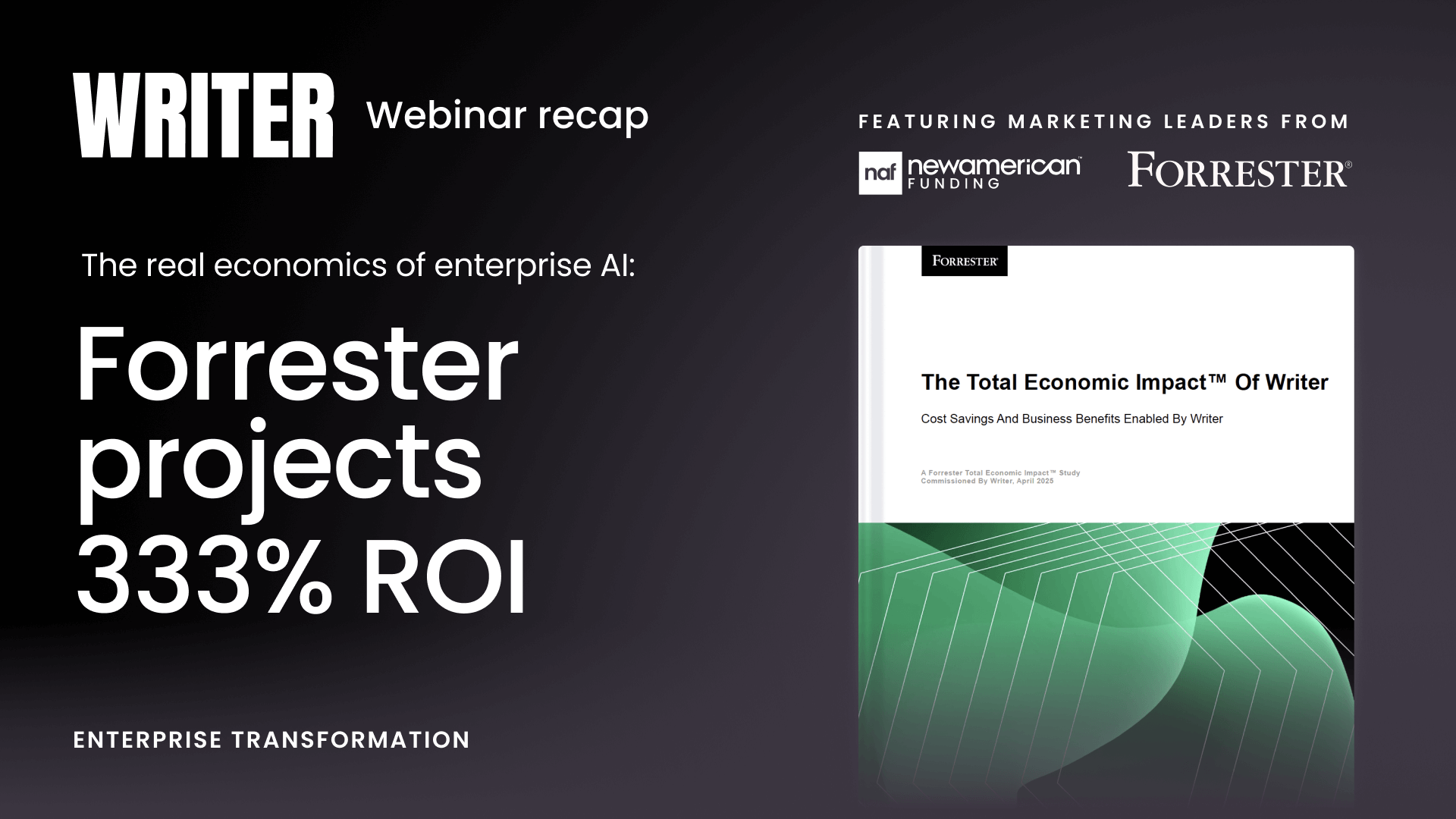
The Real Economics of Enterprise AI: Forrester Study Shows 333% ROI
Lead paragraph
A new Forrester Consulting Total Economic Impact™ study commissioned by enterprise AI platform Writer has quantified significant returns from AI deployment, delivering a 333% ROI and $12 million in net present value over three years for a composite organization based on six interviewed customers. The research highlights both broad productivity gains and specific real-world results from New American Funding, a mortgage lender that has leveraged Writer’s platform to streamline content creation and operations. As enterprises seek measurable outcomes from generative AI investments, the study provides concrete benchmarks showing how AI platforms can drive financial returns through efficiency improvements and risk reduction.
Study Details and Key Findings
According to the Writer-commissioned Forrester study, the composite organization — modeled after six interviewed customers — achieved a 333% return on investment over three years. The analysis calculated a net present value of $12 million during that period. These figures reflect benefits that outweighed implementation and ongoing costs by a substantial margin, offering one of the more detailed third-party economic assessments available for enterprise-focused generative AI platforms.
The study evaluated Writer’s full-stack generative AI platform, which includes tools for content creation, customization, governance, and integration with existing enterprise systems. Interviewed customers reportedly experienced improvements in content production speed, reduction in manual review cycles, and better consistency across marketing, sales, and operational materials. While specific technical model sizes were not disclosed in the announcement, the platform’s emphasis on enterprise-grade controls and domain-specific customization emerged as key differentiators in achieving these returns.
Forrester’s methodology involved in-depth interviews with decision-makers at organizations that had deployed Writer’s technology. The resulting composite organization represents a blend of their experiences, with benefits quantified across risk mitigation, productivity gains, and cost savings. The 333% ROI figure positions Writer competitively against other enterprise AI initiatives. For comparison, a separate Forrester study on Microsoft Foundry, also using the Total Economic Impact framework, reported a 327% ROI over three years, driven largely by $15.7 million in developer productivity gains.
New American Funding’s Real-World Results
One featured customer in the announcement is New American Funding, a prominent mortgage lender. The company has implemented Writer’s AI platform to address challenges in creating compliant, accurate, and personalized content at scale across marketing campaigns, customer communications, and internal documentation.
According to the recap, New American Funding achieved measurable benefits including faster content generation cycles and reduced dependency on external agencies or large internal creative teams. The mortgage industry faces strict regulatory requirements around disclosures and accuracy, making AI governance features particularly valuable. Writer’s platform reportedly helped the lender maintain brand voice consistency while accelerating output for digital marketing, email campaigns, and loan-related documentation.
Though exact dollar figures for New American Funding were not broken out separately from the composite model, the company’s experience is presented as validation of the broader study findings. The integration of Writer’s tools allowed subject matter experts to focus on higher-value strategic work rather than repetitive content tasks, aligning with the productivity improvements quantified in the Forrester analysis.
Competitive Landscape and Enterprise AI Economics
The Writer study arrives as enterprises continue to scrutinize AI investments amid questions about long-term value. Multiple industry reports, including those from Deloitte, indicate that improving productivity and efficiency remain the top-cited benefits of enterprise AI adoption, with roughly two-thirds of organizations reporting gains in these areas.
Forrester has emerged as a key provider of independent economic analysis in this space. Its Total Economic Impact studies offer structured frameworks that go beyond anecdotal success stories, incorporating costs of technology, training, change management, and ongoing operations. The similarity between Writer’s 333% ROI and Microsoft Foundry’s 327% ROI suggests that well-implemented enterprise AI platforms — particularly those with strong governance and integration capabilities — can deliver comparable returns despite different technical approaches.
Writer positions its platform as purpose-built for enterprises needing control over AI outputs. Unlike consumer-focused tools, the company emphasizes features such as custom model fine-tuning, policy enforcement, and auditability — capabilities that appear to have contributed to the risk reduction benefits measured in the study. The announcement notes that these governance tools help organizations avoid common pitfalls such as brand inconsistency, regulatory violations, or security issues that could erode potential ROI.
The study also underscores the importance of phased adoption. Organizations that begin with targeted pilots to establish ROI baselines, data readiness, and user experience metrics tend to achieve stronger outcomes. This measured approach contrasts with vendors advocating rapid enterprise-wide deployment without clear success criteria.
Impact on Developers, Users, and the Industry
For developers and technical teams, the productivity gains highlighted across both Writer and Microsoft studies point to significant time savings in content-related coding, testing, and iteration cycles. While the Writer study does not isolate developer-specific metrics to the same degree as the Microsoft Foundry analysis, the overall efficiency improvements suggest reduced manual effort in building and maintaining customer-facing content systems.
Business users benefit from faster access to high-quality, on-brand materials without requiring deep technical expertise. Marketing, sales, and compliance teams can generate and iterate content more rapidly while maintaining necessary oversight. This democratization of content creation potentially reduces bottlenecks and allows organizations to respond more quickly to market opportunities.
From an industry perspective, the study adds to a growing body of evidence that enterprise AI can deliver strong financial returns when properly scoped and governed. However, outcomes remain highly dependent on implementation quality, data readiness, and organizational change management. The 333% ROI figure will likely be referenced in sales and marketing conversations as enterprises evaluate competing platforms from Writer, Microsoft, and other providers.
The research also highlights the continuing importance of measuring both quantitative ROI and qualitative improvements. While $12 million in net present value provides a clear financial benchmark, factors such as improved brand consistency, reduced compliance risk, and faster time-to-market contribute to overall business value in ways that may be harder to fully quantify.
What’s Next
Writer did not announce specific timelines for new product features in conjunction with the study. However, the company is expected to continue investing in platform capabilities that enhance governance, customization, and integration — areas that directly impact the ROI drivers identified by Forrester.
Enterprises considering similar deployments will likely demand more independent studies of this type. As the generative AI market matures, third-party validation of economic impact is becoming table stakes for serious enterprise adoption. Future Forrester or Gartner analyses may provide additional comparative data across multiple platforms, helping buyers make more informed decisions.
For organizations in regulated industries like financial services, the combination of productivity gains and strong governance features demonstrated by New American Funding could serve as a model for AI implementation. Companies in mortgage lending, insurance, healthcare, and other compliance-heavy sectors may accelerate evaluations of enterprise AI platforms that offer similar controls.
The study reinforces the message that successful enterprise AI adoption requires more than access to powerful models. Organizations must focus on integration with existing workflows, change management, and measurement frameworks to capture the full economic benefits.
Sources
- The real economics of enterprise AI: Forrester study shows 333% ROI — here's how New American Funding is also achieving benefits
- The economics of enterprise AI: What the Forrester TEI study reveals about Microsoft Foundry | Microsoft Azure Blog
- The State of AI in the Enterprise - 2026 AI report | Deloitte US
- The Copilot Reality Check: What Enterprise Adoption Data Reveals About The AI Boom