
Headline:
LangChain Builds Internal GTM Agent, Boosting Lead Conversion 250%
Key Facts
- What: LangChain developed an internal “GTM Agent” that automates go-to-market tasks for its sales team.
- Impact: The agent increased lead conversion rates by 250% and saved each sales representative approximately 40 hours per month.
- Technology: Built using LangChain’s own
create_openai_tools_agentpattern. - Context: Announcement comes shortly after LangChain raised $125M at a $1.25B valuation to advance its agent engineering platform.
- Company Focus: LangChain provides open-source frameworks and LangSmith for building, testing, and deploying reliable AI agents.
Lead paragraph
LangChain has deployed an internal AI agent that dramatically improves its own sales productivity. The go-to-market (GTM) agent, built with the company’s own LangChain framework, has increased lead conversion by 250% while freeing each sales representative from roughly 40 hours of manual work per month, the company announced in a new blog post.
How LangChain Built Its GTM Agent
In the detailed technical post titled “How we built LangChain’s GTM Agent,” the company walks through the architecture and implementation decisions behind the system. The agent was constructed using LangChain’s create_openai_tools_agent pattern, which allows developers to equip large language models with a set of tools and structured reasoning capabilities.
According to the blog, the GTM agent handles multiple repetitive sales tasks that previously consumed significant human time. These include lead qualification, initial outreach personalization, scheduling follow-ups, updating CRM records, and routing high-potential leads to the appropriate sales representative. By automating these workflows, the agent enables the human sales team to focus on higher-value conversations and closing deals.
The project reflects LangChain’s broader mission to become the leading platform for agent engineering. The company recently raised $125 million in Series B funding at a $1.25 billion valuation, explicitly earmarking the capital to build tools for creating, observing, evaluating, and deploying reliable AI agents at scale.
Technical Approach and Integration
LangChain’s engineering team leveraged its own open-source framework and LangSmith platform during development. The create_openai_tools_agent constructor provides a pre-built agent architecture that integrates with OpenAI models and supports custom tools. This approach allowed the team to rapidly prototype and iterate on the GTM agent while maintaining compatibility with the broader LangChain ecosystem.
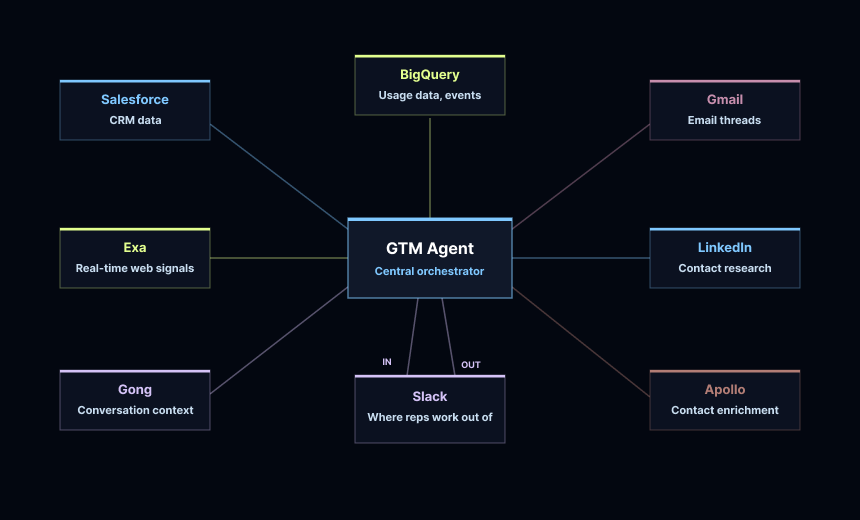
The agent is designed to operate within LangChain’s existing product and sales infrastructure. It pulls data from multiple internal systems, applies reasoning to prioritize leads, generates context-aware messages, and logs all actions for human review. This transparency is critical for enterprise-grade agent deployment, a core value proposition of the LangSmith observability and evaluation suite.
The announcement also highlights recent product releases that supported the GTM agent’s creation. Last month, LangChain launched LangSmith Agent Builder, a no-code interface for building agents that includes an advanced memory system. While the GTM agent itself was built programmatically, the lessons learned from Agent Builder’s memory architecture reportedly informed aspects of the sales agent’s long-term context handling.
Competitive Landscape and Industry Relevance
LangChain has positioned itself as a foundational layer for the rapidly growing AI agent ecosystem. Its open-source LangChain and LangGraph libraries are widely used by developers to build agents that can reason, use tools, maintain memory, and interact with external systems. The internal success of the GTM agent serves as both a proof point and a showcase for potential customers looking to deploy similar solutions.
The timing of the announcement is notable. AI agents have become one of the hottest topics in the industry, with major players racing to deliver reliable autonomous systems. By demonstrating tangible ROI from an internal agent, LangChain aims to reassure enterprises that agent technology has moved beyond experimental pilots into production use cases that directly impact revenue.
Sales and marketing automation has long been a target for AI, but earlier generations of tools often lacked the reasoning flexibility and integration depth required for complex GTM workflows. LangChain’s approach — giving the agent access to tools, memory, and structured evaluation — represents the next evolution of these systems.
Impact on Developers and Enterprises
For developers and companies using LangChain, the GTM agent case study provides a practical blueprint. The blog post outlines the specific tools the agent was given, the prompting strategies employed, and the evaluation metrics used to measure success. This level of transparency is consistent with LangChain’s open-source ethos and should accelerate adoption of similar agent patterns across sales, marketing, customer success, and operations teams.
Sales representatives at LangChain are reportedly experiencing the benefits directly. The 40-hour monthly time savings translates to nearly one full work week per person, allowing them to engage more prospects at a higher level of personalization and strategic thinking. The 250% increase in lead conversion suggests the agent is not only faster but also more effective at identifying and nurturing quality opportunities.
What’s Next
LangChain has indicated that the internal GTM agent is just the beginning of its own agent deployment journey. The company plans to continue refining the system and sharing additional technical details as it scales the solution across other departments.
On the product side, LangChain is expected to roll out more capabilities aimed at making agent development faster and more reliable. With LangChain 1.0 and LangGraph 1.0 already released alongside the recent funding, the company is accelerating its roadmap for production-grade agent infrastructure.
Enterprises interested in building similar GTM or revenue-generating agents can now reference LangChain’s own implementation as a starting point. The combination of open-source frameworks, LangSmith’s evaluation tools, and real-world performance data positions LangChain as a key player in the emerging agent economy.
The success of this internal project also validates the broader thesis behind LangChain’s $1.25 billion valuation: that organizations will increasingly adopt agent engineering platforms to automate knowledge work and drive measurable business outcomes.