
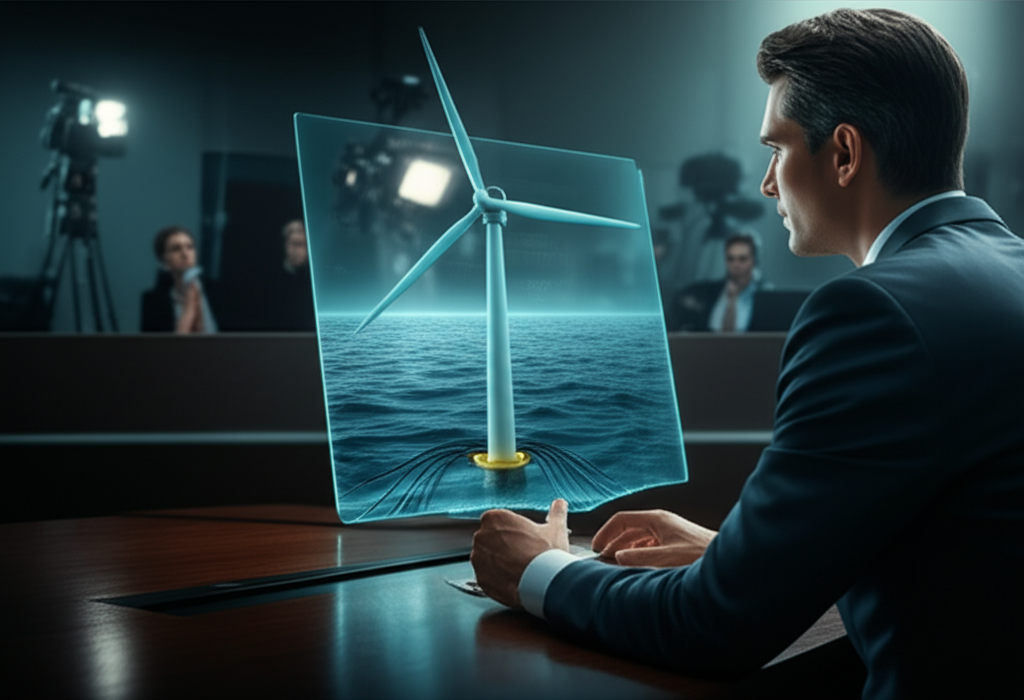
US Startup to House Data Centers Inside Offshore Wind Turbines
San Francisco-based Aikido Technologies plans to integrate data centers directly into the underwater support structures of floating offshore wind turbines, using abundant wind power and cold seawater for cooling. The company will deploy a three-legged 100-kilowatt prototype off the coast of Norway in the North Sea by the end of 2026, aiming to address surging energy demands from AI computing.
Aikido Technologies, a San Francisco-based offshore wind-power developer, announced plans to house data centers in the underwater ballast tanks that stabilize its floating wind turbine platforms. Each leg of the three-legged platform will contain a data center module, allowing servers to draw power directly from the turbine while being cooled by the chilly waters of the North Sea.
According to reports, a full-scale system could support 10 to 12 megawatts of AI compute capacity alongside a 15 to 18 megawatt turbine and integrated battery storage. This co-location approach eliminates the need for long-distance power transmission, potentially reducing costs and energy losses while providing a sustainable solution for power-hungry AI workloads.
Technical Design and Cooling Advantages
The design leverages the natural advantages of the marine environment. Servers will be water-cooled using the consistently cold ocean water surrounding the turbines, which can significantly improve energy efficiency compared to traditional air-cooled land-based data centers. The underwater placement also offers physical security and protection from surface weather conditions.
Aikido’s floating platform uses large underwater tanks for ballast and stability. These same structures will now accommodate the computing equipment, creating a tightly integrated wind-power and compute facility. The company claims the setup can deliver up to 12 megawatts of data center capacity per turbine by utilizing power generated directly at the source.
Prototype Timeline and Commercial Plans
The startup is set to launch a 100-kilowatt proof-of-concept unit off the coast of Norway later this year, according to multiple reports citing the company. This initial prototype will test the feasibility of combining a wind turbine with an AI server in real-world marine conditions.
Aikido has outlined an ambitious roadmap, with the first commercial project targeted for the United Kingdom in 2028. The company aims to scale the technology to support the growing energy needs of AI data centers, which are increasingly difficult to site due to grid constraints and power availability challenges on land.
Industry Context and Growing Demand
The announcement comes as data center operators face mounting pressure to secure reliable, low-carbon energy sources. Hyperscalers and AI companies are struggling to obtain sufficient power for new facilities, driving interest in innovative solutions like offshore co-location.
Aikido’s approach aligns with broader trends in the industry toward sustainable computing infrastructure. By integrating compute directly with renewable generation, the system could help reduce the carbon footprint of AI training and inference while bypassing many of the permitting and grid-connection delays that plague traditional data center projects.
Impact on Developers and the Sector
For AI developers and cloud providers, this technology could provide access to dedicated, high-density compute capacity located near major European markets. The direct coupling of generation and consumption may also offer more predictable power pricing and improved reliability through integrated battery storage.
The project highlights the increasing convergence between the renewable energy and technology sectors. Traditional wind farm developers are now exploring ways to monetize their infrastructure by hosting compute workloads, potentially creating new revenue streams and accelerating the buildout of clean energy capacity.
What's Next
Aikido will first focus on validating its 100-kilowatt prototype in Norwegian waters by the end of 2026. Successful testing could pave the way for the larger commercial deployment in the UK in 2028, with potential expansion to other offshore wind regions.
If proven at scale, the concept could influence future offshore wind project designs and create a new category of marine-based data center infrastructure. The company’s progress will be closely watched by both the renewable energy industry and technology firms seeking sustainable solutions for AI’s explosive energy demands.